Bitcoin Can Be Made Quantum-Safe Today Without a Soft Fork — But It’ll Cost You $150 Per Transaction
A StarkWare researcher has just shown a way to make Bitcoin transactions quantum-proof, right now, without needing a soft fork...
Quick overview
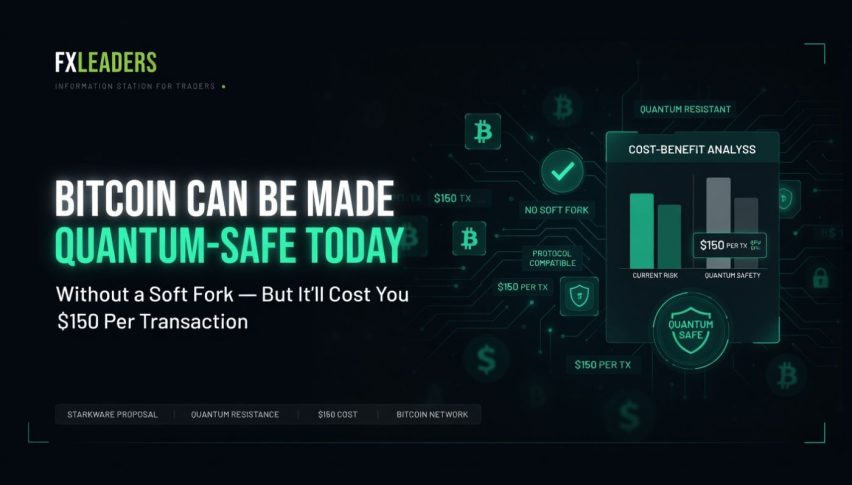
- A StarkWare researcher has introduced Quantum Safe Bitcoin (QSB), a method to make Bitcoin transactions quantum-proof without requiring a soft fork.
- QSB utilizes a hash-to-sig puzzle instead of elliptic curve signatures, providing significant pre-image resistance against quantum attacks.
- While QSB offers immediate quantum safety, it has limitations, including not addressing locked BTC in early P2PK addresses and excluding the Lightning Network.
- The implementation cost for QSB is high, ranging from $75 to $150 per transaction, making it impractical for everyday use but potentially valuable for securing large holdings.
A StarkWare researcher has just shown a way to make Bitcoin transactions quantum-proof, right now, without needing a soft fork or miner signalling – just stick with the rules you’ve got.
The scheme, called Quantum Safe Bitcoin (QSB), works its magic within the existing bitcoin script rules, and is meant to withstand the biggest theoretical threat to bitcoin’s security: a quantum computer running Shor’s algorithm.
How QSB Works
Instead of relying on this fancy elliptic curve signature stuff that a powerful quantum computer could break, QSB uses a hash-to-sig puzzle – the spender has to brute-force a hash input that produces an output that looks like a legit ECDSA signature. And guess what? There isn’t any known quantum shortcut for this task.
The paper reckons you’d need roughly 70.4 trillion attempts to get one valid solution, which gives you approximately 118 bits of pre-image resistance. QSB fixes up an earlier idea called Binohash and is the first known way to keep live Bitcoin transactions safe from Shor’s algorithm, all within the rules we use today.
The downside is you’d be looking at around $75 to $150 in GPU compute for each transaction – which makes it a non-starter for everyday payments, but might be worth considering for protecting large holdings.
LATEST: StarkWare releases paper on Quantum Safe Bitcoin (QSB), enabling quantum-resistant transactions on Bitcoin without requiring a softfork pic.twitter.com/9b4bE0IWwK
— crypto.news (@cryptodotnews) April 10, 2026
Community Reaction and Limitations
StarkWare’s Eli Ben-Sasson reckons this is a major win for making Bitcoin quantum-safe immediately – but not everyone agrees.
Key limitations include:
- it doesn’t touch the estimated 1.7 million BTC locked away in early P2PK addresses (public keys that are already exposed, possibly including some of those old Satoshi-era coins).
- it excludes the Lightning Network.
- it means some users may need non-standard transaction routing.
The Quantum Arms Race
QSB arrives at a time when a lot more people are getting worried, after a March 2026 Google research paper suggested that quantum computers might break Bitcoin’s cryptography more easily than people thought.
Other recent efforts include this “quantum escape hatch” prototype from Lightning Labs CTO Olaoluwa Osuntokun , plus the longer-term BIP-360 (a soft-fork proposal that got merged in February 2026). You can bet on a quantum-resistant soft fork in 2026 on Polymarket and the odds are pretty low, reflecting how slow Bitcoin is at getting things done – Taproot took 7.5 years, after all.
Avihu Levy, the QSB creator, describes it as an emergency tool for when all else fails – proof that there is a way to make bitcoin quantum-safe today, using the rules we’ve already got in place, at the price of what amounts to a plane ticket in GPU compute per transaction.
It’s a bit of a stunt, but QSB shows that quantum defence is possible right now, if you’re willing to pay the cost.
- Check out our free forex signals
- Follow the top economic events on FX Leaders economic calendar
- Trade better, discover more Forex Trading Strategies
- Open a FREE Trading Account
- Read our latest reviews on: Avatrade, Exness, HFM and XM

Related Articles

Sidebar rates

Related Posts
 Save
Save