Cathie Wood Says Bitcoin Could Hit $1.2M by 2030 as ETF Outflows and Iran Tensions Shake Markets
Cathie Wood predicts Bitcoin (BTC) price could hit $1.2M by 2030 as ETF outflows, Iran tensions, and weak momentum pressure BTC.
Written by:
Arslan Butt•Tuesday, May 26, 2026•3 min read
•Last updated: Tuesday, May 26, 2026
Quick overview
Bitcoin dipped below $77,000 amid ETF outflows and geopolitical tensions, but Cathie Wood's bullish forecast suggests a potential surge to $750,000-$1.2 million by 2030.
ARK Invest identifies generational wealth transfer, emerging market adoption, and institutional allocation growth as key drivers for Bitcoin's long-term value.
Despite recent ETF outflows and macro risks, Bitcoin's market infrastructure is expanding, with Nasdaq's approval of cash-settled Bitcoin index options seen as a positive development.
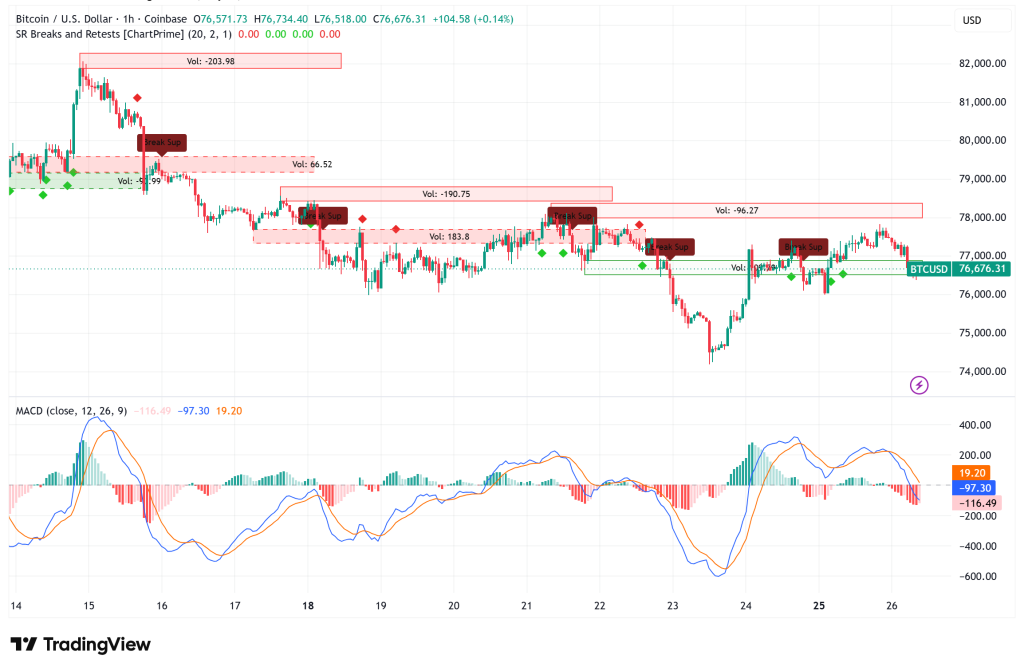
Bitcoin remains range-bound between $76,000 and $82,000, with a potential breakout above $82,000 triggering significant market movements.
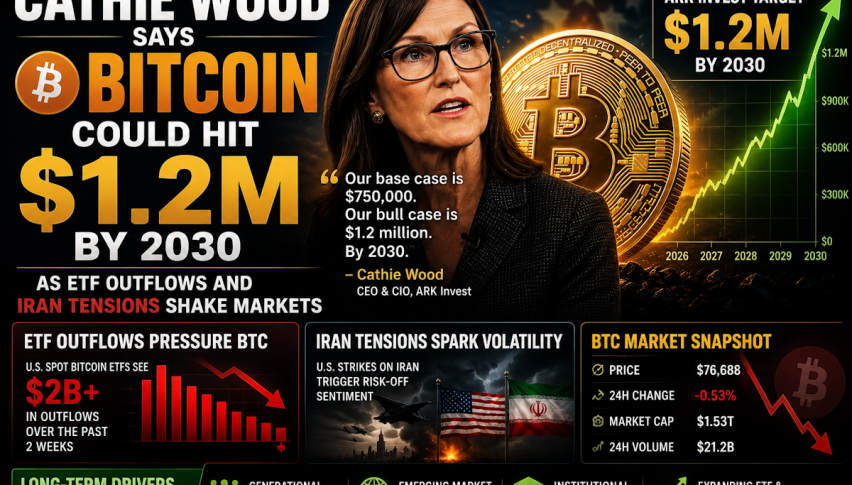
Bitcoin slipped below $77,000 on May 26, but long-term bullish conviction around the world’s largest cryptocurrency intensified after Cathie Wood reiterated her forecast that Bitcoin could surge to between $750,000 and $1.2 million by 2030.
Bitcoin traded near $76,700, down roughly 0.5% over the past 24 hours, as institutional ETF outflows and renewed geopolitical tensions pressured short-term sentiment. Yet Wood’s latest comments reignited debate around Bitcoin’s long-term valuation potential and whether institutional adoption could eventually overwhelm current macro headwinds.
Cathie Wood’s Bitcoin Price Target: Why ARK Still Sees a Massive Upside
Wood laid out three major drivers behind ARK Invest’s bullish Bitcoin outlook:
Generational wealth transfer
Emerging market adoption
Institutional allocation growth
According to Wood, younger investors increasingly prefer Bitcoin over gold as a store of value, while inflation-stricken economies continue turning to crypto as protection against currency debasement.
But the biggest long-term catalyst may still be Wall Street.
Bitcoin ETFs and regulated derivatives products are making it significantly easier for pension funds, endowments, wealth managers, and institutions to gain exposure to BTC without directly holding crypto.
Even modest institutional allocations could dramatically reshape Bitcoin’s supply-demand dynamics because of BTC’s fixed 21 million supply cap.
ARK’s official base-case model reportedly targets Bitcoin near $710,000–$750,000 by 2030, while its bull-case scenario reaches roughly $1.2 million–$1.25 million.
Wood herself has held Bitcoin since prices were near $250.
ETF Outflows Are Pressuring Bitcoin Price in the Near Term
Despite the bullish long-term narrative, institutional positioning has weakened sharply in recent weeks.
Spot Bitcoin ETFs have now seen persistent net outflows throughout May, with analysts estimating more than $2 billion has exited ETF products over the past two weeks.
Swissblock warned Bitcoin is entering a “high-risk” phase as ETF demand no longer absorbs market selling pressure effectively.
Glassnode also described recent ETF flows as a sustained institutional distribution signal.
That shift matters because ETF inflows were one of Bitcoin’s strongest structural supports earlier this year.
Without fresh institutional demand, BTC has struggled to break above key resistance levels.
Iran Tensions and Macro Risk Keep Bitcoin Range-Bound
Geopolitical uncertainty is adding further pressure.
Bitcoin briefly fell below $76,500 after reports that U.S. forces launched new strikes targeting Iranian missile infrastructure despite ongoing diplomatic progress between Washington and Tehran.
The market reaction was relatively contained, but the episode reinforced Bitcoin’s growing sensitivity to macro headlines.
Traders are now balancing two opposing forces:
Short-term geopolitical and macro risk
Long-term institutional adoption and monetary debasement narratives
That tug-of-war has left Bitcoin trapped in a broad consolidation range for nearly four months.
Nasdaq Bitcoin Options Approval Adds Another Institutional Catalyst
Even as ETF flows weaken, Bitcoin’s market infrastructure continues expanding.
The SEC recently approved Nasdaq PHLX’s proposal to launch cash-settled Bitcoin index options under the ticker QBTC. The product tracks a broader Bitcoin benchmark rather than a single ETF.
The approval represents another step toward integrating crypto products deeper into traditional finance.
The contracts will:
Settle in U.S. dollars
Offer regulated Bitcoin exposure
Potentially lower barriers for institutions and sophisticated traders
The product still requires additional approvals before launch, but analysts view it as another sign of growing institutional normalization around Bitcoin trading.
Implied volatility has dropped to an eight-month low near 36%
Short positions remain heavily concentrated above $82K
The decline in volatility suggests traders expect continued consolidation, but historically low volatility periods often precede larger directional moves.
Key Support and Resistance Levels for BTC/USD
Immediate support: $76,000–$77,000
Major support: $72,000
Immediate resistance: $78,000–$78,500
Major resistance: $81,000–$82,000
Short-squeeze zone: $82,000–$83,000
Major breakout zone: Above $85,000
A breakout above $82,000 could trigger a large short squeeze due to concentrated bearish positioning in derivatives markets.
However, failure to hold $76,000 would increase the risk of another move toward the $72,000 support region.
Long-Term Outlook: Structural Bull Case vs. Short-Term Fragility
Bitcoin’s near-term structure remains fragile as ETF outflows, geopolitical uncertainty, and weak momentum continue weighing on price action.
But the long-term thesis outlined by Cathie Wood remains increasingly difficult for institutional investors to ignore.
Bitcoin now sits at the intersection of:
Institutional adoption
Global monetary instability
Expanding ETF infrastructure
Regulated derivatives growth
Scarcity-driven supply dynamics
The next major move may ultimately depend on whether institutional capital returns strongly enough to absorb current selling pressure.
For now, Bitcoin remains stuck below breakout resistance — but the long-term battle over whether BTC becomes a million-dollar asset has clearly already begun.
Lead Markets Analyst – Multi-Asset (FX, Commodities, Crypto)
Arslan Butt serves as the Lead Commodities and Indices Analyst, bringing a wealth of expertise to the field. With an MBA in Behavioral Finance and active progress towards a Ph.D., Arslan possesses a deep understanding of market dynamics.
His professional journey includes a significant role as a senior analyst at a leading brokerage firm, complementing his extensive experience as a market analyst and day trader. Adept in educating others, Arslan has a commendable track record as an instructor and public speaker.
His incisive analyses, particularly within the realms of cryptocurrency and forex markets, are showcased across esteemed financial publications such as ForexCrunch, InsideBitcoins, and EconomyWatch, solidifying his reputation in the financial community.




 Save
Save