USDJPY Price Forecast: 1.618 Fib Defense Intact as Warsh-Fed Yield Premium Targets 164.22 Resistance Ceiling
A multi-day build-up in global foreign exchange derivative blocks is holding ground between regional sentiment and a structurally wide...
Quick overview
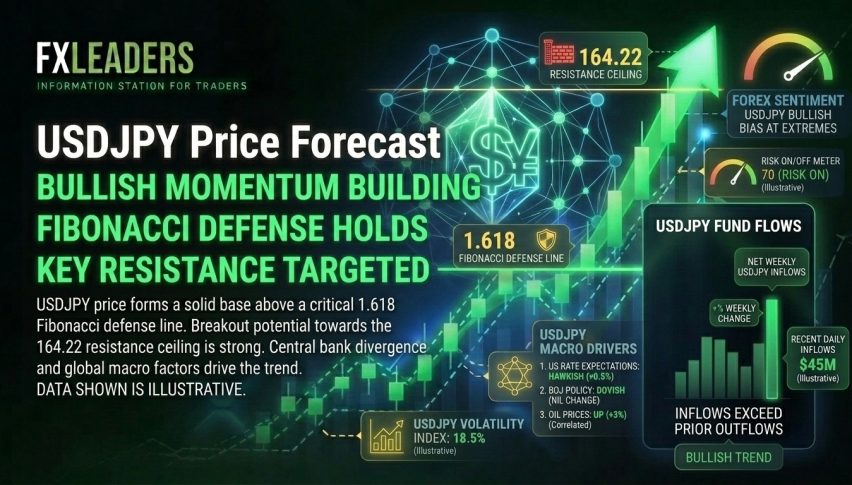
- The USD/JPY currency pair is experiencing a significant upward trend, trading at 162.46 due to a combination of U.S. monetary policy and regional sentiment.
- New Fed chair Kevin Warsh has eliminated forward guidance, leading traders to adjust their expectations towards potential rate increases, which supports the U.S. dollar.
- The Bank of Japan has raised interest rates to a three-decade high, but the disparity in yields continues to favor U.S. dollar investments.
- The recent US-Iran peace agreement has reduced geopolitical tensions, lessening the demand for safe-haven currencies like the yen.
A multi-day build-up in global foreign exchange derivative blocks is holding ground between regional sentiment and a structurally wide yield premium. At afternoon prompt Wednesday, July 8 2026, the USD/JPY currency cross is continuing its sharp move higher, trading at 162.46.
Execution desks and cross-border carry traders are holding the line to defend their local VWAP demand levels, which is boosting the spot to multi-month highs as the total dis-assignment of the safe-haven trade collides with high-for-long U.S. restrictive monetary policy.
The Warsh Fed Erases Forward Guidance and Re-Enforces the Yield Premium
The one core driver behind the relentless structural advance of this currency pair is new Fed chairperson Kevin Warsh and his strict rules-based monetarism. Amid a high-print 4.1% core CPI print and 3.8% headline inflation, Warsh used his panel speech at the recent ECB Forum on Central Banking in Sintra, Portugal to change the Fed’s narrative.
He dropped all “forward guidance” from central bank communication and removed all of the Fed’s summary economic projections, meaning the public will have to wait for a private meeting to hear any updates on key economic data.
Warsh did mention that the risk of inflation over the short-term has decreased a bit in the last four weeks as regional fuel prices have come down, which caused Treasury yields to pause for a little while, but the U.S. remains very tight.
Traders are unwinding their September rate-cut bets now and are starting to price in potential rate increases in October. Warsh’s explicit longer-harrier policy has kept real U.S. yields strongly supported and increased the yield differential, making the U.S. dollar a long-term buy from here.
BOJ Goes to Three-Decade Peak, Fails to Narrow
In the backdrop of peak restrictive conditions from the Fed, the Bank of Japan (BOJ) has kept the process going towards higher interest rates after decades of ultra-loose conditions. In its June 16 2026 monetary policy meeting, Governor Kazuo Ueda and a 7-1 majority increased the short-term policy rate by 25 basis points to 1%, the highest since September 1995.
The official BOJ release added that the recent tensions in the Middle East have affected B2B trade and are a potential upside surprise for CPI that risks missing the 2% target.
The BOJ also decided to stop reducing the pace at which it purchases JGBs starting this April to help Prime Minister Sanae Takaichi’s proactive fiscal program. But macro fund managers say the U.S. will continue buying the pair because the real rate is still very negative once you take out inflation.
The resulting structural disparity, with US benchmark interest rates trading well hundreds of basis points higher than Tokyo’s 1% baseline, provides an undeniable pull for institutional carry trade networks to continue leveraging the yen to trade high-yielding USD instruments.
Islamabad Accord Normalization Eases Geopolitical Safe-Haven Demand
In addition, the US-Iran Interim Peace Agreement (the Islamabad Memorandum of Understanding or US-Iran MoU), executed on 19th June via Pakistanian diplomatic intervention in Switzerland, places a cap on short-term explosive moves across the pair.
This key peace treaty was instrumental in resolving the regional armed conflict that characterized most of the early 2nd quarter (Q2).
Furthermore, the recent reopening of the highly significant Strait of Hormuz shipping artery allowed commercial maritime cargo capacity to recover towards approximately 85% of average seasonal levels and pushed front-month Brent Oil to trade back under $73/barrel.
The restoration of peace has lifted the short-term elevated fear-driven war-risk premium across international commodity markets and diminished the localized demand for safe-haven currency demand that typically triggers immediate, rapid unwind flows into the yen during periods of heightened global risk.
Technical Analysis: USDJPY Retains Compressive Bullish Structure Above Core 1.618 Fibonacci Floor
Shifting focus from the upcoming interest rate events to the daily technical chart, USDJPY has produced a well-scannable ascending channel structure in the vicinity of key demand levels.
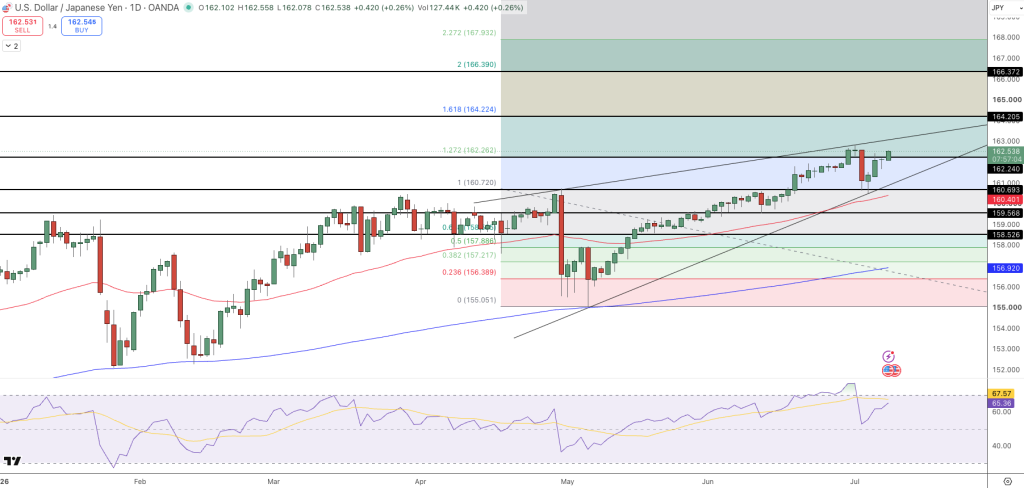
The pair has established a classic bullish framework, recording a consecutive series of higher highs and higher lows, whilst also maintaining a positive position relative to its main structural base (the Ascending Black Trendline Base of 160.40). Price has also exceeded its immediate historical breakout zone and trades well away from its long-term moving averages, such as the Daily 200-SMA (156.92).
The 14-period Relative Strength Indicator (RSI) has formed at a steady bullish valuation of 67.53, supporting a short-term bullish position while still leaving substantial room before the metric enters overbought territory.
This bullish sentiment is also corroborated by the Moving Average Convergence Divergence Oscillator (MACD Histogram), which is currently printing increasingly robust positive bars above its zero line and indicating that algorithmic accumulation orders remain in place for prices trading above the 160.72 primary Fibonacci base.
Conclusion & Trade Idea
USDJPY maintains a solid fundamentally bullish profile based on a stable interest rate spread, a highly dovish monetary regime in Tokyo and the recently reduced geopolitical demand for safe-haven capital following the Islamabad MoU.
Although occasional verbal commentary from the Japanese Ministry of Finance can lead to short-term price volatility, the persistent divergence between Kevin Warsh’s aggressive dollar and the Bank of Japan’s moderate policy normalization should continue to offer strong support during bearish dips.
Execution Strategy
Look to buy dips from confirmed daily bar formations at key support and resistance levels, including the 160.72 trendline zone. Place a tight stop-loss order just below the key structural invalidation level of 158.89 and look to exit at the 1.272 Fibonacci extension zone at 164.22 and subsequent 166.39 support zone.
- Check out our free forex signals
- Follow the top economic events on FX Leaders economic calendar
- Trade better, discover more Forex Trading Strategies
- Open a FREE Trading Account
- Read our latest reviews on: Avatrade, Exness, HFM and XM

Related Articles


Sidebar rates

Related Posts
 Save
Save