Bullish Silver Forecast: Dual Shocks from China Export Rules and US Strategic Reclassification
China's Ministry of Commerce introduced strict export licensing on refined silver, limiting permissions to a tight list of state-approved, high-volume entities.
Quick overview
- China's Ministry of Commerce has imposed strict export licensing on refined silver, limiting it to a select group of state-approved entities.
- The export ban on sulfuric acid, essential for copper mining, indirectly restricts global silver output since 70% of silver is mined as a byproduct of copper.
- The US Geological Survey has added silver to its Official Critical Minerals List, prompting national security trade laws due to reliance on imported processed silver.
- Despite recent market fluctuations, silver remains in a structural supply deficit, with demand significantly outpacing supply.
China’s Ministry of Commerce introduced strict export licensing on refined silver, limiting permissions to a tight list of state-approved, high-volume entities.
Protect their domestic manufacturing base. China dominates global solar panel manufacturing and electric vehicle (EV) infrastructure. Because silver is the most electrically conductive metal on Earth, they cannot scale their green-tech or advanced computing dominance without monopolizing the physical metal.
To complement direct export limits, China implemented an export ban on sulfuric acid. Sulfuric acid is the essential chemical input used in heap-leach copper mining (particularly in Chile). Because roughly 70% of the world’s silver is mined as a byproduct of copper, lead, and zinc, squeezing global copper processing naturally chokes off Western silver output without China ever having to touch a dedicated silver mine.
The US Geological Survey added silver to the Official Critical Minerals List. This wasn’t just a symbolic title change; it triggered concrete legal and economic frameworks:
Washington subsequently invoked national security trade laws (Section 232), concluding that the country’s heavy reliance on imported processed silver poses a direct threat to economic and national defense infrastructure.
Beyond commercial AI data centers, the military-industrial complex is entirely dependent on silver for satellite communications, missile guidance systems, and advanced radar.
silver’s underlying structural fundamentals remain remarkably robust Despite the broader market shakeout that pulled silver down from its parabolic surge earlier this year (where it briefly breached the historic $100–$120 mark),
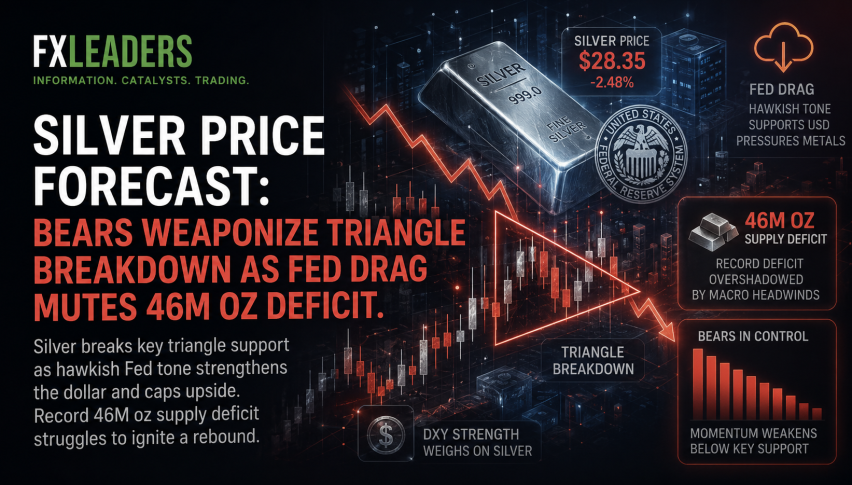
The most critical fundamental driver is that the silver market is in its sixth consecutive year of a structural supply deficit (estimated at a 46 to 67-million-ounce shortage). Demand is flatly outstripping my supply.
Increasing silver production is notoriously difficult. Roughly 70% of silver is mined as a by-product of mining other metals like copper, lead, and zinc. Miners cannot simply “turn on the tap” for silver just because prices are high.
Industrial fabrication makes up over 50% of silver’s total demand. While the solar sector has experienced some “thrifting” (using less silver per panel), explosive demand for high-efficiency silver-coated semiconductors in AI data centers and heavy electrical loads in EVs are acting as a major price floor.
Policy shifts have added institutional pressure. China recently implemented strict export controls on silver, and the United States officially reclassified silver as a critical mineral for the first time.
- Check out our free forex signals
- Follow the top economic events on FX Leaders economic calendar
- Trade better, discover more Forex Trading Strategies
- Open a FREE Trading Account
- Read our latest reviews on: Avatrade, Exness, HFM and XM

Related Articles
Sidebar rates

Related Posts
 Save
Save