Gold Price Forecast: 57k NFP Labor Shock Triggers Historic Short-Squeeze Back Above $4,120
The global precious metal markets took a sudden, violent structural reversal at the opening of the trading week, catching trend-following...

Quick overview
- The global precious metal markets experienced a sudden reversal, with spot gold rallying over 2% to around $4,137.25/oz due to a significant macroeconomic shock.
- A disappointing U.S. jobs report showing only 57,000 new jobs created in June has weakened the dollar and softened the Federal Reserve's stance on interest rates.
- Central banks, particularly the People's Bank of China, continue to accumulate gold, providing a structural support for prices amid declining physical supply.
- Technical analysis indicates that gold has invalidated its recent downtrend, suggesting potential for further upside as short positions are squeezed.
The global precious metal markets took a sudden, violent structural reversal at the opening of the trading week, catching trend-following systems and paper short positions off-guard. On Tuesday, July 7, spot gold (XAU/USD) broke out to rally with significant volume as the trade was coming to a close. The metal moved up +2.15% in late afternoon trading to trade around $4,137.25/oz. troy.
The recent technical breakdown parameters are completely overturned. Institutional depositories and market makers are forced to cover heavily exposed short positions, as a massive macroeconomic shock hits the physical metal markets.
U.S. Labor Market Slowdown Triggers 57k Payroll Shock and Softens Greenback
U.S. jobs growth slows, payroll print of 57k and dollar weakens. The most important fundamental driver behind the strong reversal in the precious metal markets is the shocking decline in U.S. job creation in the July 3 Nonfarm Payrolls (NFP) report.
The U.S. economy only created 57k jobs in June, a number that misses the expected increase of 110k jobs and represents the lowest jobs figure in over four months. The unemployment rate increased to 4.2%. The macroeconomic reality of declining job creation has softened the Fed stance of the new Chairman of the Federal Reserve, Kevin Warsh.
In a joint public statement, Chairman Warsh said that although core CPI inflation remains stubborn at 4.1%, the inflation outlook continues to improve in tandem with the slowdown in employment, enabling the Fed to remain on price level.
The FedWatch Tool at the CME suggests the likelihood of an imminent rate increase has fallen from 66% to 50% over the course of a few days.
As interest-rate tightening fears fade, U.S. Treasury real yields drop, and the U.S. dollar index falls to its lowest point on a weekly basis since April. Since gold prices denominated in U.S. dollars maintain an inverse relationship with the greenback, a decline in dollar strength makes it easier for physical allocators to buy gold, drawing capital into the metal markets.
Swiss Signing Ceremony Meets 17-Month Sovereign Accumulation Run
The Islamabad Memorandum of Understanding follows 17-month central bank buy. On top of the macroeconomic relief from the Fed, the precious metals markets are being pushed higher by a shrinking physical supply. During June, paper desks piled on short exposure to the metal based on the smooth progress of the U.S.-Iran interim peace treaty (the Islamabad Memorandum of Understanding). In the Middle East, the de-escalation eased tensions.
Oil spot prices, benchmarked at Brent crude, were reduced to levels around $73 per barrel, with the drop in energy costs lowering gold mining expenses while eroding the demand for gold for tactical hedging purposes.
However, non-retail allocation remains robust and strong. The PBOC has now continued the streak of gold accumulation for at least 17 months running. More broadly, sovereign central banks from emerging markets are shifting the allocation mix in their capital reserve portfolios out of dollar- and Euro-denominated government debt, and into the physical metal.
Central bank demand continues to provide a structural floor to the metal price, so that any liquidations caused by short-term dollar fluctuations are readily absorbed, as the long-term demand from the central banks easily outpaces the short-term supply provided by the paper trading market.
Gold (XAU/USD) Technical Analysis: High-Volume Rebound Reclaims Trendline and Decimates Short Setup
Ignoring central bank interest rate outlooks and focusing in on the 2-hour technical view, spot gold has dramatically and definitively invalidated the structure of its recent collapse.
The XAU/USD has completed a strong, high-volume bullish engulfing impulse swing, breaking above the $4,050.10 consolidation low and pushing past $4,137.25. Such a move renders any potential high-probability bearish setups previously identified by mechanical sellers as completely null and void.
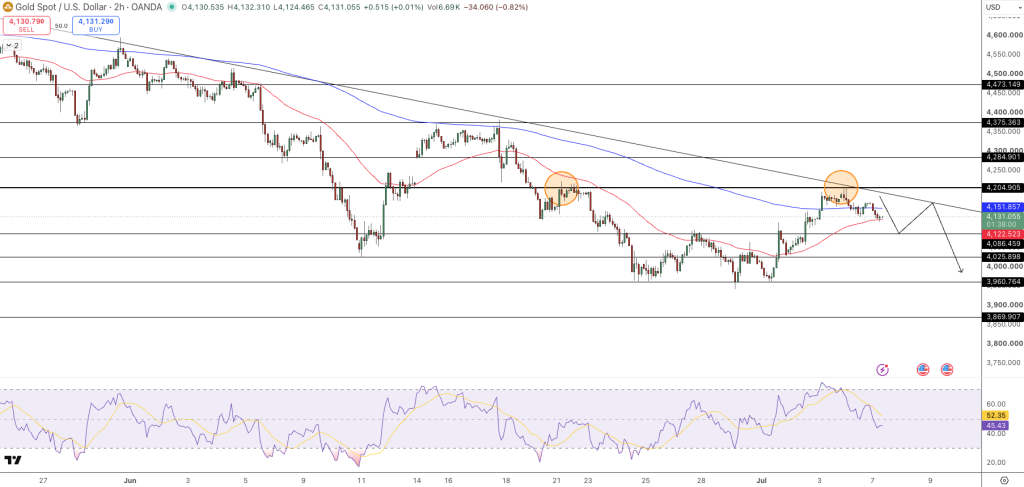
This rally is once again touching the descending trendline, which effectively flips the broken dynamic resistance ceiling back into a robust baseline support floor.
The 14-period RSI has recovered from oversold territory to form a healthy 44.02 value, implying that the near-term buying pressure is strong with enough mathematical space for a secondary extension to the upside before a return to overbought conditions. This is also confirmed by the MACD histogram, which has completed a bullish crossover under the zero line and continues to print a series of expanding green accumulation bars.
This suggests that short positions are being squeezed into the weekly open, leaving more room for upside continuation targeting the macro 2-hour 200-EMA at $4,222.00.
Summary and Trade Idea
Gold is currently in a short-covering markup phase, fueled by the 57,000 missed jobs report which has shifted macro leverage away from the interest rate outlooks of the Warsh Fed. Given the 17-month run of sovereign buying and resilient global inflation risks, the return of price action to the old trendline structure has effectively transferred control of the near-term price discovery back to buyers.
Tactical Continuation Plan
Look to initiate long positions on low-volume technical pullbacks with confirmation of the immediate horizontal pivot support zone at $4,091.00. Stop losses should be placed securely below the local technical invalidation zone at $4,024.00, targeting the first short-squeeze phase back towards the old horizontal value zone at $4,157.00, with further technical extensions targeting the macro 2-hour 200-EMA dynamic ceiling around $4,222.00.
- Check out our free forex signals
- Follow the top economic events on FX Leaders economic calendar
- Trade better, discover more Forex Trading Strategies
- Open a FREE Trading Account
- Read our latest reviews on: Avatrade, Exness, HFM and XM

Related Articles


Sidebar rates

Related Posts
 Save
Save