Home Depot (HD) Beats Estimates with $41.8B Q1 Sales, But Caution Looms
Home Depot (HD) beats Q1 estimates with $41.8B in sales, but falling EPS and big-ticket hesitancy signal a stock at a crossroads.
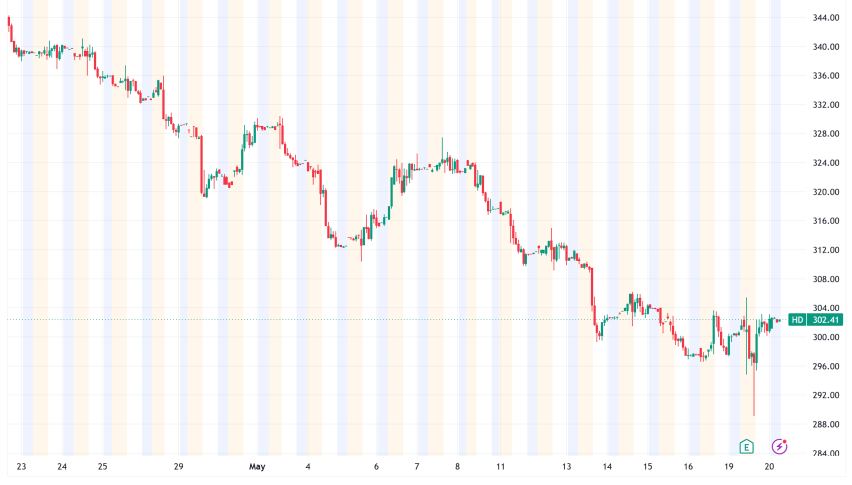
Quick overview
- Home Depot's Q1 FY 2026 sales reached $41.77 billion, exceeding estimates and showing a 4.8% year-over-year increase.
- Despite the sales growth, net income fell to $3.3 billion, and adjusted EPS decreased to $3.43, although it surpassed analyst expectations.
- The company reaffirmed its full-year guidance for modest sales and EPS growth, while facing macroeconomic challenges that are impacting consumer spending.
- Analysts maintain a consensus 'Buy' rating for Home Depot, with a 12-month price target averaging $395.48, indicating potential upside from current levels.
Home Depot opened fiscal 2026 with a beat. Q1 sales hit $41.77 billion, topping Wall Street’s $41.52 billion estimate and rising 4.8% year over year. Comparable sales grew 0.6% overall, with U.S. comps up 0.4%.
But beneath the headline number, earnings are under pressure. Net income fell to $3.3 billion from $3.4 billion a year ago. Adjusted EPS came in at $3.43 — down from $3.56 last year, though it edged past the Street’s $3.41 estimate.
Home Depot Reports Total Sales Growth with Pressure
The company reaffirmed its full-year guidance: total sales growth of 2.5%–4.5%, comparable sales of flat to +2%, and EPS growth of flat to +4%. Operating margin guidance holds at 12.4%–12.6%.
Q1 FY 2026 Earnings: Key Metrics
- Net sales: $41.77B (+4.8% YoY) — beat estimate of $41.52B
- Comparable sales: +0.6% overall; +0.4% in the U.S.
- Adjusted EPS: $3.43 — beat estimate of $3.41
- Net income: $3.3B — down from $3.4B a year ago
- Average ticket (spend per visit): +2.2% YoY
- Comparable transactions: −1.3% YoY
The split between rising ticket size and falling transactions tells the story. Customers who visit are spending more. But fewer people are walking through the door. Big-ticket transactions — defined as $1,000 or more — rose just 0.8%. Large remodeling projects remain firmly on pause.
Latest Developments for Home Depot Investors to Monitor
Q1 was busy beyond the income statement. Several moves signal where management is placing long-term bets.
- Mingledorff’s acquisition completed. Home Depot’s SRS Distribution subsidiary closed the deal after the quarter ended. Mingledorff’s is a carrier-focused HVAC wholesale distributor. CEO Ted Decker highlighted its parts business as a pathway to national distribution — leveraging existing stores, online capabilities, and direct fulfillment centers.
- SIMPL Automation acquired (April 15). The deal reinforces a push into supply chain and operational efficiency technology.
- New CTO named. Dr. Franziska “Fran” Bell was appointed Executive VP and Chief Technology Officer effective April 6, 2026 — a clear signal of intensifying tech investment.
- E-commerce hits fourth straight double-digit quarter. Online sales grew ~10% YoY — roughly double the rate of total sales growth. Home Depot ranks #4 in North America’s Top 2000 e-commerce database and leads the Hardware & Home Improvement category.
- Pro business driving resilience. Heavy investment in professional contractors and builders — through SRS Distribution, digital tools, and dedicated services — is helping offset soft DIY demand.
- Tariff refunds partially offsetting fuel costs. Executives confirmed receiving some refunds, though no figures were disclosed.
The e-commerce push is bearing fruit. Home Depot now routes orders to the optimal store based on distance, inventory, and delivery speed — what it calls “ship from best location.” The result: fewer cancellations and faster fulfillment. EVP Ann-Marie Campbell reported “tremendous growth in deliveries out of stores” as a result.
Home Depot Faces Macro Headwinds
Home Depot’s results don’t exist in a vacuum. The macro backdrop is the story’s true antagonist.
CFO Richard McPhail was blunt. Customers are worried about economic uncertainty. Fuel costs are rising. Mortgage rates climbed again after declining through 2025. Layoffs are ticking up. The result: a consumer who engages on small projects but continues to defer large remodels.
- U.S. consumer sentiment hit a record low in early May 2026
- The war in Iran has fanned inflation and strained household finances
- Housing affordability remains severely constrained — high prices, high rates
- Comparable customer transactions dipped 1.3% versus a year ago
- Home Depot’s average basket size is roughly $90
The housing market’s paralysis is the deepest structural challenge. Without turnover, homeowners have less incentive for renovation. Analyst Joseph Feldman of Telsey Advisory Group put it plainly: Home Depot is likely taking share in a difficult environment, but “the recovery still appears some time away.”
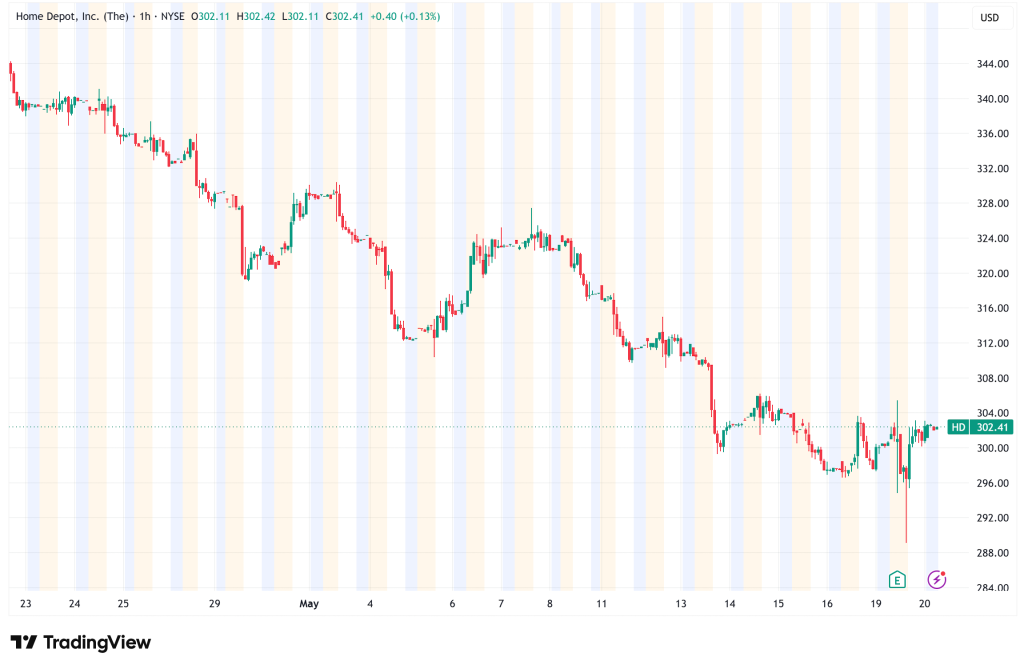
HD Stock Technical Analysis: Oversold Territory
HD’s chart tells a story of a stock that ran hard into 2026 and has since corrected sharply. From a January peak near $379, the stock has declined roughly 20% to the current $302 level.
Key Levels to Watch
- 50-day MA (~$333) — Bearish. Price is trading well below this level. Near-term trend is down.
- 200-day MA (~$357) — Death Cross. The 50-day has crossed below the 200-day — a classic institutional selling signal.
- RSI (14) — Near Oversold. Approaching the 35–40 zone. A technical bounce scenario becomes increasingly plausible from here.
- MACD — Bearish. Trading below the signal line. No confirmed reversal yet.
- Support: ~$285–$295. Key zone from prior consolidation. A break below this level would be technically significant.
- Resistance: ~$320–$330. The 50-day MA zone. Reclaiming this area on volume would meaningfully improve sentiment.
- Volume — Neutral. No climactic selling to suggest an exhaustion bottom has formed.
Bull scenario: Stock holds $295 support, reclaims $320 on volume, RSI builds from oversold, housing data improves — path toward $350+ opens.
Bear scenario: Breaks $295, macro deteriorates, mortgage rates stay elevated, EPS guidance cut — tests $265–$270 range.
Wall Street Analyst Forecast on Home Depot (HD) Stock Valuation
36 analysts polled by S&P Global give HD a consensus “Buy” rating, with an average 12-month price target of $395.48 — roughly 31% above the current price. The range runs from a low of $310 to a high of $454.
The breakdown: 42% Strong Buy, 38% Buy, 21% Hold, 0% Sell. Not a single analyst recommends selling.
Several firms have trimmed targets recently — Wells Fargo to $375, Truist to $394, Citi to $400 — while maintaining Buy or Overweight ratings. The direction of revisions is down. Conviction in the long-term thesis, however, remains intact.
Home Depot (HD)’s Long-Term Potential
The bear thesis on Home Depot is essentially a thesis about timing — not about whether the company is fundamentally strong. It clearly is.
With 2,361 stores, over 1,280 SRS locations, and more than 470,000 employees, this is the world’s largest home improvement retailer. The scale advantage is enormous.
- Pro business deepening the moat. SRS Distribution embeds HD into the supply chains of contractors and builders. The Mingledorff’s acquisition adds HVAC parts distribution with national reach potential.
- E-commerce compounding. Four straight quarters of 10%+ online growth, with AI-driven search, faster fulfillment, and omnichannel investment. HD is #4 in North American e-commerce by annual sales.
- Dividend track record. The dividend has increased by an average of 15% per year over the past decade. The current yield is approximately 2.5% — above the industry average of 1.9%, with a payout ratio of around 65% of earnings.
- EPS growth expected. Analysts forecast EPS to grow roughly 21% over the next three years, as housing recovers and operating leverage returns.
- Housing cycle leverage. When mortgage rates fall and housing turnover picks up, HD is positioned as a primary beneficiary. Each home that changes hands historically generates thousands in home improvement spend.
The key risk is duration — not direction. If rates stay elevated and housing remains frozen for another 18–24 months, earnings pressure will persist. But management’s consistent guidance reaffirmation suggests they view the current environment as cyclically — not structurally — challenged.
Should You Buy Home Depot Stock?
Home Depot is a structurally sound business trading at a cyclical discount.
Q1 results show resilience — beating estimates, growing online, and investing aggressively in the Pro segment and supply chain. But the macro reality is clear: big-ticket demand is frozen, transactions are declining, and EPS is contracting year over year.
Technically, the stock is in a confirmed downtrend with no reversal signal yet. Fundamentally, the long-term case is compelling. The question isn’t whether HD recovers — it’s when.
For investors with patience and a 12–24 month horizon, the current zone near $300 may represent a compelling entry relative to the $395 analyst consensus target. For near-term traders, the chart offers little comfort until the stock reclaims $320 on meaningful volume.
- Check out our free forex signals
- Follow the top economic events on FX Leaders economic calendar
- Trade better, discover more Forex Trading Strategies
- Open a FREE Trading Account
- Read our latest reviews on: Avatrade, Exness, HFM and XM

Related Articles



Sidebar rates

Related Posts
 Save
Save