Cutting 8,000 Jobs, Spending $125B: Inside Meta’s Costly Bet on AI Supremacy
META: pristine fundamentals, broken chart. $145B AI bet, 8,000 layoffs, 24% off peak. Bull or bear, this is Mag-7's most polarizing trade.
Quick overview
Meta Platforms is in the middle of its most aggressive transformation since the 2021 metaverse pivot. This time, the target is artificial intelligence. And Zuckerberg is spending at a scale that makes even Wall Street nervous.
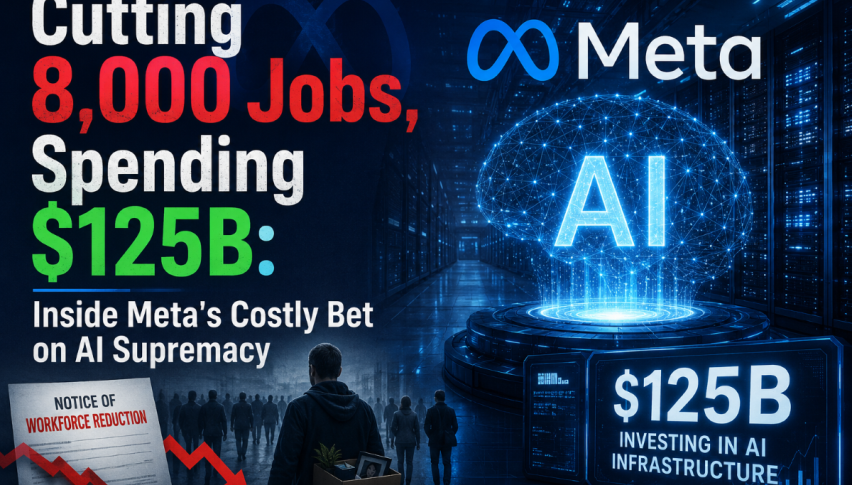
On May 20, 2026, Meta began notifying roughly 8,000 employees of layoffs — about 10% of its global workforce. Simultaneously, 7,000 workers are being moved into four new AI-focused organizations. The message is unmistakable: every dollar saved on headcount is a dollar redirected to data centers.
Meta’s Latest Financials
- Q1 2026 revenue: $56.3B (+33.1% YoY)
- EPS: $10.44 — obliterated the $6.67 consensus by 57%
- Net margin: 32.84%
- Return on equity: 36.93%
- Market cap: $1.52 trillion
- 52-week range: $520.26 – $796.25
An Overview of Meta Platforms’ Fundamentals
Q1 Earnings Reveal 33% Revenue Surge
Meta’s Q1 2026 report was a blowout by almost every measure. Revenue surged 33% year-over-year to $56.3 billion. The net margin of 32.84% and return on equity of 36.93% are benchmarks most S&P 500 companies can only aspire to.
The core Family of Apps business — Facebook, Instagram, WhatsApp, Messenger — continues to print money. Ad revenue remains the engine, and AI-driven personalization is making those ads more effective, not less.
The Capex Elephant in the Room
The controversy lies below the headline numbers. Meta raised its 2026 capital expenditure guidance to $125–$145 billion, up from $115–$135 billion. That’s a 73% jump over 2025’s actual spend of $72.2 billion.
This is roughly $10.4 billion per month, or $31.3 billion per quarter — nearly double Q1’s $19.8 billion in actual capex. The spend is driven by data center expansion, AI chip procurement, and infrastructure buildout.
CFO Susan Li framed it plainly on the Q1 earnings call:
“We’re very focused on leveraging AI tools to substantially increase our productivity, and we’re seeing that reflected in the accelerating output from our engineers.”
Projected out to 2027: applying a 58% operating cash flow margin to analyst revenue forecasts of ~$302 billion gives roughly $175 billion in OCF. Deduct ~$137 billion in capex, and free cash flow settles around $37–40 billion. At a 2.5% FCF yield, that implies a fair value close to today’s price — meaning the stock is roughly fairly valued, or modestly cheap, depending on your assumptions.
The average analyst price target of $840 suggests the street sees significantly more upside.
Meta Reality Labs: An Ongoing Drag
Meta’s Reality Labs division has accumulated roughly $75 billion in operating losses since 2020. It is projected to add approximately $19 billion more this year. Horizon Worlds is being pulled from the Quest Store by end of March and all VR platforms by June 15.
The metaverse bet has not paid off. The market has largely priced this in — but as AI capex balloons, investors are asking whether two massive spending programs can run simultaneously without something breaking.
META Stock Technical Analysis
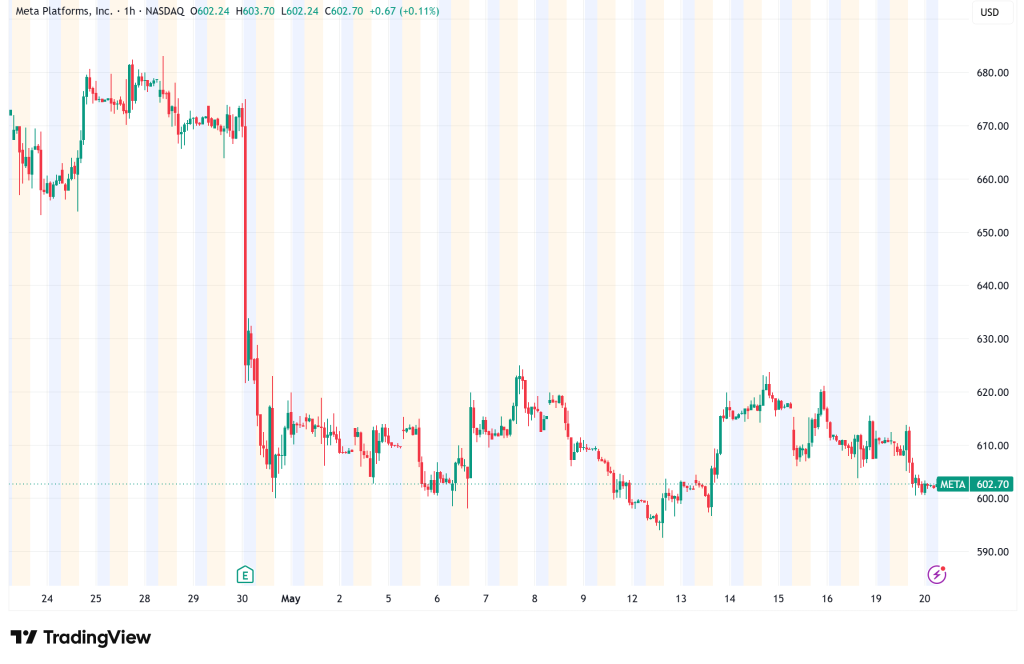
The technical picture is firmly bearish in the near term. META is trading below every major moving average — a classic distribution pattern, not accumulation.
Key Levels to Watch
- $602 — immediate support. A decisive close below opens the door to $590.
- $574–$585 — secondary support zone, OTM put breakeven territory.
- $520.26 — 52-week low. The floor of last year’s worst drawdown.
- $642 — critical resistance (Ichimoku Kijun). Reclaiming this is the first requirement for any bullish case.
- $672 — SMA-200. A close above here would signal a genuine trend reversal.
- $796.25 — 52-week high. META is currently 24% off this peak.
Likely Near-Term Scenarios for META Stock
- Base case (65%): Sideways consolidation between $602 and $639. Low volatility, no decisive move from either side.
- Bearish case (20%): A break below $602 support triggers a deeper pullback toward the $574–$590 zone.
- Bullish case (<15%): A decisive break above $642 resistance could spark a move toward $650–$670. Probability is low without a meaningful catalyst.
Meta’s Latest Developments
The AI Restructuring: What’s Happening with 8,000 Layoffs
Meta is not just cutting costs. It’s engineering a complete operational pivot. The 8,000 layoffs eliminate roles across Reality Labs, social teams, sales, recruiting, and global operations. The 7,000 employees shifting to AI roles are being consolidated into four dedicated divisions.
Janelle Gale, Meta’s Head of People, told staff in an April memo:
“We’re doing this as part of our continued effort to run the company more efficiently and to allow us to offset the other investments we’re making.”
The layoffs began May 20, with notifications sent in three regional batches.
Other Key Developments for Meta Traders to Monitor
- Capex raised again: higher component pricing and data center costs pushed the 2026 guidance ceiling to $145 billion.
- WhatsApp AI access: Meta is offering rival AI chatbots limited free access to WhatsApp in Europe before charging at scale — a strategic platform play.
- Horizon Worlds sunset: the flagship metaverse product exits all VR platforms by June 15, surviving only as a standalone mobile app.
- Insider sale: CTO Andrew Bosworth sold 7,847 shares on May 18 at $607.83, a 94.99% reduction in his position. The sale was executed under a pre-arranged 10b5-1 plan for tax withholding — technically routine, but the scale is notable.
Wall Street Valuation for Meta Stock
The consensus among 47 analysts is a Moderate Buy with an average price target of $840.31 — implying roughly 39% upside from current levels. The breakdown: 4 Strong Buy, 34 Buy, 9 Hold.
But sentiment is not uniform. JPMorgan downgraded META post-earnings, saying the company faces “a more challenging path to returns” compared with its AI rivals. Bank of America warned the current strategy may not be “sustainable long-term,” noting that AI investment returns are “less clear vs. Cloud providers.”
Individual price targets range from $775 (Morgan Stanley, Overweight) to $945 (Tigress Financial, Strong Buy). That spread reflects genuine uncertainty about how quickly massive capex converts to revenue growth.
Risks and Opportunities for META’s Investors
Risks
- $125–$145 billion annual capex with an uncertain and delayed ROI timeline
- Reality Labs has lost ~$75 billion cumulatively since 2020
- JPMorgan downgrade; Bank of America sustainability concerns
- 10% workforce reduction creates execution risk and morale drag
- CTO sold 95% of his equity position this month
- META is down ~9% YTD, ranking 5th among the Magnificent 7 — ahead of only Tesla and Microsoft
- Intensifying AI competition from Google, Amazon, and Microsoft
Opportunities
- 3 billion+ daily active users across the Family of Apps
- AI-enhanced ad targeting improving CPMs and conversion rates
- WhatsApp monetization still in early innings — enormous addressable market
- Llama open-source model attracting a developer ecosystem competitors can’t easily replicate
- P/E of 21.91x is modest for a company growing revenue at 33%
- $48+ billion in trailing 12-month free cash flow (excluding finance leases)
- Options strategy: short-dated OTM puts at the $585 strike yield ~1.85% per month
What Does Meta’s Long-Term Potential Look Like?
The bear case on Meta is essentially a capex timing argument: too much money, spent too fast, with returns too uncertain. The bull case argues the opposite — that Zuckerberg is building an infrastructure moat that will compound for a decade.
History is worth noting. Meta was written off during the 2022 “Year of Efficiency.” The stock fell from $380 to $88. Then it delivered a 10x recovery. This is a company that has demonstrated the ability to pivot hard and execute at scale.
Three long-term catalysts stand out.
First, AI as an ad engine. Every improvement in AI-driven content recommendation drives higher CPMs and better advertiser ROI. This is already showing up in revenue growth, and the flywheel is still accelerating.
Second, emerging market monetization. WhatsApp’s 2+ billion users across Asia, Latin America, and Africa are barely monetized today. A payments or commerce layer — even a partial one — changes the revenue math dramatically.
Third, augmented reality optionality. The Ray-Ban Meta smart glasses are gaining traction. If AR becomes the next dominant computing interface, Meta is better positioned than almost anyone. The timeline is uncertain, but the option has real value.
The 5-year chart tells the broader story: +109% total return. The 10-year chart is more striking: +443%. Meta rewards patience — but also tests it during restructuring cycles.
- Check out our free forex signals
- Follow the top economic events on FX Leaders economic calendar
- Trade better, discover more Forex Trading Strategies
- Open a FREE Trading Account
- Read our latest reviews on: Avatrade, Exness, HFM and XM

Related Articles
Sidebar rates

Related Posts
 Save
Save