Intuit (INTU) Plunges After 17% Layoff Shock: Can AI Restructuring Revive Growth?
Intuit (INTU) stock plunges after 17% layoffs and slowing growth spark fears over AI disruption and software demand. What's next for INTU?
Quick overview
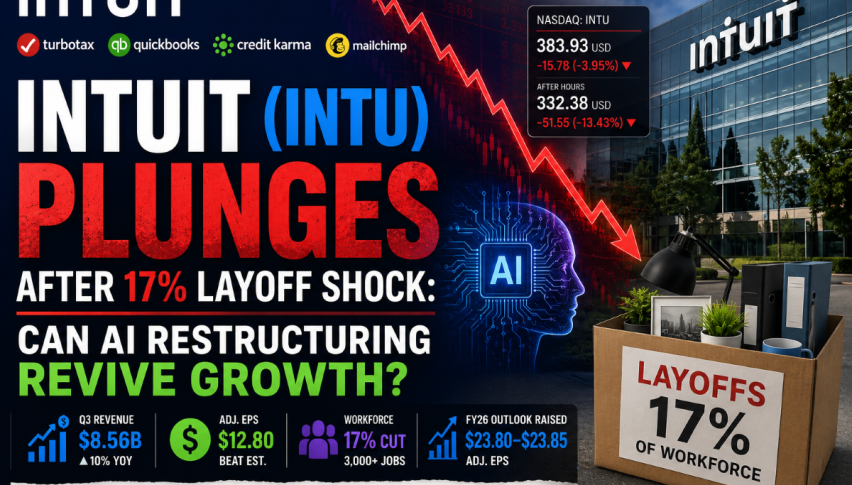
- Intuit's shares fell 3.95% during regular trading and an additional 13.4% in after-hours following the announcement of a 17% workforce reduction affecting over 3,000 employees.
- The company reported a revenue growth slowdown to 10%, its weakest since 2024, despite raising its full-year guidance for revenue and adjusted EPS.
- Intuit is focusing on integrating AI into its operations, emphasizing that the layoffs were not driven by AI but aimed at improving efficiency.
- Investors are concerned about the company's ability to transition into an AI-driven platform, as evidenced by the significant stock selloff.
Shares of INTU plunged in after-hours trading Wednesday after the company announced sweeping layoffs and reported slowing revenue growth.
The stock closed down 3.95% at $383.93 before falling another 13.4% after hours to around $332. Intuit shares are now down more than 40% in 2026, sharply underperforming the broader market.
The selloff highlights growing investor anxiety around software companies as artificial intelligence reshapes the industry.
Intuit Cuts 17% of Workforce, Over 3,000 Employees Affected
The biggest surprise was the restructuring announcement.
Intuit said it will eliminate roughly 17% of its workforce, impacting more than 3,000 employees. The company expects restructuring charges of $300 million to $340 million.
CEO Sasan Goodarzi said the move is designed to simplify operations and improve execution speed.
The restructuring includes:
- Reducing management layers
- Eliminating redundant roles
- Integrating TurboTax and Credit Karma more closely
- Scaling back Mailchimp operations
- Closing offices in Reno and Woodland Hills
Goodarzi insisted the layoffs were not driven by AI replacement.
“None of it had to do with AI,” he told CNBC. “Everything was about how do we become more effective.”
Still, the timing fueled concerns that software firms are accelerating cost cuts as AI changes competitive dynamics.
Intuit’s Earnings Beat on Profit, Miss Slightly on Revenue
Intuit’s fiscal third-quarter results were mixed.
| Metric | Result | Estimate |
|---|---|---|
| Revenue | $8.56B | $8.61B |
| Adjusted EPS | $12.80 | $12.57 |
| Revenue Growth | +10% YoY | — |
| Net Income | $3.06B | — |
Revenue growth slowed to 10%, the company’s weakest pace since 2024.
However, profitability remained strong, and management raised full-year guidance.
Updated fiscal 2026 outlook:
- Revenue: $21.34B–$21.37B
- Adjusted EPS: $23.80–$23.85
- Expected revenue growth: 13%–14%
The guidance topped analyst expectations, but investors focused more on slowing growth and restructuring risks.
TurboTax Live and QuickBooks Remain Key Growth Drivers
Despite broader weakness, several business segments continue performing well.
TurboTax Live remains Intuit’s fastest-growing major product:
- Customers expected to grow 38% this year
- Revenue projected to rise 36%
- Expected to account for 53% of TurboTax revenue
Management also highlighted stronger cross-selling between TurboTax and Credit Karma, with combined users generating roughly 30% higher average revenue per user.
Meanwhile, QuickBooks and enterprise offerings remained solid.
Key growth metrics included:
- Online ecosystem revenue: +19%
- Mid-market products: +38%
- Payment volume growth: +30%
- Credit Karma revenue: +15%
AI Strategy Is Now Central to Intuit’s Strategy
Artificial intelligence is becoming increasingly important to Intuit’s long-term strategy.
The company is investing heavily in:
- AI-powered tax assistance
- Financial automation
- AI-driven business tools
- Consumer finance products
- Integrated financial “control tower” systems
Goodarzi argued AI could strengthen Intuit’s moat because financial decisions require trust, compliance, and accuracy.
“People don’t buy code, they buy confidence,” he said.
That argument may become critical as investors debate whether AI platforms from companies like OpenAI could disrupt traditional software businesses.
Fundamentals Still Look Strong
Operationally, Intuit remains financially strong.
| Metric | Latest Reading |
|---|---|
| Net Income | $3.06B |
| Cash & Investments | $6.8B |
| Debt | $6.2B |
| Share Buybacks (Q3) | $1.6B |
| Dividend Increase | +15% |
The company continues generating strong cash flow while returning capital to shareholders.
Its biggest long-term strengths remain:
- TurboTax
- QuickBooks
- Credit Karma
- Massive financial datasets
- Deep customer relationships
- Regulatory and compliance expertise
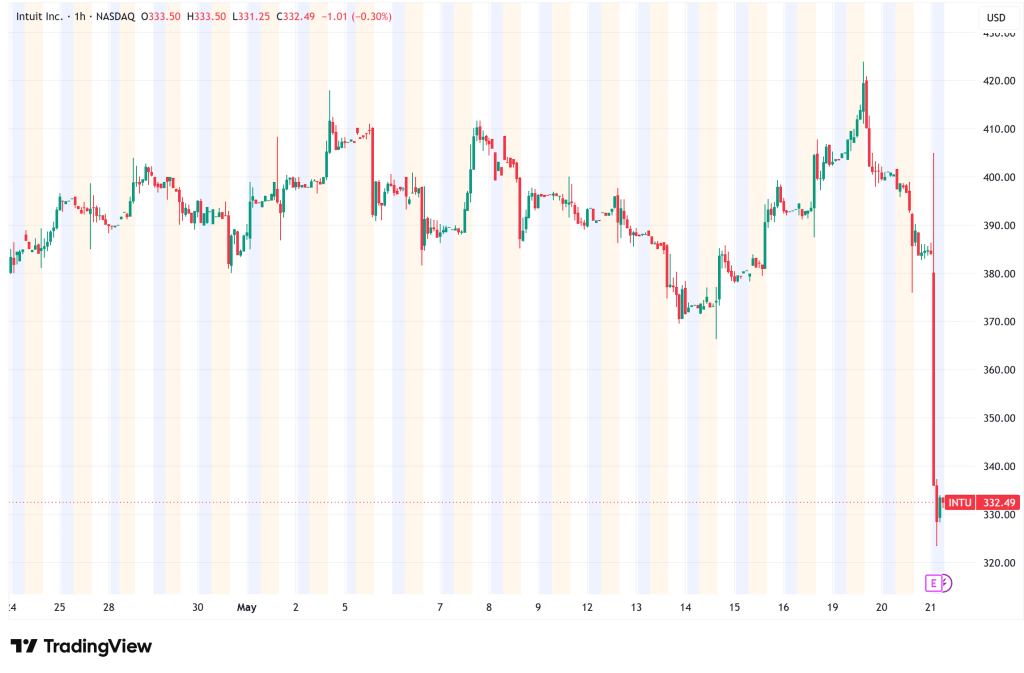
INTU Technical Analysis: Downtrend Intensifies
Technically, INTU’s chart has weakened significantly. The chart shows a clear long-term downtrend, with the earnings reaction triggering another breakdown.
Key Technical Signals
- Shares remain below major moving averages
- Volume surged sharply during the selloff
- Momentum indicators remain bearish
- Institutional selling pressure appears elevated
Moving Averages
The technical setup remains negative:
- 20-day moving average: declining
- 50-day moving average: declining
- 200-day moving average: declining
This alignment typically signals continued bearish momentum.
RSI and MACD
RSI likely moved near oversold territory after the sharp after-hours drop.
That could support short-term relief rallies, but MACD momentum remains negative, suggesting sellers still control the trend.
Key Support and Resistance Levels
| Level Type | Approximate Area |
|---|---|
| Immediate Resistance | $385–$400 |
| Major Resistance | $430 |
| Near-Term Support | $330 |
| Psychological Support | $300 |
| Major Long-Term Support | $275–$280 |
If shares fail to hold above $330, traders may begin targeting the $300 level.
Intuit (INTU) Long-Term Outlook: Transition Phase Underway
The core debate around Intuit is whether it can evolve from a traditional software company into an AI-native financial platform.
The company still owns dominant consumer and small-business ecosystems. That gives it advantages many AI startups lack.
But the market is no longer rewarding stability alone.
Investors now want:
- Faster AI-driven growth
- Higher efficiency
- Better monetization
- Stronger competitive positioning
Intuit is attempting to address all four simultaneously through restructuring and AI integration.
The challenge is execution.
For now, the market appears skeptical. The sharp selloff suggests investors see the layoffs less as a sign of efficiency and more as evidence that even established software leaders are under pressure to adapt quickly in the AI era.
- Check out our free forex signals
- Follow the top economic events on FX Leaders economic calendar
- Trade better, discover more Forex Trading Strategies
- Open a FREE Trading Account
- Read our latest reviews on: Avatrade, Exness, HFM and XM

Related Articles


Sidebar rates

Related Posts
 Save
Save