South African Rand: USD/ZAR Retreats Toward R16 Amid Peace Deal Hopes and Fed Watch
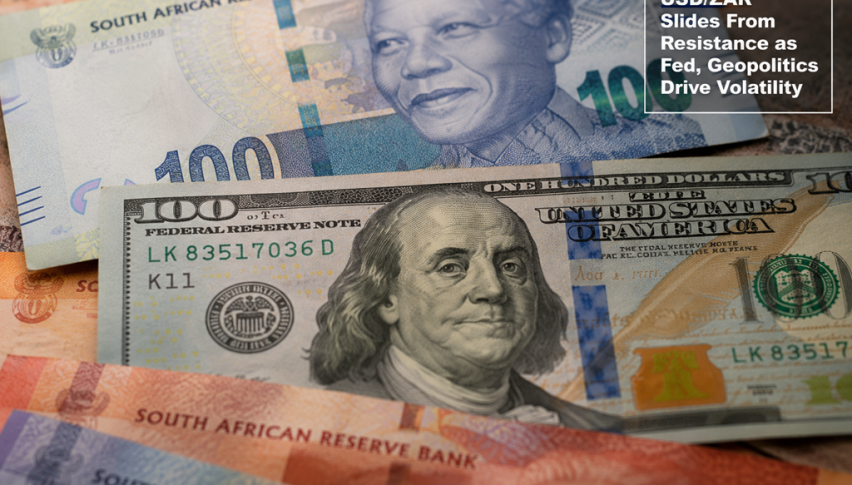
USD/ZAR has turned lower toward the R16 level as improving geopolitical sentiment and a softer US dollar outweigh strong US economic data and keep resistance levels intact.
Quick overview
- USD/ZAR has declined towards the R16 level due to improving geopolitical sentiment and a weaker US dollar, despite strong US economic data.
- The pair failed to maintain a breakout above key resistance levels, leading to renewed selling pressure and a return to the R16.20 area.
- Improving global risk sentiment, particularly related to Middle East peace talks, has bolstered the rand and reduced geopolitical risk premiums.
- South Africa's external position has weakened slightly, with foreign exchange reserves declining, while domestic growth signals remain fragile amid economic uncertainty.
USD/ZAR has turned lower toward the R16 level as improving geopolitical sentiment and a softer US dollar outweigh strong US economic data and keep resistance levels intact.
USD/ZAR Moves Lower After Failed Break Above Resistance
USD/ZAR has reversed from recent highs after failing to sustain a breakout above key technical resistance levels over the past three months. The pair briefly pushed above R16.50 earlier in June, supported by stronger-than-expected US Non-Farm Payrolls and broader dollar strength, while the rand came under pressure.
However, momentum faded as buyers failed to overcome the 200-day simple moving average, a level that has repeatedly acted as a ceiling for upside attempts. The rejection triggered renewed selling pressure, sending USD/ZAR back toward the R16.20 area.
The shift reflects a combination of technical exhaustion and improving risk appetite, with traders increasingly reluctant to maintain long USD positions at stretched levels.
Peace Talks Boost Emerging Market Sentiment
A key driver behind the rand’s recent recovery has been improving global risk sentiment following reports of progress in negotiations involving the United States, Iran, and regional partners toward a broader Middle East de-escalation framework.
The proposed arrangement is understood to include steps toward limiting nuclear escalation risks and reducing uranium enrichment activity, alongside discussions around reopening critical maritime trade routes.
One focal point has been the Strait of Hormuz, a vital global oil corridor. Comments attributed to US leadership suggesting that the waterway could “open for business” shortly helped reinforce expectations of reduced geopolitical disruption.
Markets responded quickly, with equities gaining on lower risk premiums while crude oil prices fell sharply as traders unwound supply-disruption hedges.
Iran’s confirmation of a ceasefire memorandum of understanding added further clarity, removing ambiguity from earlier reports. The framework suggests regulated maritime traffic coordination involving Iran and Oman rather than a full unrestricted reopening, signalling a managed easing of tensions rather than a complete normalization.
This development has effectively reduced the geopolitical risk premium across energy and FX markets, supporting emerging market currencies such as the rand.
US Dollar Outlook Shaped by Fed Expectations
Attention now shifts to the upcoming Federal Reserve policy meeting, which remains a central catalyst for global FX direction.
The Federal Open Market Committee is widely expected to hold rates steady in the 3.50%–3.75% range. However, market focus will be on updated economic projections and forward guidance for clues on whether policy will remain restrictive for longer.
Stronger-than-expected inflation and labour data have reinforced expectations that the Fed may delay any easing cycle. Some market participants have even begun pricing in the possibility of an additional rate hike later in the year.
Chair commentary will be closely scrutinized for signals on whether inflation is moving sustainably toward target levels. While broader risk sentiment has improved, the US dollar’s trajectory remains highly sensitive to any indication that policy will stay tight for an extended period.
USD/ZAR Chart Daily – The 200 SMA Keeps the Pressure to the Downside

On the monthly chart, USD/ZAR seems to have bottomed at the 100 SMA (green) where it found support in the last two months. Last month we saw a rebound as the Rand weakened while the Dollar gained, but buyers are facing the 50 SMA (yellow) and in April the forex pair has reversed lower again. For the larger uptrend to resume, USD/ZAR would need to push above this moving average.
USD/ZAR Chart Monthly – Rebounding Off the 100 SMA

South Africa’s External Position Weakens Slightly
South Africa’s foreign exchange reserves declined modestly to $76.58 billion in May 2026 from $77.09 billion in April, marking the lowest level since December 2025.
The decline was primarily driven by valuation effects in gold holdings and small outflows linked to government-related transactions. Gold reserves fell to $18.27 billion, while foreign currency reserves also edged lower.
Although the monthly changes are not large, the steady downward drift has drawn attention to the gradual erosion of external buffers, particularly in an environment of global uncertainty and volatile capital flows.
Domestic Growth Signals Remain Fragile
Recent survey data suggests South Africa’s private sector contracted in May, with weaker output and declining new orders reflecting pressure from higher input costs and persistent global uncertainty.
Despite the slowdown, firms remain cautiously optimistic about medium-term conditions, indicating expectations of stabilization rather than a deep contraction.
Markets are now focused on a series of key macroeconomic releases this week, including GDP data, the current account balance, and sectoral indicators for mining and manufacturing. These figures will help determine whether the economy is stabilizing or continuing to lose momentum, with implications for the rand’s medium-term trajectory.
- Check out our free forex signals
- Follow the top economic events on FX Leaders economic calendar
- Trade better, discover more Forex Trading Strategies
- Open a FREE Trading Account
- Read our latest reviews on: Avatrade, Exness, HFM and XM

Related Articles


Sidebar rates

Related Posts
 Save
Save