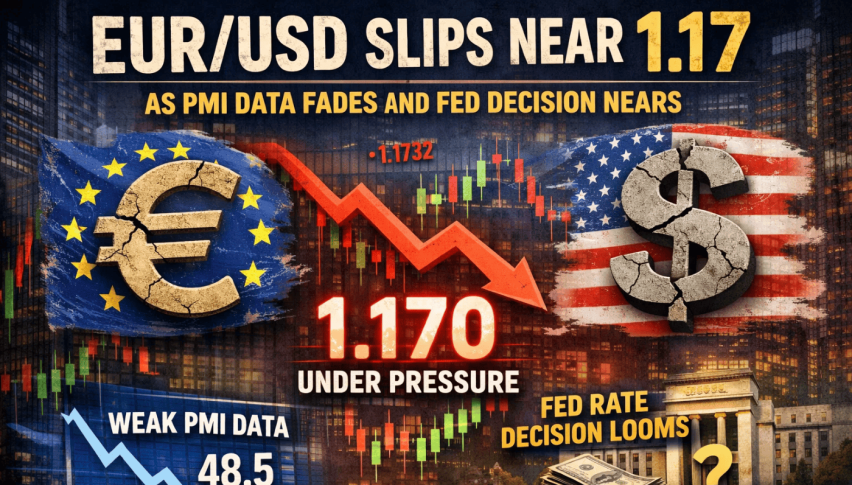
EUR/USD Slips Near 1.17 as PMI Data Fades and Fed Decision Nears
EUR/USD has been struggling to build on its gains even though the US dollar has weakened as a whole, with prices...
Quick overview
- EUR/USD is struggling to gain traction despite a weaker US dollar, currently hovering around the $1.1730 - $1.1740 zone.
- Investors are cautious ahead of the Fed's interest rate decision, with expectations of no change to the current rate range.
- Mixed Eurozone PMI data shows slight improvements but indicates that the manufacturing sector remains in contraction.
- Technically, EUR/USD is stabilizing with key support at $1.1695 and resistance at $1.1769, suggesting potential for a significant move.
EUR/USD has been struggling to build on its gains even though the US dollar has weakened as a whole, with prices now headed lower near that $1.1730 – $1.1740 zone. The dollar has lost strength due to rising tensions between the US and Europe but the euro hasn’t had the kind of catalyst you would need for a sustained rally and so it’s just drifted – you know, rather than actually moving in a direction.
Investors are keeping a low profile ahead of the Fed’s interest rate decision coming up where everyone is expecting to see no change at all to the current range of 3.50 – 3.75 % as shown on the CME FedWatch tool. Until we get some clear policy guidance and the markets calm down a bit then people don’t seem keen to push the boat out in either direction.
Eurozone PMI Data Barely Lifts The Euro
On the European side, the January flash HCOB PMI figures were a bit of a mixed bag. The services PMI stayed steady at 51.6 which was exactly as the experts had predicted and the manufacturing figure went higher to 49.4 from 48.8. Now the improved figure is at least a sign of stabilization but it’s by no means a sign that things are on the mend and the sector is still officially in contraction below the key 50 threshold.
Germany’s numbers looked a bit similar:
- Services PMI came in at 53.3
- Manufacturing PMI went up to 48.7
So they’re both showing gradual improvement but not quite enough to signal a big rebound in growth. As a result, despite the dollar being weaker, the euro saw no sustained demand.
EUR/USD – What The Charts Are Saying – Consolidation Not Reversal
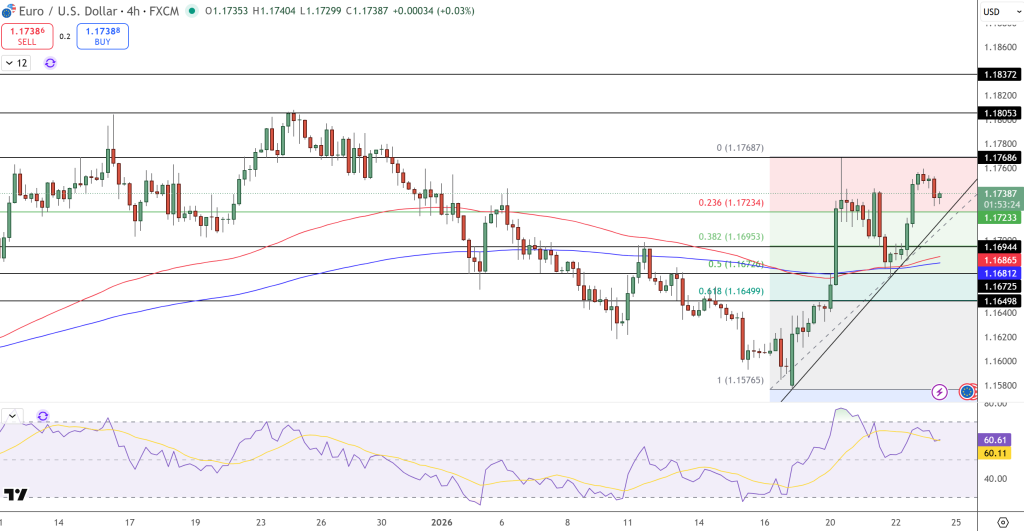
Technically, EUR/USD has stabilised at around $1.1739 after that sharp bounce back from the low point of $1.1577 on the 4-hour chart. That recovery actually broke a descending channel so the short-term trend just shifted a bit higher and those recent bullish candles look like they’re following through even though the upper wicks are sticking up near $1.1769 to hint that there are some sellers about.
Key levels to watch:
- Support:
- $1.1695 – that 38.2% Fibonacci level
- $1.1672 – the 50% Fibonacci, plus a couple of Emas in the same area
- Resistance:
- $1.1769 – that’s the high point from before
- $1.1810 – the top of an extension zone
EUR/USD is sitting on a rising trend line and is being supported by the 50 and 200 EMA at the $1.1680 – $1.1690 area. Momentum remains pretty positive too, with RSI about 60 after coming back from being overbought. There’s a tight triangle on the chart which does suggest a pretty big move could be on the way.
What Traders Are Focusing On Next
So with mixed signals from the macro side and the technical picture getting all tight, EUR/USD is currently just kind of pausing rather than moving in any one direction. A break through the resistance would open up the possibility of a big move up, but losing that key support would send people reaching for the mid-$1.16 levels.
Trade idea (short-term):
- Buy on the dip near $1.1695
- Target $1.1765
- Stop-loss below $1.1645
- Check out our free forex signals
- Follow the top economic events on FX Leaders economic calendar
- Trade better, discover more Forex Trading Strategies
- Open a FREE Trading Account
- Read our latest reviews on: Avatrade, Exness, HFM and XM

Related Articles

Sidebar rates

Related Posts
 Save
Save
