AUD/USD Price Analysis: Bearish Bias Near $0.7010 as Markets Eye US Data
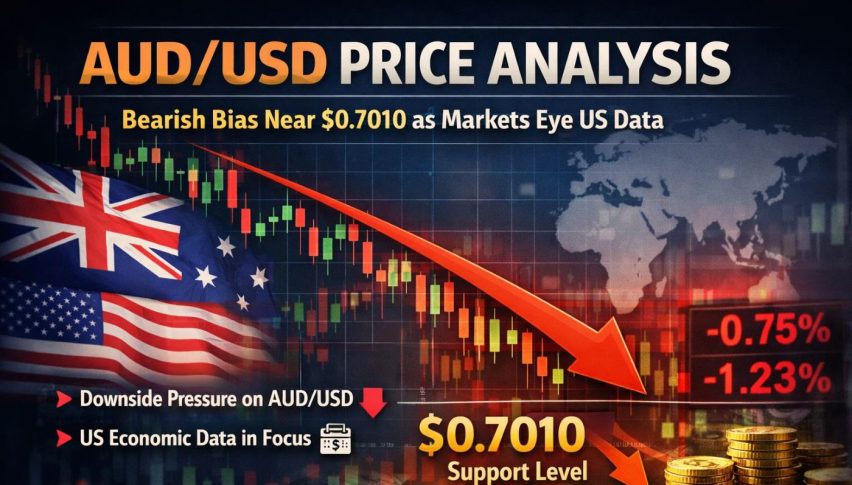
The AUD/USD pair is consolidating around 0.7010 in the European session. Although the pair is under pressure from a stronger US Dollar...
Quick overview
- The AUD/USD pair is consolidating around 0.7010, pressured by a stronger US Dollar but supported by the RBA's hawkish stance.
- Key economic data releases today, including ADP Private Payrolls and ISM Services PMI, are influencing market sentiment.
- The RBA's recent rate hike to 3.85% aims to combat inflation, potentially aiding the Australian Dollar despite US Dollar strength.
- Technical analysis shows the AUD/USD remains in a rising channel, with critical support levels that traders should monitor.
The AUD/USD pair is consolidating around 0.7010 in the European session. Although the pair is under pressure from a stronger US Dollar, the long-term outlook is still positive thanks to the Reserve Bank of Australia’s hawkish stance.
Why is the AUD/USD Falling Today?
The main reason for the current bearish trend is the stronger US Dollar (DXY), which is up about 0.2% and trading near 97.55. Investors are adjusting their positions before key economic data that could influence the Federal Reserve’s decisions for the rest of 2026.
Several factors are putting pressure on the pair:
- US Dollar Momentum: Anticipation of strong employment and service sector data.
- Safe-haven demand: Ongoing global market concerns after recent tech sector volatility.
- Technical resistance: The pair is pulling back after failing to stay above the key 0.7050 level.
What US Economic Data is Moving the Market?
Traders are closely watching two major releases today that will give an update on the US economy:
- ADP Private Payrolls (January): The market expects the private sector to add 48,000 jobs, up from 41,000 in December. If the actual number is higher, it could support the Fed keeping interest rates higher for longer.
- ISM Services PMI: Forecasted at 53.5, down a bit from 54.4. This is a slight slowdown, but any number above 50 still means the services sector is growing, which is important for the US economy.
Market insight: The CME FedWatch Tool shows that markets expect the Federal Reserve to keep interest rates steady at the March and April meetings, which helps support the US Dollar.
Is the RBA’s Hawkish Pivot Saving the Australian Dollar?
Even with the strong US Dollar, the Australian Dollar (AUD) is supported by the RBA’s recent policy change. On Tuesday, the RBA raised the cash rate by 25 basis points to 3.85% to fight inflation, which is now at 3.4%.
Governor Michele Bullock has said the board “isn’t ruling anything in or out,” so more rate hikes are possible if private demand stays strong. This difference between a tightening RBA and a steady Fed often helps the AUD/USD recover after declines.
Technical Outlook: Is the AUD/USD Pullback Ending?
Technically, the AUD/USD is still moving within a clear rising channel on the 4-hour chart. The overall uptrend that started at $0.665 should continue as long as the pair stays above key support levels.
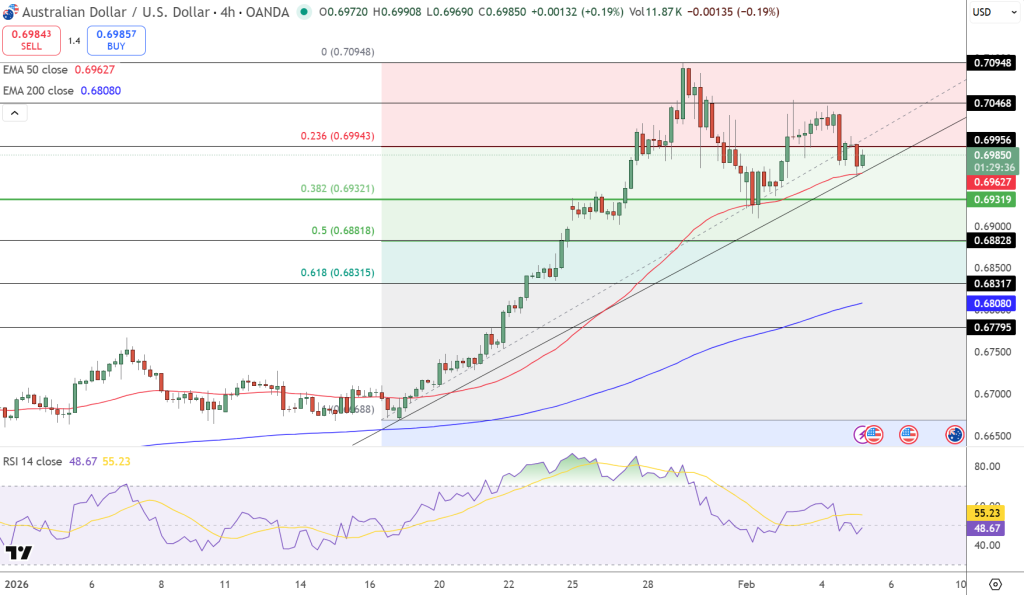
| Immediate Resistance | $0.7040 – $0.7090 | Prior highs and channel ceiling. |
| Dynamic Support | $0.6960 | Aligns with the 50-period EMA. |
| Major Support | $0.6810 | The 200-period EMA; critical for the long-term trend. |
| Fibonacci Pivot | $0.6930 | The 0.382 retracement level; a “must-hold” for bulls. |
The Relative Strength Index (RSI) is currently hovering near 49, suggesting that the market is in a neutral state. This “coiling” effect often precedes a breakout once the US data is digested.
Trade Idea: How to Trade the AUD/USD Consolidation?
With the RSI neutral and the price near the 50-EMA support, swing traders might consider a buy-the-dip strategy.
- Entry: Near $0.6950 (Support zone).
- Target: $0.7050 (Recent resistance).
- Stop Loss: Below $0.6900 (Invalidation of the rising channel).
- Check out our free forex signals
- Follow the top economic events on FX Leaders economic calendar
- Trade better, discover more Forex Trading Strategies
- Open a FREE Trading Account
- Read our latest reviews on: Avatrade, Exness, HFM and XM

Related Articles



Sidebar rates

Related Posts
 Save
Save
