Intel Stock Heads to $60 After Reclaiming $50 as CPU Supply Tightens, China Demand Increases
After a volatile start to the year, Intel is showing early signs of stabilization as tighter supply, product optimism, and renewed foundry..
Quick overview
- Intel is showing early signs of stabilization after a volatile start to the year, with shares climbing approximately 6% recently.
- Supply constraints in Intel's server processor business and renewed interest in its product roadmap are contributing to improved investor sentiment.
- Despite stronger-than-expected earnings, cautious guidance for the upcoming quarter has raised concerns about the sustainability of the recovery.
- Intel's foundry ambitions are gaining attention, with potential partnerships being explored with major companies like Apple and Nvidia.
Live INTC Chart
[[INTC-graph]]
After a volatile start to the year, Intel is showing early signs of stabilization as tighter supply, product optimism, and renewed foundry interest begin to reshape investor sentiment.
A Volatile Start to the Year, Followed by a Tentative Turn
Intel’s 2026 trading year has been anything but smooth. The stock began the year with optimism, only to suffer a sharp pullback as cautious guidance and lingering doubts about execution weighed on sentiment. That narrative, however, has started to evolve. Shares climbed roughly 6% on Friday, reclaiming the psychologically important $50 level, as a series of incremental developments encouraged investors to reassess the near-term outlook.
While the move does not erase Intel’s longer-term challenges, it does suggest that downside conviction may be weakening. For a stock that has struggled to regain credibility after years of missed targets and competitive pressure, even modest shifts in tone matter.
Supply Tightness Signals Real Demand
A key catalyst behind the latest rally came from a Reuters report highlighting supply constraints in Intel’s server processor business. According to the report, Intel has warned some Chinese customers that delivery lead times for certain data-center chips could stretch as long as six months. One source suggested that price increases of more than 10% are being applied “generally” across Intel’s server products in the region.
China represents more than 20% of Intel’s total revenue, making any shift in pricing power or demand conditions there particularly meaningful. Intel confirmed to Reuters that rapid AI adoption is driving stronger-than-expected demand for traditional compute workloads. Management added that inventories are expected to hit their lowest levels in the first quarter, with supply improvements targeted for the second quarter.
For investors, this development cuts both ways. On one hand, supply tightness points to genuine demand resilience in data centers. On the other, it underscores the strain placed on Intel’s manufacturing footprint at a time when execution consistency remains under scrutiny.
Compared to December, Intel’s CPU share increased by 0.25% to 56.64%. Even though the increase is small, it ends a downward trend that began in September, when Intel accounted for 58.61% of the market. Its percentage fell to 56.39% at the end of 2025.
Product Momentum Returns to the Conversation
Beyond supply dynamics, renewed enthusiasm around Intel’s product roadmap has played an important role in lifting sentiment. Leaked performance data surrounding the upcoming Core Ultra 9 290K Plus processor helped reignite excitement around Intel’s desktop lineup.
Early benchmarks suggest meaningful gains over the existing Ultra 9 285K, with reported improvements of roughly 10–11% in both single-core and multi-core performance. Crucially, these gains appear to come without a dramatic architectural overhaul. The chip is expected to retain the same 24-core, 24-thread configuration, with improvements driven by higher clock speeds and better thermal efficiency.
Reported benchmark scores of 3,535 in single-core and 25,106 in multi-core testing compare favorably not only with Intel’s prior generation, but also with AMD’s latest high-end offerings. Claims that the chip outperforms AMD’s Ryzen 9 9950X3D in certain workloads caught the market’s attention, even if investors remain cautious about real-world performance until official launches.
After several product cycles defined by disappointment, even incremental progress carries outsized signaling value for Intel’s credibility.
Foundry Speculation Adds Strategic Optionality
Intel’s longer-term narrative has also benefited from renewed discussion around its foundry ambitions. Reports from DigiTimes Asia suggest that Apple and Nvidia are exploring limited partnerships with Intel for select chips toward the latter part of the decade, potentially around the 2028 timeframe.
Under the reported framework, Nvidia would continue to rely on TSMC for core GPU dies, while shifting portions of I/O dies and advanced packaging to Intel. This would leverage Intel’s EMIB chip-to-chip packaging technology and possibly its future 14A process, assuming yield targets are met. Apple, meanwhile, is said to be evaluating Intel as a manufacturing partner for entry-level M-series chips, driven by diversification, cost considerations, and geopolitical factors rather than dissatisfaction with TSMC.
While highly speculative, these discussions reinforce a subtle but important shift: Intel’s foundry business is no longer being dismissed outright. For a company that has invested heavily in rebuilding manufacturing relevance, that change in perception matters.
Technical Picture Shows Buyers Defending Key Levels
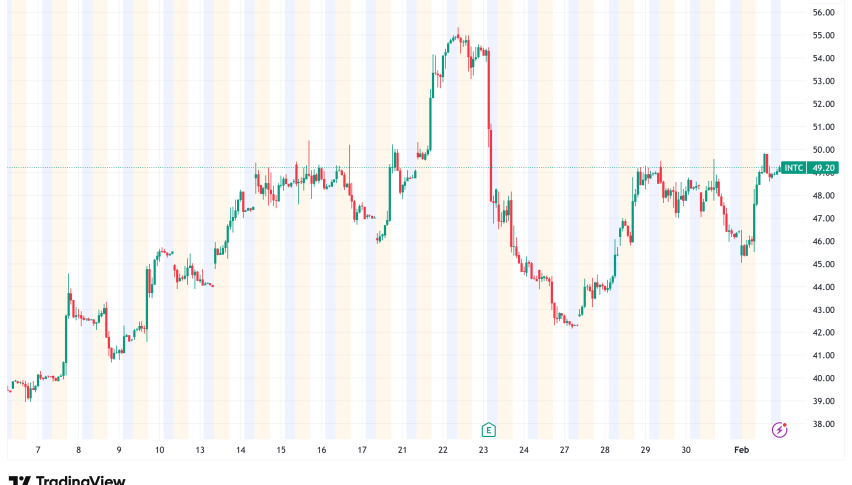
Technically, Intel’s recent price action reflects a market searching for balance. The stock’s post-earnings sell-off erased a breakout above $54 and drove shares down toward the $42.50 area, a zone aligned with prior resistance from October that has since turned into support.
INTC Chart Daily – Bouncing Off $42.50 Support

The successful defense of that level marked a turning point. From there, Intel staged a swift rebound, reclaiming $50 and restoring some near-term momentum. The speed of the bounce suggests that buyers remain willing to step in when valuations appear attractive, even if longer-term conviction remains fragile.
The next test will be whether Intel can sustain trade above former resistance levels and begin forming a higher base rather than another short-lived rally.
Solid Results Overshadowed by Conservative Guidance
Intel’s latest earnings report was stronger than the initial market reaction implied. Adjusted earnings per share came in at $0.15, beating expectations, while revenue of $13.67 billion also exceeded forecasts. Margins showed notable improvement, with adjusted gross margin rising to 37.9% and operating margin improving to 8.8%.
These figures point to tangible progress in cost discipline and operational efficiency, particularly after years of margin compression. Datacenter and AI revenue reached $4.74 billion, beating estimates, while Intel Foundry revenue of $4.51 billion also came in ahead of expectations, lending early support to the foundry strategy.
However, guidance for the March quarter proved to be the stumbling block. Management forecast breakeven adjusted EPS, revenue of $11.7–$12.7 billion, and a drop in gross margin to 34.5%. That cautious outlook triggered a sharp sell-off, reminding investors that recovery remains uneven.
A Recovery Story That Still Needs Proof
Intel’s recent rebound does not mark a full turnaround, but it does suggest that the market is becoming more receptive to incremental improvement. Product momentum, supply tightness, and foundry optionality are all helping to stabilize sentiment after a turbulent start to the year.
Still, execution risk remains high. For Intel to sustain this recovery narrative, it must translate product optimism and strategic ambition into consistent delivery and improving cash flow. Until then, the rally is best viewed not as a victory lap—but as a tentative vote of confidence that the worst may no longer be inevitable.
- Check out our free forex signals
- Follow the top economic events on FX Leaders economic calendar
- Trade better, discover more Forex Trading Strategies
- Open a FREE Trading Account
- Read our latest reviews on: Avatrade, Exness, HFM and XM



 Save
Save