Nvidia NDA Stock’s Record High Masks Mounting Valuation Risks Beneath the Surface
After hitting fresh record highs, Nvidia’s rally is increasingly risked by overvaluation risks, geopolitical setbacks, and growing skepticis
Quick overview
- Nvidia's recent stock surge is driven by speculation rather than solid fundamentals, raising concerns about overvaluation and sustainability.
- The company faces significant challenges, including a $4.5 billion charge due to export restrictions to China and ongoing supply constraints that could hinder growth.
- Despite strong earnings, investor sentiment is cautious as doubts about the sustainability of AI-driven capital expenditures and competitive pressures grow.
- Technical indicators suggest a shift in momentum, with the stock slipping below key support levels, indicating potential vulnerability in the near term.
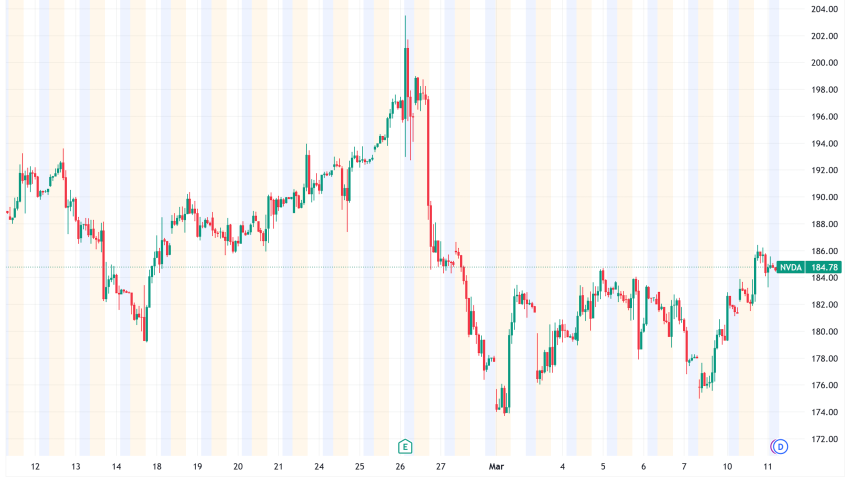
Live NVDA Chart
[[NVDA-graph]]
After hitting fresh record highs, Nvidia’s rally is increasingly risked by overvaluation risks, geopolitical setbacks, and growing skepticism around AI sustainability.
Record Highs Driven by Speculation, Not Stability
Shares of NVIDIA surged to new all-time highs, fueled largely by market cap speculation and aggressive options activity rather than improving fundamentals. A notable $2.2 million bet on short-dated $210 calls highlights the extent of bullish positioning, with call options outpacing puts by more than two-to-one.
This surge in speculative activity has pushed volatility sharply higher ahead of earnings, signaling an unstable setup. While Nvidia’s valuation continues to expand, the reliance on leveraged bets raises concerns that the rally is being driven more by momentum chasing than sustainable growth.
China Exposure Becomes a Structural Drag
Beneath the surface, serious cracks are forming. Nvidia disclosed a $4.5 billion charge tied to its H20 chips due to export restrictions to China—a major blow to one of its key growth markets.
Even more concerning, the company’s forward guidance excludes any data center revenue from China, effectively acknowledging a long-term disruption. This removes a significant demand pillar and introduces uncertainty about how Nvidia will offset the lost revenue stream.
Supply Constraints Threaten Growth Narrative
Operational challenges are also intensifying. CEO Jensen Huang admitted that manufacturing bottlenecks could persist for two to three years, undermining the company’s ability to fully capitalize on AI demand.
At the same time, gaming segment supply constraints are expected to continue weighing on performance. These issues suggest that even with strong demand, Nvidia may struggle to deliver consistent growth due to execution limitations.
Momentum Looks Increasingly Fragile
Despite record highs, Nvidia’s outlook is becoming more precarious. Between geopolitical headwinds, supply constraints, rising competition, and growing skepticism about AI economics, the rally appears increasingly disconnected from underlying risks.
With expectations stretched to extreme levels, even minor disappointments could trigger a sharp reversal—suggesting that Nvidia’s current strength may be more vulnerable than it appears.
Technical Picture Reflects Waning Momentum
Nvidia’s technical setup mirrors the shifting sentiment. The stock has slipped below its 20-week simple moving average (gray), a level that previously provided reliable support. That average has now turned into resistance, rejecting recent rebound attempts.
NVDA Chart Weekly – The 20 SMA Has Turned Into Resistance

Momentum indicators have weakened, and market participants are increasingly discussing the possibility of a deeper pullback toward the 50-week moving average (yellow). While the long-term uptrend remains intact, short-term control has shifted toward sellers.
Strong Results Fail to Reassure Investors
Although Nvidia delivered another “beat and raise” quarter, supported by spending from Microsoft Corporation and Amazon, the market reaction has turned increasingly cautious.
The focus has shifted away from headline growth toward deeper concerns about whether AI-driven capital expenditure is sustainable. Questions are emerging about cash flow pressure, return on investment, and the long-term monetization of AI infrastructure.
Competitive and Strategic Uncertainty Builds
Nvidia’s push into AI inference strengthens its ecosystem advantage, but it does not eliminate competition. Rivals like Advanced Micro Devices and Broadcom continue to target areas of potential weakness.
Meanwhile, uncertainty around its relationship with OpenAI adds another layer of risk. Slowing discussions and doubts about large-scale investments point to hesitation even among key partners.
📊 NVIDIA Q4 & Fiscal 2026 Financial Highlights
🔹 Gross Margins
- Fourth Quarter:
- GAAP gross margin: 75.0%
- Non-GAAP gross margin: 75.2%
Full Fiscal 2026:
- GAAP gross margin: 71.1%
- Non-GAAP gross margin: 71.3%
➡️ Q4 margins expanded versus the full-year average, reflecting strong product mix and AI-driven demand.
🔹 Earnings Per Share (Diluted)
Fourth Quarter:
- GAAP EPS: $1.76
- Non-GAAP EPS: $1.62
Full Fiscal 2026:
- GAAP EPS: $4.90
- Non-GAAP EPS: $4.77
➡️ Quarterly earnings outpaced the fiscal-year average, underscoring continued strength in data center and AI segments.
🔹 Capital Return to Shareholders
- Total capital returned in Fiscal 2026: $41.1 billion
- Via share repurchases and cash dividends
- Remaining share repurchase authorization: $58.5 billion (as of Q4 end)
➡️ Strong free cash flow continues to support aggressive buybacks and shareholder returns.
🔹 Dividend Announcement
- Next quarterly dividend: $0.01 per share
- Payment date: April 1, 2026
- Record date: March 11, 2026
- Check out our free forex signals
- Follow the top economic events on FX Leaders economic calendar
- Trade better, discover more Forex Trading Strategies
- Open a FREE Trading Account
- Read our latest reviews on: Avatrade, Exness, HFM and XM

Related Articles

Sidebar rates

Related Posts
 Save
Save