Court Upholds SARS 200% Taxpayer Penalty in Controversial Tax Case
The South African Revenue Service (SARS) has secured a significant Tax Court victory involving a taxpayer linked to the State Capture-era Chinese locomotive deal, reinforcing its ability to reopen historic tax matters backed by forensic evidence.
Quick overview
- SARS won a significant Tax Court case against a taxpayer linked to the State Capture-era Chinese locomotive deal.
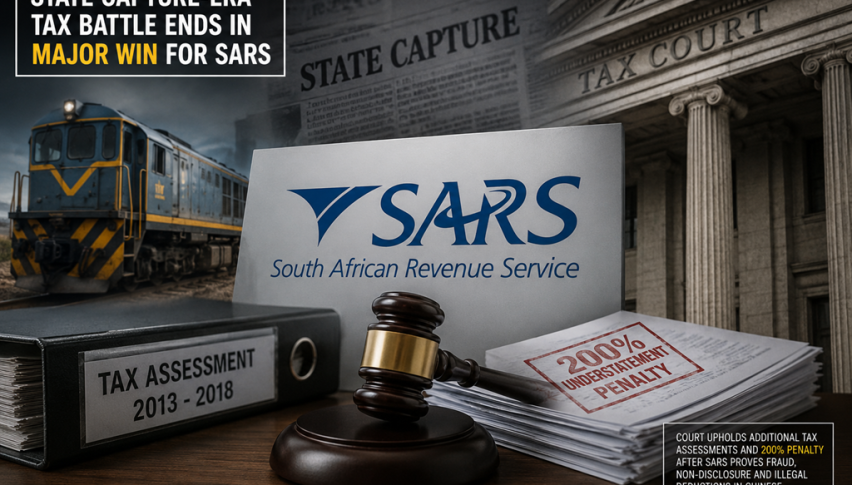
- The court upheld additional tax assessments and a 200% understatement penalty for the years 2013 to 2018.
- SARS was allowed to reopen tax assessments despite the taxpayer's argument of prescription due to fraud and non-disclosure.
- The ruling highlights SARS's reliance on forensic investigations and international cooperation in addressing complex tax matters.
The South African Revenue Service (SARS) has secured a significant Tax Court victory involving a taxpayer linked to the State Capture-era Chinese locomotive deal, reinforcing its ability to reopen historic tax matters backed by forensic evidence.
SARS Secures Legal Victory in High-Profile Tax Dispute
The South African Revenue Service (SARS) has won a major Tax Court case against a taxpayer linked to the controversial Chinese locomotive deal associated with the State Capture era.
In the case of Taxpayer LE (Pty) Ltd v CSARS, the court upheld additional tax assessments as well as a 200% understatement penalty covering the 2013 to 2018 tax years. The ruling enables SARS to pursue tax liabilities years after the original transactions occurred.
Prescription Argument Rejected by Court
A key issue in the case was whether SARS could reopen tax assessments that would normally have prescribed under Section 99 of the Tax Administration Act.
The taxpayer argued that the assessments were issued outside the standard three-year prescription period and were therefore invalid.
However, the court ruled that prescription does not apply where underpayment results from fraud, misrepresentation, or non-disclosure of material facts, allowing SARS to proceed with reassessments.
Evidence Uncovered Through Extensive Investigations
The court accepted SARS’s position that crucial information only emerged after extensive investigations involving the South African Reserve Bank, forensic inquiries, and broader State Capture probes.
SARS also relied on data obtained through international exchange-of-information requests under a double taxation agreement with Hong Kong, alongside inputs from commercial banks and audit firms.
Procedural Challenges Dismissed
During proceedings, the taxpayer raised procedural objections, including recusal applications and disputes over evidence admissibility. However, the taxpayer ultimately closed its case without presenting supporting evidence.
The court found that procedural objections could not substitute for substantive proof and upheld SARS’s assessments in full.
Penalties and Final Ruling
SARS imposed a 200% understatement penalty plus interest, reflecting its tougher stance on alleged concealment and illicit financial flows.
The court reaffirmed the principle that SARS assessments remain valid unless the taxpayer proves them incorrect, ultimately confirming that the taxpayer failed to discharge the burden of proof.
The judgment underscores SARS’s increasing reliance on international cooperation and forensic investigations in complex historic tax cases.
- Check out our free forex signals
- Follow the top economic events on FX Leaders economic calendar
- Trade better, discover more Forex Trading Strategies
- Open a FREE Trading Account
- Read our latest reviews on: Avatrade, Exness, HFM and XM

Related Articles



Sidebar rates

Related Posts
 Save
Save
