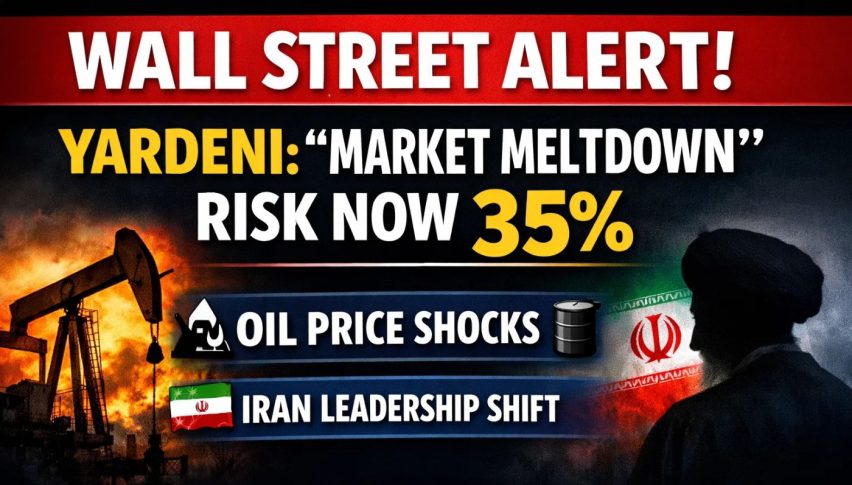
Wall Street Alert: Yardeni Raises “Market Meltdown” Odds to 35% as Oil Shocks and Iran Leadership Pivot Spook Investors
As of March 10, 2026, financial markets have become much more volatile. Ed Yardeni, a well-known strategist...
Quick overview
- As of March 10, 2026, Ed Yardeni has increased the likelihood of a U.S. market meltdown from 20% to 35% due to rising volatility and geopolitical tensions.
- The surge in oil prices above $100 per barrel is contributing to inflation concerns and has diminished hopes for an interest rate cut by the Federal Reserve.
- Recent labor market data shows a rise in unemployment and a drop in hiring, complicating the Federal Reserve's response to rising prices.
- Crypto-related stocks are under pressure, with companies like Core Scientific pivoting to AI infrastructure by selling off Bitcoin holdings.
As of March 10, 2026, financial markets have become much more volatile. Ed Yardeni, a well-known strategist, has raised the chance of a U.S. market ‘meltdown’ from 20% to 35%. This change comes as the ongoing U.S.-Israel-Iran conflict disrupts global energy markets and raises fears of a return to 1970s-style stagflation.
Yardeni’s new outlook matches a sharp drop in investor confidence. He now puts the chance of a speculative ‘meltup’ at just 5%, down from 20%. For crypto-related stocks and the tech sector, this period is a real test of how well they can handle a stronger U.S. Dollar and rising costs.
The “Stagflation” Ghost: Why $100 Oil is Re-Writing the Fed Playbook
The primary catalyst for Yardeni’s bearish turn is the “energy squall” currently gripping the globe. With West Texas Intermediate (WTI) and Brent crude surging past $100 to $117 per barrel, the Federal Reserve is now caught between “Iran and a hard place.”
- The Inflation Trap: Analysts estimate that every $10 increase in crude oil adds roughly 0.2% to 0.4% to consumer inflation. This has effectively evaporated hopes for a June interest rate cut, with markets now bracing for a “higher-for-longer” stance that could push the first cut as far back as September 2026.
- Labor Market Cracks: Recent payroll data from February showed a drop in hiring, and the unemployment rate rose to 4.4%. The Federal Reserve now faces the difficult situation of rising prices along with a weaker job market.
- GDP Downgrades: Early estimates for first-quarter 2026 GDP have been cut from 3.2% to 2.1%. This drop shows how high fuel prices are quickly reducing consumer spending and company profits.
🚨 A MARKET MELTDOWN RISK JUST JUMPED
Veteran strategist Ed Yardeni just raised the chance of a stock market meltdown to 35%, up from 20%.
What changed:
The February 28, 2026 U.S.–Israel airstrikes that killed Iran’s supreme leader triggered a wider conflict.
Since then:
— Naeem Aslam (@NaeemAslam23) March 9, 2026
Iran’s Hardline Pivot: Mojtaba Khamenei and the “Hormuz Blockade”
Geopolitical uncertainty reached a fever pitch on March 9, following the appointment of Mojtaba Khamenei as Iran’s new Supreme Leader. Succeeding his late father, Ali Khamenei (who was killed in the war’s opening salvo), the 56-year-old cleric is viewed as even less compromising than his predecessor.
- Strategic Continuity: His strong connections to the Revolutionary Guard suggest that Tehran is preparing for a long conflict instead of looking for a quick resolution.
- Global Trade Risks: Iran’s closure of the Strait of Hormuz has stopped about 20% of the world’s seaborne oil and gas shipments. If the blockade continues into April, it could also raise global food prices by disrupting fertilizer exports.
Crypto Stocks Under Pressure: Core Scientific’s Major Shift
Crypto-related stocks, including miners, exchanges, and infrastructure firms, are the most exposed in this market. With Bitcoin holding near $68,000, these companies are quickly reducing risk:
- Core Scientific (CORZ): Core Scientific (CORZ), a Nasdaq-listed mining company, plans to sell all its Bitcoin holdings (over 2,500 BTC) by the end of the first quarter of 2026. The company aims to use the money to shift fully into AI infrastructure and high-density colocation services.
- The “Mining Exit” Trend: Other companies, such as Bitdeer and MARA Holdings, are also selling their Bitcoin reserves to fund AI data centers. Many mining executives now agree that, with high energy costs and inflation, AI contracts provide more stable revenue than the unpredictable rewards from mining.
Technical Outlook: Managing the 35% Correction Risk
Looking at the bigger picture, Yardeni’s 35% downside risk means the S&P 500 could fall back to the 4,200–4,500 range if stagflation takes hold. For crypto investors, Bitcoin’s strong link to high-growth tech stocks means that if the stock market drops, digital assets could also fall to their recent support levels.
- Check out our free forex signals
- Follow the top economic events on FX Leaders economic calendar
- Trade better, discover more Forex Trading Strategies
- Open a FREE Trading Account
- Read our latest reviews on: Avatrade, Exness, HFM and XM

Related Articles

Sidebar rates

Related Posts
 Save
Save