Walmart's shares dropped over 7% after the company warned that rising fuel prices and financial stress on lower-income consumers could hinder spending growth.
Despite strong quarterly sales and market-share gains, Walmart's cautious guidance fell short of Wall Street expectations, raising concerns about consumer spending.
The company reported significant growth in e-commerce and advertising revenue, indicating a successful expansion of its digital ecosystem.
Walmart's long-term strategy is evolving beyond traditional retail, focusing on logistics, digital advertising, and AI-powered commerce, but remains vulnerable to consumer spending trends.
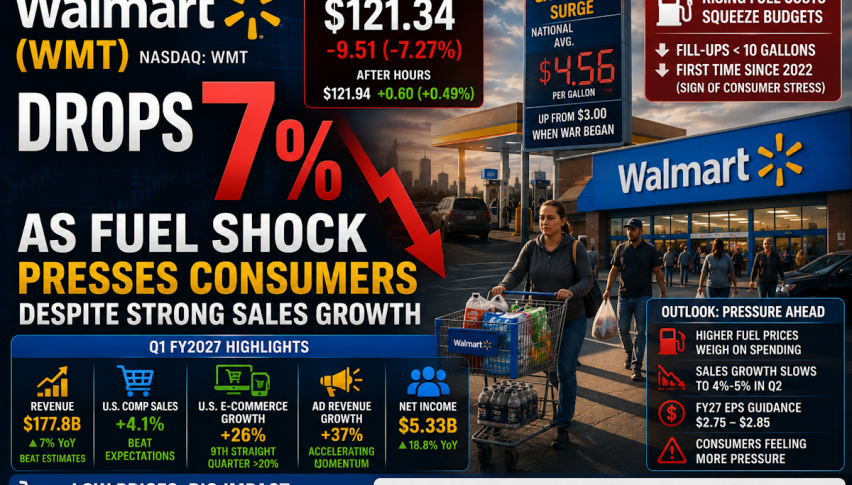
Shares of WMT fell more than 7% Thursday after the retail giant warned that rising fuel prices and growing pressure on lower-income consumers could slow spending growth in the coming quarters.
The stock closed at $121.34 after investors reacted negatively to weaker-than-expected guidance, despite Walmart posting another quarter of strong sales growth and market-share gains.
The results reinforced a growing concern across Wall Street: the U.S. consumer is still spending, but financial stress is widening beneath the surface.
Walmart Is Seeing Clear Signs of Consumer Pressure
Walmart executives repeatedly pointed to rising fuel prices as a major headwind.
The ongoing Iran conflict has pushed U.S. gasoline prices sharply higher, with the national average climbing above $4.50 per gallon.
According to CFO John David Rainey, consumers are beginning to cut discretionary spending to offset higher fuel costs.
One of the clearest warning signs came at Walmart’s fuel stations.
For the first time since 2022, the average customer filled less than 10 gallons per trip.
“That’s an indication of stress,” Rainey said.
Management also warned that higher tax refunds earlier this year may have temporarily masked the financial pressure consumers are now facing.
Walmart’s Guidance Disappoints Investors
The biggest issue for investors was Walmart’s cautious outlook.
The company maintained its full-year fiscal 2027 guidance:
Net sales growth: 3.5%–4.5%
Adjusted EPS: $2.75–$2.85
However, both ranges came in below Wall Street expectations.
Walmart also guided current-quarter sales growth to 4%–5%, missing analyst estimates near 5.1%.
The conservative outlook overshadowed otherwise strong quarterly results.
Q1 Results Still Show Operational Strength
Despite the selloff, Walmart’s core business remains resilient.
Q1 FY2027 Highlights
Metric
Result
YoY Growth
Revenue
$177.8B
+7%
Net Income
$5.33B
+18.8%
Adjusted EPS
$0.66
In line
U.S. Comparable Sales
+4.1%
Beat expectations
Global E-commerce Growth
+26%
Strong
Advertising Revenue Growth
+37%
Accelerating
The company continues attracting shoppers across income groups, particularly higher-income households seeking value amid inflation and economic uncertainty.
Importantly, transaction growth accelerated to its strongest level in six quarters.
That suggests Walmart is still gaining traffic share from competitors.
Walmart’s Digital Ecosystem Is Expanding Rapidly
Beyond groceries and physical retail, Walmart’s digital business continues accelerating.
The company recorded:
Its ninth straight quarter of U.S. e-commerce growth above 20%
Marketplace sales growth near 50%
Rapid expansion in advertising revenue
Growth in Walmart+ membership engagement
Management also highlighted increasing usage of “Sparky,” Walmart’s AI-powered shopping assistant.
Weekly active users more than doubled during the quarter.
The company is increasingly blending:
Physical stores
Delivery infrastructure
AI shopping tools
Marketplace sellers
Advertising services
Membership ecosystems
That strategy is helping Walmart compete more directly with Amazon across digital commerce.
Fuel Costs Are Hitting Margins Too
Walmart is not only seeing pressure on shoppers.
The company said elevated fuel prices reduced first-quarter operating income by roughly $175 million.
Management warned that impact could worsen if oil prices remain elevated.
There are also broader inflation concerns.
Walmart said prolonged disruption around the Strait of Hormuz could eventually increase food costs because fertilizer, nitrogen, and phosphate prices may rise further.
That creates additional pressure for both consumers and retailers.
How to trade Walmart stock after earnings
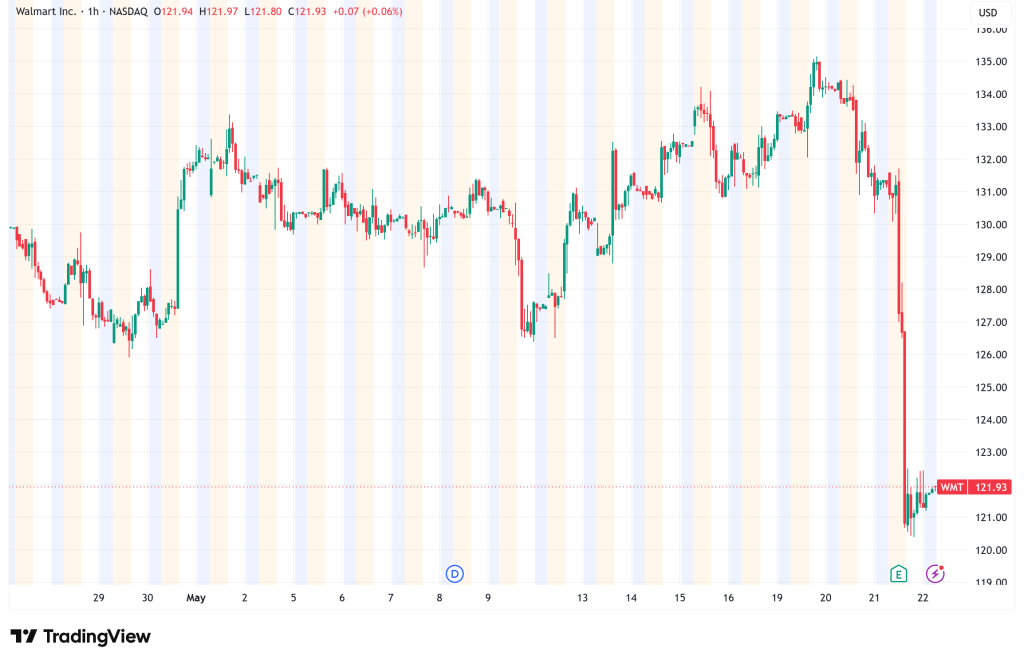
WMT Technical Analysis: Long-Term Trend Weakens After Sharp Breakdown
Technically, Walmart’s chart suffered significant damage after the earnings reaction. The chart shows shares breaking sharply lower following months of relative outperformance.
Key Technical Signals
Shares broke below near-term support
Selling volume expanded sharply
Momentum indicators weakened materially
The stock remains above long-term trend support
Defensive retail leadership is fading short term
Moving Averages
The technical setup has deteriorated:
Moving Average
Approximate Level
20-day MA
Near recent highs
50-day MA
Still rising
200-day MA
Long-term support remains intact
The sharp earnings decline likely pushed shares below the 20-day moving average while threatening medium-term momentum.
RSI and MACD
RSI likely moved toward oversold territory after the 7% drop.
That could support short-term stabilization or relief rallies.
However, MACD momentum appears to be turning bearish following the breakdown.
Key Support and Resistance Levels for Walmart Stock
Level Type
Approximate Area
Immediate Resistance
$126–$130
Major Resistance
$135
Near-Term Support
$120
Secondary Support
$115
Major Trend Support
$108–$110
Holding above the $120 area may become important for stabilizing sentiment.
A sustained move below that level could trigger additional downside pressure.
Walmart Is Still Winning Market Share
Despite the weak stock reaction, Walmart continues outperforming many competitors operationally.
The company remains uniquely positioned because of:
Massive scale
Grocery dominance
Pricing power
Supply-chain efficiency
Delivery infrastructure
Growing digital ecosystem
Management emphasized that Walmart is increasingly attracting higher-income consumers while still serving budget-conscious shoppers.
That dynamic matters during periods of economic pressure.
Analysts noted that Walmart’s transaction growth suggests the company is taking “real traffic share” rather than simply benefiting from inflation.
Long-Term Outlook: Walmart Is Becoming More Than a Retailer
The long-term investment thesis around Walmart is evolving.
The company is no longer just a traditional big-box retailer.
It is increasingly becoming:
A logistics platform
A digital advertising company
A membership ecosystem
A grocery delivery network
An AI-powered commerce platform
Its growing alternative revenue streams — particularly advertising and marketplace services — carry much higher margins than traditional retail.
That could gradually improve profitability over time.
Still, Walmart remains heavily tied to consumer spending trends.
And right now, management is signaling that financial pressure is increasing, particularly for lower-income households.
The stock’s sharp selloff suggests investors are becoming more concerned that fuel inflation and weakening consumer confidence may eventually slow even Walmart’s resilient growth engine.
Lead Markets Analyst – Multi-Asset (FX, Commodities, Crypto)
Arslan Ali Butt serves as the Lead Commodities and Indices Analyst, bringing a wealth of expertise to the field. With an MBA in Behavioral Finance and active progress towards a Ph.D., Arslan possesses a deep understanding of market dynamics.
His professional journey includes a significant role as a senior analyst at a leading brokerage firm, complementing his extensive experience as a market analyst and day trader. Adept in educating others, Arslan has a commendable track record as an instructor and public speaker.
His incisive analyses, particularly within the realms of cryptocurrency and forex markets, are showcased across esteemed financial publications such as ForexCrunch, InsideBitcoins, and EconomyWatch, solidifying his reputation in the financial community.



 Save
Save