D-Wave Quantum (QBTS) Surges 33% After $100M U.S. Quantum Bet Signals Industry Turning Point
D-Wave (QBTS) stock jumps 33% after securing a proposed $100M U.S. quantum investment under the CHIPS Act initiative. What's next for QBTS?
Written by:
Arslan Butt•Friday, May 22, 2026•3 min read
•Last updated: Friday, May 22, 2026
Quick overview
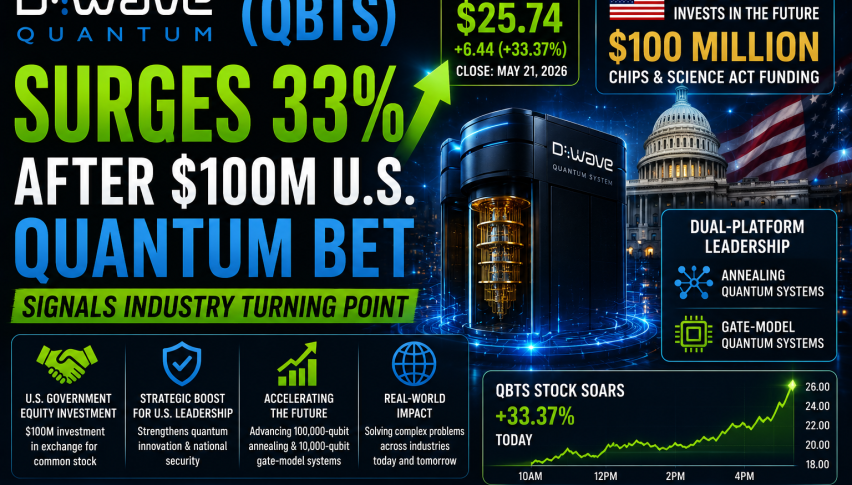
Shares of QBTS surged 33.4% after D-Wave announced plans to receive $100 million in funding from the U.S. Department of Commerce under the CHIPS and Science Act.
The funding will allow D-Wave to accelerate the development of advanced quantum systems and expand operations in multiple locations.
The U.S. government's direct equity investment signals a growing confidence in the commercialization of quantum technology as a strategic national-security asset.
Despite the excitement, D-Wave remains a speculative investment with significant financial risks, including cash burn and potential dilution.
Shares of QBTS exploded higher Thursday after the quantum computing company announced plans to receive $100 million in proposed funding from the U.S. Department of Commerce under the CHIPS and Science Act.
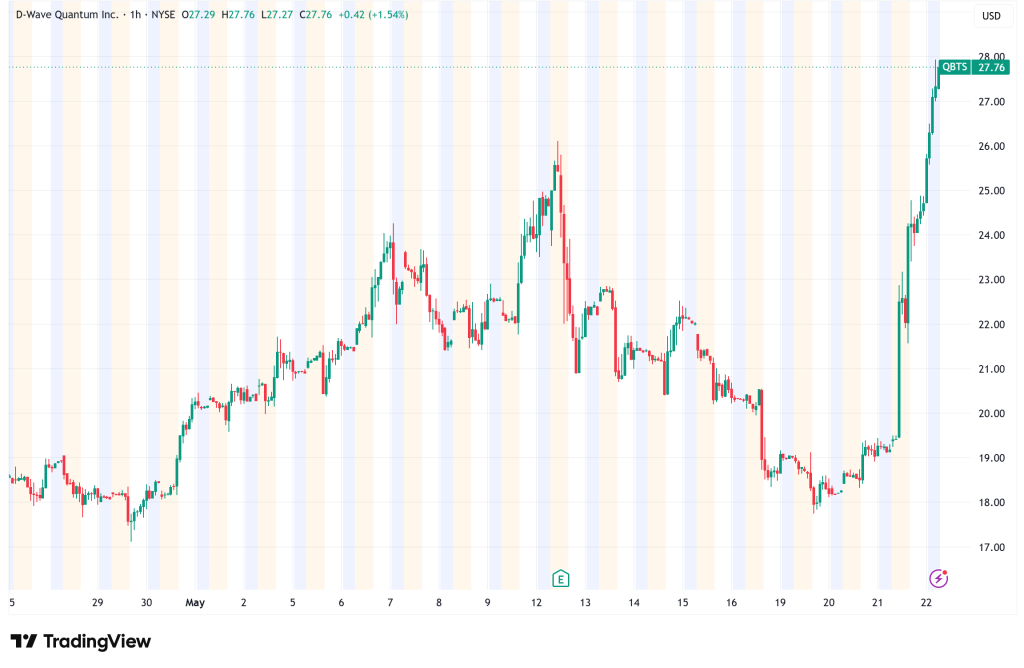
The stock surged 33.4% to close at $25.74 before extending gains in after-hours trading to nearly $28. Volume topped 119 million shares, far above normal trading activity, as investors rushed back into quantum computing names following the landmark government announcement.
The move positions D-Wave among the biggest beneficiaries of Washington’s growing push to establish U.S. leadership in quantum technology amid intensifying competition with China.
Washington Is Making a Direct Quantum Bet
The proposed funding is notable for one major reason: the U.S. government is not simply issuing grants.
It is taking equity stakes.
Under the Letter of Intent, D-Wave would receive $100 million through the CHIPS and Science Act in exchange for issuing $100 million worth of common stock to the Department of Commerce.
That makes D-Wave one of the first quantum computing firms to receive direct federal equity investment support.
The funding forms part of a broader $2 billion U.S. quantum initiative that also includes companies such as:
IBM
RGTI
GlobalFoundries
The announcement signals that quantum computing is increasingly being treated as a strategic national-security technology alongside AI and semiconductors.
D-Wave’s Dual-Platform Strategy Is Drawing Attention
D-Wave differentiates itself from many rivals through its “dual-platform” approach.
The company develops both:
Annealing quantum systems
Gate-model quantum systems
That strategy allows D-Wave to pursue commercial quantum applications today while also developing next-generation fault-tolerant architectures.
Management says the proposed funding would accelerate development of:
A 100,000-qubit annealing system
A 10,000-qubit gate-model system
Advanced superconducting quantum hardware
Expanded R&D infrastructure
The company plans to use the capital to expand operations in:
Boca Raton, Florida
New Haven, Connecticut
Burnaby, British Columbia
CEO Alan Baratz called the initiative a “transformative moment” for both D-Wave and the broader quantum industry.
Quantum Computing Is Moving Closer to Commercialization
Quantum computing has long been viewed as highly experimental.
That perception is beginning to shift.
Recent breakthroughs in qubit coherence, error correction, and quantum hardware scaling have reignited investor interest across the sector.
The technology could eventually transform industries including:
Drug discovery
Financial modeling
Cryptography
Materials science
Artificial intelligence
Logistics optimization
The U.S. government’s involvement is particularly important because it signals growing confidence that commercial quantum deployment may arrive faster than previously expected.
Unlike many speculative technology themes, Washington now appears willing to directly invest taxpayer capital into quantum infrastructure.
D Wave’s Fundamentals Remain Highly Speculative
Despite the excitement, D-Wave remains an early-stage company with significant financial risks.
Current metrics include:
Metric
Approximate Reading
Market Cap
$7.1B
Gross Margin
33%
Revenue Growth
Improving
Profitability
Still loss-making
Share Dilution Risk
Elevated
The company continues burning cash while investing aggressively in research, infrastructure, and commercialization efforts.
That means future equity raises remain a key risk for shareholders.
The government investment may help ease some near-term funding pressure, but investors will still closely monitor:
Cash burn
Commercial adoption
Customer growth
Scalability
Dilution
Why did QBTS stock surge today?
QBTS Stock Technical Analysis: Momentum Has Turned Explosive
Technically, QBTS has entered a highly volatile momentum phase. The chart shows a powerful breakout following the CHIPS Act announcement.
The stock now trades well above major moving averages:
20-day moving average: rising
50-day moving average: rising
200-day moving average: rising
This alignment supports the broader bullish trend structure.
RSI and MACD
RSI likely moved deep into overbought territory following Thursday’s rally.
That increases the probability of:
Sharp volatility
Profit-taking swings
Rapid momentum reversals
However, MACD momentum remains strongly positive, reflecting aggressive buying pressure.
Key Support and Resistance Levels
Level Type
Approximate Area
Immediate Resistance
$28–$30
Psychological Resistance
$35
Near-Term Support
$22–$24
Secondary Support
$19–$20
Major Trend Support
$15
A sustained breakout above $30 could intensify speculative momentum.
Failure to hold above the low-$20 range may trigger aggressive pullbacks given the stock’s volatility.
QBTS Risks Remain Extremely High
Quantum computing remains one of the market’s most speculative sectors.
Major risks include:
Commercialization uncertainty
Long adoption timelines
Technical limitations
Heavy competition
Funding needs
Regulatory dependency
Dilution risk
The industry still faces major scientific challenges, including:
High error rates
Qubit stability
Scaling complexity
Cooling requirements
There is also no guarantee that current quantum architectures become commercially dominant long term.
Long-Term Outlook: QBTS Is One of the Highest-Risk AI Adjacent Trades
The long-term bull case for D-Wave is straightforward.
If quantum computing becomes commercially viable at scale, early infrastructure leaders could see enormous upside.
D-Wave already holds several advantages:
Commercial annealing systems
Existing enterprise customers
Government relationships
Cloud-based quantum access
Dual-platform architecture
Importantly, the company now has something many speculative quantum startups lack: direct U.S. government backing.
That credibility boost could attract additional enterprise customers, partnerships, and institutional investors.
Still, investors should recognize that quantum computing remains far earlier-stage than AI infrastructure or cloud computing.
For now, D-Wave is trading less like a traditional technology company and more like a high-beta frontier technology asset tied to one of the market’s most speculative long-term themes.
And after Thursday’s explosive rally, volatility is likely to remain extreme.
Lead Markets Analyst – Multi-Asset (FX, Commodities, Crypto)
Arslan Butt serves as the Lead Commodities and Indices Analyst, bringing a wealth of expertise to the field. With an MBA in Behavioral Finance and active progress towards a Ph.D., Arslan possesses a deep understanding of market dynamics.
His professional journey includes a significant role as a senior analyst at a leading brokerage firm, complementing his extensive experience as a market analyst and day trader. Adept in educating others, Arslan has a commendable track record as an instructor and public speaker.
His incisive analyses, particularly within the realms of cryptocurrency and forex markets, are showcased across esteemed financial publications such as ForexCrunch, InsideBitcoins, and EconomyWatch, solidifying his reputation in the financial community.


 Save
Save