SanDisk SNDK Stock Risks Breakdown If Support Goes, Despite NAND Expansion and MS Price Target Raise as Asian Chip Selloff Weighs
SanDisk shares extended their sharp decline as a broad semiconductor selloff, AI valuation concerns, and renewed profit-taking overshadowed the company's latest NAND production milestone with Kioxia.
Quick overview
- SanDisk shares have extended their decline amid a broader semiconductor selloff and concerns over AI valuations.
- Despite achieving a significant NAND production milestone with Kioxia, investor sentiment remains focused on profit-taking and market reassessment.
- The stock has broken below key technical support levels, increasing the likelihood of further downside if buying interest does not return.
- Long-term demand fundamentals for SanDisk remain strong, but recent market volatility highlights the challenges posed by valuation concerns.
SanDisk shares extended their sharp decline as a broad semiconductor selloff, AI valuation concerns, and renewed profit-taking overshadowed the company’s latest NAND production milestone with Kioxia.
SanDisk Extends Selloff as Semiconductor Sector Loses Momentum
Shares of SanDisk remained under heavy selling pressure, extending last week’s sharp decline toward the $1,700 level as investors continued reducing exposure to semiconductor stocks. The latest weakness came despite positive operational developments, highlighting how broader concerns over artificial intelligence valuations have begun outweighing company-specific achievements.
The decline reflects a notable shift in market sentiment after months of exceptional gains across memory-chip manufacturers. Investors who aggressively accumulated AI-related names are increasingly locking in profits as questions emerge over whether current valuations fully reflect future earnings potential.
Although SanDisk remains well positioned in the long-term memory market, the stock has become caught in a broader reassessment of semiconductor valuations.
Kioxia Partnership Advances Next-Generation NAND Production
While the market focused on selling pressure, SanDisk announced an important manufacturing milestone alongside Kioxia.
The two companies officially began production of their tenth-generation 3D NAND flash memory at the Fab2 facility within the Kitakami Plant in Japan. The expansion significantly increases manufacturing capacity for advanced storage products serving enterprise computing, cloud infrastructure and increasingly data-intensive applications.
The site had previously produced eighth-generation NAND products following the opening of the K2 facility in 2025. The transition to tenth-generation technology represents another step in the partners’ long-term strategy to expand bit output and improve manufacturing efficiency.
Both product generations utilize CBA (CMOS directly Bonded to Array) architecture, which directly bonds CMOS circuitry to memory arrays. The design enables higher storage density, improved performance and lower power consumption while supporting next-generation enterprise storage solutions.
Despite the technological progress, investors largely ignored the announcement as broader sector weakness continued dominating market sentiment.
Goldman Turns More Bullish on SanDisk Ahead of Earnings
Goldman Sachs raised its price target on SanDisk to $2,200 from $1,200 on Monday while reiterating its Buy rating, reflecting growing confidence in the memory-chip maker’s near-term outlook. The investment bank expects SanDisk to benefit from tight supply conditions in the NAND flash memory market ahead of its fiscal fourth-quarter earnings report in August.
Goldman also believes expanding demand for enterprise solid-state drives from hyperscale cloud providers will improve the company’s product mix and profitability. The firm further revised its forecasts to reflect stronger NAND pricing expectations, while also accounting for higher operating costs.
Technical Breakdown Shifts Momentum to the Bears
SanDisk’s recent price action represents a significant technical deterioration.
After reaching an all-time high near $2,354, the shares have corrected by more than 15%, falling below the important psychological $2,000 level before extending losses toward the $1,700 area.
The break below multiple technical support levels has weakened bullish momentum and increased the probability of additional downside if buyers fail to re-enter the market.
Momentum indicators have also deteriorated considerably, suggesting investors have shifted from chasing upside opportunities toward preserving recent gains accumulated during the stock’s powerful post-spin-off rally.
Unless SanDisk quickly reclaims previous support levels, technical traders may continue viewing rallies as selling opportunities rather than signs of a sustained recovery.
South Korean Chip Selloff Weighs on Global Semiconductor Stocks
The immediate catalyst behind the latest decline has been the sharp correction across South Korea’s semiconductor sector.
Heavy selling swept through Korean technology stocks as investors reduced exposure to several AI-driven chip manufacturers. The broader market weakened as concerns surrounding stretched valuations, slowing momentum and tighter regulatory oversight prompted investors to unwind speculative positions.
Major memory producers experienced particularly steep declines, amplifying concerns that the semiconductor industry could be entering a broader consolidation phase after its extraordinary rally.
The weakness quickly spread beyond South Korea, affecting semiconductor companies globally as investors reassessed risk across the AI supply chain.
Although comments suggesting moderating inflation supported parts of the broader equity market, they failed to reverse the heavy selling pressure across memory-chip producers, where valuation concerns remained the dominant theme.
SNDK Chart Daily – The 20 SMA Is Broken As Support

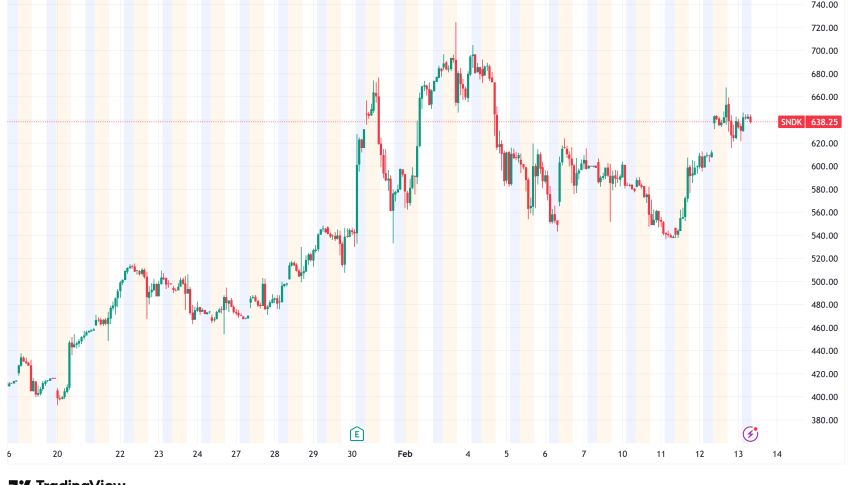
With selling pressure accelerating, traders are increasingly focused on the $1,720 region, which corresponds with the rising 20-day moving average and the previous record high established earlier in June. A move toward that level would represent a substantial retracement from recent peaks and could test investor conviction in the stock’s longer-term growth story. The next target now is the 50 SMA in yellow at $1,600.
Valuation Concerns Replace AI Optimism
One of the biggest changes in investor sentiment has been the shift from enthusiasm to caution regarding AI-related semiconductor stocks.
Following its separation from Western Digital, SanDisk experienced an exceptional rally that dramatically expanded its market valuation. That surge reflected expectations that accelerating AI investment would generate sustained demand for advanced memory solutions.
However, the rapid appreciation also left the shares increasingly vulnerable to disappointment. As expectations climbed, investors became less willing to overlook execution risks, cyclical industry dynamics and elevated earnings multiples.
Recent analyst commentary has suggested much of the anticipated growth may already be reflected in current valuations, limiting upside unless financial performance continues exceeding expectations.
Capacity Expansion Revives Memory Cycle Concerns
Beyond valuation worries, investors are once again focusing on the cyclical nature of the memory industry.
Large-scale production expansions by major manufacturers have revived concerns that the sector could eventually face oversupply if capacity grows faster than long-term demand. While hyperscale cloud providers and AI infrastructure continue driving strong memory consumption today, investors recognize that the industry has historically experienced pronounced boom-and-bust cycles.
Additional uncertainty surrounding legal challenges involving memory manufacturers and ongoing industry pricing dynamics has further encouraged a more cautious investment approach.
Although demand fundamentals remain healthy, markets are becoming increasingly sensitive to the possibility that future supply growth could pressure pricing and compress margins.
Long-Term Fundamentals Remain Supportive
Despite the recent correction, SanDisk continues to benefit from powerful structural growth trends. Expanding cloud computing, enterprise storage, artificial intelligence infrastructure and next-generation data centers are expected to support long-term demand for advanced NAND memory products.
The company’s deeper manufacturing partnership with Kioxia strengthens its competitive position and provides a scalable production platform capable of supporting future technological advances.
Nevertheless, recent trading illustrates that strong operational progress alone may not be sufficient to offset broader shifts in market sentiment. Until confidence returns to the semiconductor sector and investors become more comfortable with AI-related valuations, SanDisk shares could remain vulnerable to continued volatility as the market balances long-term growth opportunities against near-term valuation risks.
- Check out our free forex signals
- Follow the top economic events on FX Leaders economic calendar
- Trade better, discover more Forex Trading Strategies
- Open a FREE Trading Account
- Read our latest reviews on: Avatrade, Exness, HFM and XM

Related Articles
Sidebar rates

Related Posts
 Save
SaveAva
