Will SPCX Stock Fall Toward $140 After SpaceX’s Nasdaq-100 Debut Triggers Selloff?
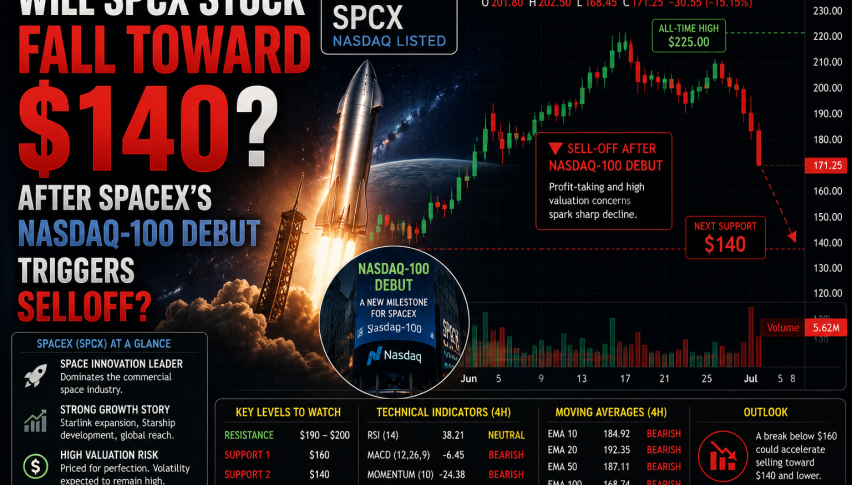
SpaceX stock SPCX slides below $150 after SpaceX Nasdaq-100 entry as bullish analyst calls clash with weak 4-hour technicals.
Quick overview
- SpaceX's stock dropped sharply despite its historic inclusion in the Nasdaq-100 and positive Wall Street coverage, raising concerns about valuation and short-term technical weakness.
- The company's limited free float and modest Nasdaq-100 weight have resulted in passive demand that is not sufficient to offset selling pressure.
- Analysts remain divided, with bullish ratings from major brokerages focusing on growth engines like Starship and Starlink, while some caution against overly ambitious valuation assumptions.
- Technical indicators show a bearish trend for SpaceX, with key support levels at $150, $145, and $140, which could determine the stock's near-term direction.
SpaceX shares dropped sharply despite joining the Nasdaq-100 and receiving bullish Wall Street coverage, as investors questioned valuation, AI-hardware momentum, and short-term technical weakness.
SpaceX Slides After Historic Nasdaq-100 Inclusion
SpaceX made history by becoming one of the fastest companies ever added to the Nasdaq-100, but the stock’s first day in the index was marked by heavy selling rather than a breakout. The decline shows that index inclusion alone may not be enough to offset valuation concerns after one of the largest IPOs in market history.
Nasdaq-100 Entry Adds Passive Demand for SPCX
SpaceX’s inclusion in the Nasdaq-100 gives the stock a new source of structural demand.
Funds and ETFs tied to the index, including Invesco QQQ, must now hold SPCX to track the benchmark. That forced-buying dynamic is normally viewed as bullish, especially for a newly listed company with strong brand recognition.
However, SpaceX’s free float remains limited. Because only a small portion of shares is publicly traded, its Nasdaq-100 weight is still modest, reportedly near 1.34%. That means the near-term passive flow is meaningful but not large enough to dominate trading in a stock with a market value around $2 trillion.
Bullish Brokerages Line Up After SpaceX IPO
Wall Street has moved quickly to frame the SpaceX investment case.
Morgan Stanley, Goldman Sachs, JPMorgan, and several other brokerages initiated coverage with bullish ratings. Analysts are focused on three major growth engines: Starship, Starlink, and SpaceXAI.
Raymond James issued the most aggressive call, setting a price target of $800 and describing Starship as one of the defining industrial innovations of the century. Other firms argue SpaceX could scale across space infrastructure, satellite connectivity, launch services, and AI.
Still, skepticism remains. Some non-underwriting research shops have issued neutral or sell-equivalent ratings, warning that parts of the valuation already reflect extremely ambitious execution assumptions.
Starship and Starlink Remain the Core Long-Term Thesis
The long-term bull case still begins with Starship.
If SpaceX can prove rapid reuse at scale, launch economics could change dramatically. Analysts have published forecasts ranging from more than 1,500 to as many as 5,000 Starship launches annually by 2031, depending on reusability, demand, and execution.
Starlink adds a second major pillar. Its global satellite broadband network gives SpaceX recurring connectivity revenue and a strategic position in communications infrastructure.
Together, Starship and Starlink explain why investors are willing to compare SpaceX to infrastructure platforms rather than traditional aerospace companies.
SpaceXAI Adds Another Growth Angle
SpaceXAI is also becoming part of the stock story.
Reports indicate SpaceXAI and Cursor could launch a jointly developed AI model as soon as Wednesday, after delaying the release to improve efficiency. The model is expected to compete in some areas with advanced systems from OpenAI and Anthropic.
SpaceX agreed in June to acquire Anysphere, the company behind Cursor, in an all-stock deal reportedly worth $60 billion. That gives SpaceX a deeper foothold in AI coding tools, enterprise software, and compute-heavy AI infrastructure.
For bulls, this turns SpaceX into more than a rocket and satellite company. For bears, it adds another capital-intensive business line at a time when valuation is already stretched.
SPCX Technical Analysis: Short-Term Trend Turns Bearish
From a technical perspective, SpaceX’s 4-hour chart has weakened.
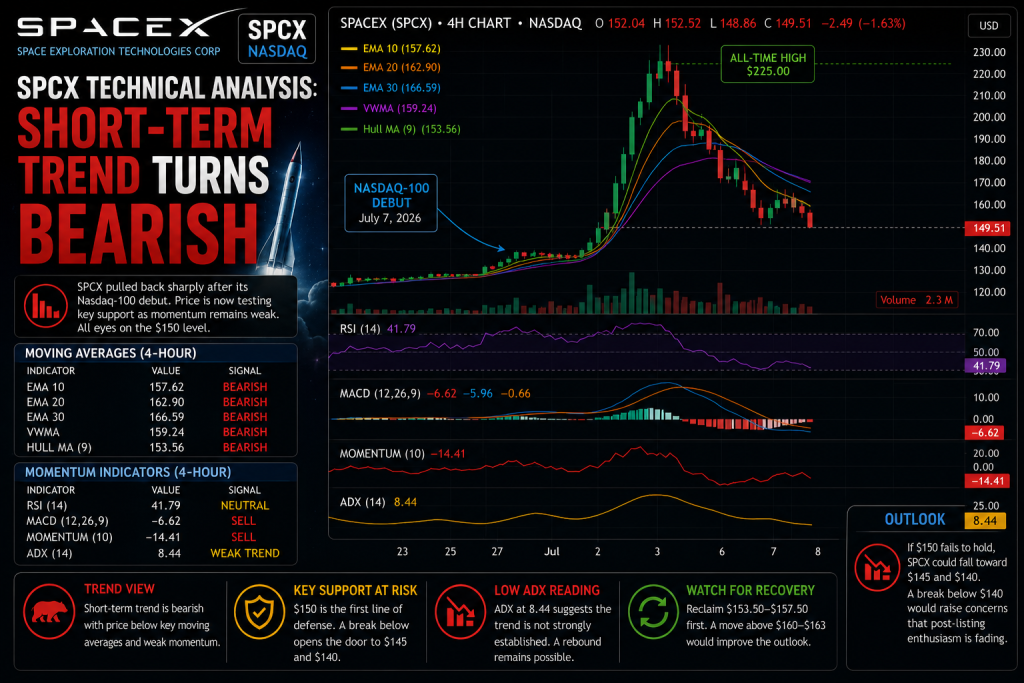
SPCX is trading below the 10 EMA at $157.62, the 20 EMA at $162.90, and the 30 EMA at $166.59. It is also below the VWMA at $159.24 and the Hull Moving Average at $153.56, confirming short-term selling pressure.
Momentum is also negative. MACD shows a sell signal at -6.62, while Momentum is at -14.41. RSI sits at 41.79, still neutral but moving toward weaker territory.
The ADX at 8.44 suggests the current trend is not yet strongly established, which means a rebound remains possible if buyers defend the next support zone.
Key Levels: $150, $145 and $140
The first key level is $150, where SPCX is currently trying to stabilize.
If the stock fails to reclaim that level convincingly, sellers may target $145, followed by $140. A move below $140 would bring the stock close to its IPO pricing zone and could raise concerns that post-listing enthusiasm is fading.
On the upside, buyers need to recover $153.50-$157.50 first. A stronger rebound would require a move back above $160-$163, where short-term moving averages and volume-weighted resistance are clustered.
SpaceX’s Index Inclusion Helps, but SPCX Valuation Is the Test
SpaceX’s Nasdaq-100 entry is a major milestone and creates long-term passive demand. The company also has rare growth narratives across reusable launch, satellite broadband, AI infrastructure, and enterprise AI tools.
However, the stock’s sharp drop shows that investors are no longer rewarding hype alone. With SPCX trading below key 4-hour averages, the market wants evidence that SpaceX can justify one of the largest public-market valuations ever.
For now, $150 is the immediate battleground. If buyers defend it, SPCX could rebound toward $160. If it breaks, the next downside targets sit near $145 and $140.
- Check out our free forex signals
- Follow the top economic events on FX Leaders economic calendar
- Trade better, discover more Forex Trading Strategies
- Open a FREE Trading Account
- Read our latest reviews on: Avatrade, Exness, HFM and XM

Related Articles

Sidebar rates

Related Posts
 Save
Save