Will SK Hynix SKHY Rally After Its $26.5 Billion Nasdaq Debut?
SK Hynix’s $26.5B Nasdaq debut puts HBM demand in focus, but memory-cycle risk keeps ₩2.18M support key.
Quick overview
- SK Hynix is entering the U.S. market with a Nasdaq listing after raising $26.5 billion, providing investors access to the AI memory boom.
- The company's high-bandwidth memory (HBM) leadership positions it as a key player in AI infrastructure, with strong demand from investors despite market volatility.
- The listing aims to broaden SK Hynix's investor base and potentially reduce the valuation gap with competitors like Micron.
- While SK Hynix has strong growth prospects, the memory sector remains cyclical, posing risks if supply catches up with demand.
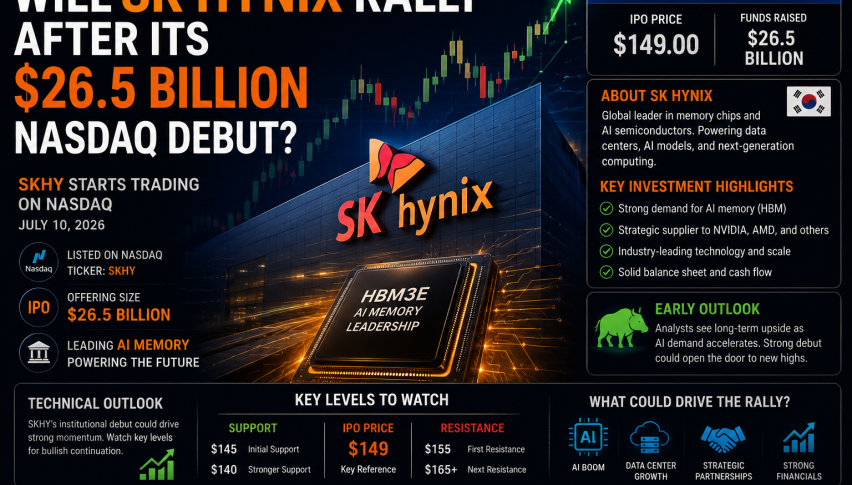
SK Hynix is set to begin trading in the U.S. through Nasdaq-listed ADRs after raising $26.5 billion, giving investors a new way to buy into the AI memory boom while testing whether HBM demand can avoid the old memory-cycle bust.
SK Hynix Enters Nasdaq as AI Memory Demand Explodes
SK Hynix is entering the U.S. market at one of the most important moments in the memory-chip cycle. The company is already a dominant player in high-bandwidth memory, or HBM, but the Nasdaq listing gives U.S. investors easier access to one of the biggest beneficiaries of the global AI infrastructure boom.
$26.5 Billion Listing Becomes a Blockbuster
SK Hynix priced 177.9 million ADRs at $149 each, raising roughly $26.5 billion.
That makes the listing one of the largest share sales in history and one of the biggest U.S. listings ever by a foreign company. Each ADR represents one-tenth of a common share traded in South Korea.
The strong demand shows how aggressively investors are still chasing AI infrastructure exposure, even after recent volatility in memory stocks. Reports indicated the offering was oversubscribed by about 7 times, highlighting institutional appetite for direct exposure to SK Hynix’s HBM leadership.
HBM Leadership Drives the Bull Case
The core reason investors want SK Hynix is simple: AI servers need advanced memory.
High-bandwidth memory sits next to AI accelerators and allows processors to access critical data quickly. That makes HBM essential for Nvidia GPUs and next-generation AI systems.
SK Hynix is widely viewed as the leader in HBM, ahead of Samsung and Micron in key product segments. Nvidia CEO Jensen Huang recently emphasized SK Hynix’s importance, saying the company is expected to remain a major partner as AI memory shortages persist.
That gives SK Hynix pricing power at a time when demand continues to exceed supply.
US Listing Could Narrow the Micron Valuation Gap
One of the strategic goals of the U.S. listing is to broaden SK Hynix’s investor base.
Micron has benefited from easier access to U.S. capital markets, helping it trade at a higher forward earnings multiple despite SK Hynix’s stronger position in HBM. A Nasdaq ADR could help reduce that valuation gap over time.
The fresh capital will also support fabrication facilities, advanced packaging, and next-generation equipment, all critical for scaling HBM production.
Cramer Warns Memory Remains a Rollercoaster
Jim Cramer said SK Hynix looks “remarkably cheap” despite its huge rally, noting that the stock trades at a low earnings multiple compared with its growth.
However, he also warned that memory chips have historically been a boom-and-bust business. When supply eventually catches up with demand, pricing power can disappear quickly.
That is the main risk for SK Hynix. AI demand may have changed the duration of the cycle, but it has not yet proven that the memory industry has permanently escaped cyclicality.
SK Hynix Technical Analysis – Seoul Shares Hold Above Key Support
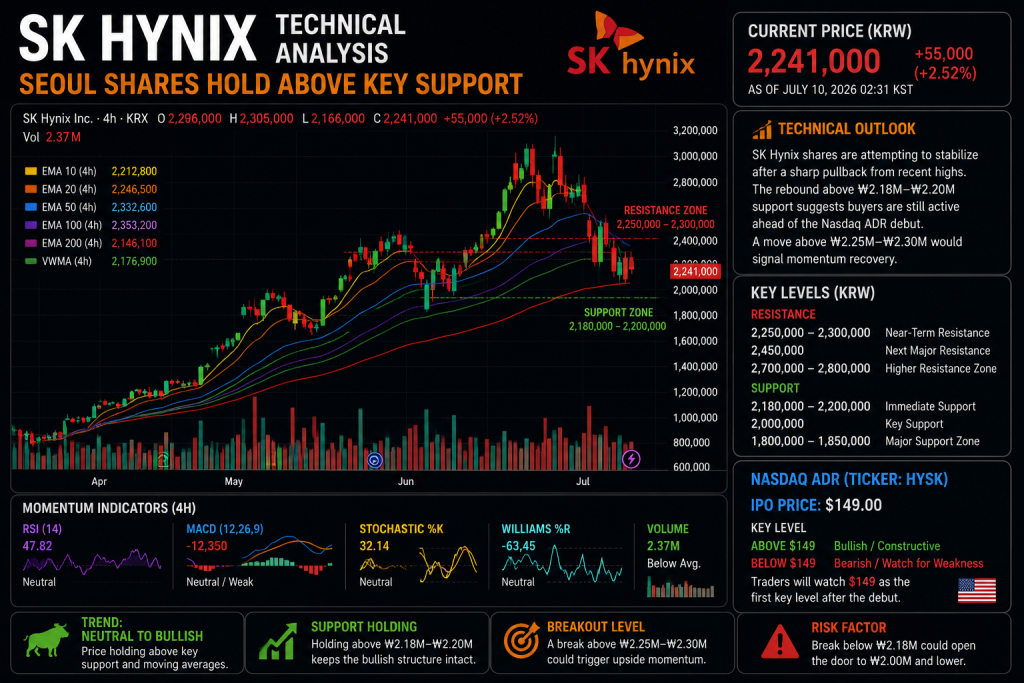
From a technical perspective, SK Hynix’s Korea-listed shares are trying to stabilize after a sharp pullback from recent highs.
The stock recently closed near ₩2,186,000 and later traded around ₩2,241,000, rebounding as investors positioned ahead of the Nasdaq ADR debut. That move suggests buyers are still willing to defend the stock after the recent memory-sector selloff.
Immediate support sits near ₩2,180,000-₩2,200,000. A break below that area could reopen downside toward ₩2,000,000, especially if U.S. trading disappoints or memory stocks weaken again.
On the upside, the first resistance zone is around ₩2,250,000-₩2,300,000. A clean move above that range would suggest the ADR listing is helping restore momentum.
For the Nasdaq ADR, traders will likely watch the $149 IPO price as the first key level. Holding above $149 would be constructive, while a break below it could signal that initial demand was already priced in.
SK Hynix Is an AI Memory Winner, But Cycle Risk Still Matters
SK Hynix has one of the strongest AI memory stories in the market. It dominates HBM, has deep ties to Nvidia, and now has a Nasdaq listing that gives global investors easier access to the stock.
However, the memory sector remains volatile. Recent selling in Samsung, Micron, SanDisk, and SK Hynix shows that investors are increasingly asking whether current profits are sustainable.
For now, the key levels are clear: $149 for SKHY ADRs and ₩2.18 million for the Korea-listed shares. If both hold, SK Hynix could regain momentum. If they break, the Nasdaq debut may become another test of whether the AI memory boom can survive profit-taking.
- Check out our free forex signals
- Follow the top economic events on FX Leaders economic calendar
- Trade better, discover more Forex Trading Strategies
- Open a FREE Trading Account
- Read our latest reviews on: Avatrade, Exness, HFM and XM

Related Articles

Sidebar rates

Related Posts
 Save
SaveAva

