Prices Forecast: Technical Analysis
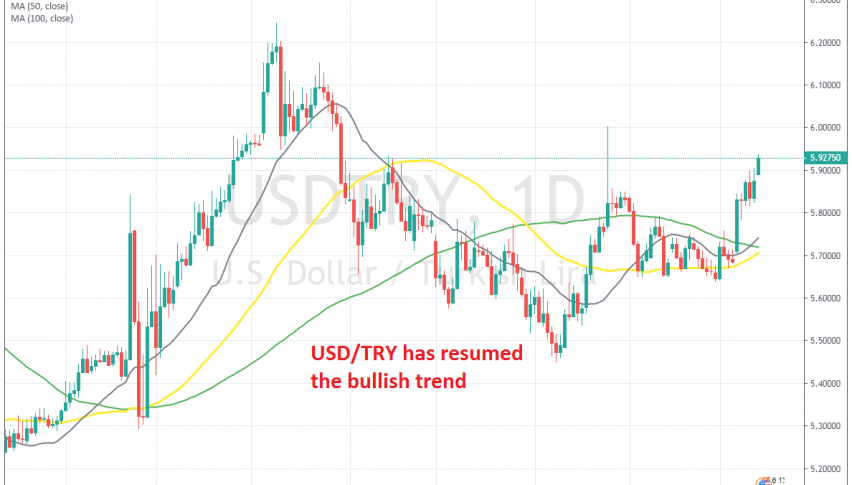
For today, the predicted closing price for USD/TRY is 46.50, with a range of 46.30 to 46.70. Looking ahead to the week, the forecasted closing price is 46.80, with a range of 46.50 to 47.00. The technical indicators suggest a strong bullish trend, as evidenced by the RSI at 93.9988, indicating overbought conditions. The ATR of 0.107 suggests moderate volatility, which could lead to price fluctuations within the predicted range. The ADX at 55.8294 indicates a strong trend, reinforcing the bullish outlook. The price has been consistently closing above the pivot point of 46.28, which is a positive sign for buyers. Resistance levels at 46.62 and 46.80 may act as barriers, while support at 46.11 could provide a safety net for the price. Overall, the combination of high RSI, strong ADX, and favorable price action suggests that traders should look for buying opportunities in the current market.
Fundamental Overview and Analysis
Recently, USD/TRY has shown significant upward momentum, driven by various macroeconomic factors. The Turkish economy is facing inflationary pressures, which have led to increased demand for USD as a safe haven. Additionally, geopolitical tensions and economic policies have contributed to the volatility in the currency pair. Investor sentiment appears bullish, as many are looking to capitalize on the potential for further price increases. However, risks remain, including potential regulatory changes and market volatility that could impact the currency’s value. The current valuation of USD/TRY suggests it may be slightly overvalued, given the high RSI readings. Nevertheless, the ongoing demand for USD amidst economic uncertainty presents opportunities for growth. Traders should remain cautious and monitor economic indicators closely to navigate potential challenges.
Outlook for USD/TRY
The future outlook for USD/TRY remains bullish, with expectations of continued upward movement in the short term. Current market trends indicate strong buying interest, supported by historical price movements that show resilience above key support levels. In the next 1 to 6 months, we anticipate the price could reach levels around 47.00 to 48.00, driven by ongoing inflation concerns and demand for USD. Long-term projections suggest that USD/TRY could stabilize between 48.00 and 50.00 over the next 1 to 5 years, depending on economic recovery and geopolitical developments. External factors such as changes in U.S. monetary policy or significant geopolitical events could also impact the price trajectory. Overall, the market sentiment remains optimistic, but traders should be prepared for potential corrections.
Technical Analysis
Current Price Overview: The current price of USD/TRY is 46.4441, slightly up from the previous close of 46.4311. Over the last 24 hours, the price has shown a bullish trend with moderate volatility, indicating strong buying pressure. Support and Resistance Levels: Key support levels are at 46.11, 45.77, and 45.60, while resistance levels are at 46.62, 46.80, and 47.13. The pivot point is at 46.28, and the asset is currently trading above this level, indicating bullish sentiment. Technical Indicators Analysis: The RSI is at 93.9988, suggesting an overbought condition, which could lead to a price correction. The ATR of 0.107 indicates moderate volatility, while the ADX at 55.8294 shows a strong trend. The 50-day SMA is at 46.1125, and the 200-day EMA is at 44.8948, indicating a bullish crossover. Market Sentiment & Outlook: Sentiment is currently bullish, supported by price action above the pivot, a high RSI, and a strong ADX indicating trend strength.
Forecasting Returns: $1,000 Across Market Conditions
The table below outlines potential investment scenarios for USD/TRY, providing insights into expected returns based on different market conditions.
| Scenario | Price Change | Value After 1 Month |
|---|---|---|
| Bullish Breakout | +10% to ~$51.00 | ~$1,100 |
| Sideways Range | 0% to ~$46.44 | ~$1,000 |
| Bearish Dip | -5% to ~$44.10 | ~$950 |
FAQs
What are the predicted price forecasts for the asset?
The predicted daily closing price for USD/TRY is 46.50, with a range of 46.30 to 46.70. For the weekly forecast, the closing price is expected to be around 46.80, ranging from 46.50 to 47.00.
What are the key support and resistance levels for the asset?
Key support levels for USD/TRY are at 46.11, 45.77, and 45.60. Resistance levels are identified at 46.62, 46.80, and 47.13, with the pivot point at 46.28.
What are the main factors influencing the asset’s price?
The asset’s price is influenced by macroeconomic factors such as inflation rates, geopolitical tensions, and demand for USD as a safe haven. Investor sentiment and regulatory changes also play significant roles.
What is the outlook for the asset in the next 1 to 6 months?
In the next 1 to 6 months, USD/TRY is expected to reach levels around 47.00 to 48.00, driven by ongoing inflation concerns and strong demand for USD. Long-term projections suggest stabilization between 48.00 and 50.00.
What are the risks and challenges facing the asset?
Risks include potential regulatory changes, market volatility, and geopolitical events that could impact the currency’s value. Traders should remain cautious and monitor economic indicators closely.
Disclaimer
In conclusion, while the analysis provides a structured outlook on the asset’s potential price movements, it is essential to remember that financial markets are inherently unpredictable. Conducting thorough research and staying informed about market trends and economic indicators is crucial for making informed investment decisions.
 ABOUT THE AUTHOR
See More
ABOUT THE AUTHOR
See More




 Save
Save