Micron MU Stock Rebounds Off Support but Semiconductor Sector Faces Reality Check and Analyst Scrutiny
A sharp reversal in semiconductor stocks, led by Micron, reflects rising doubt over AI-driven valuations as macro pressures and cautious guidance disrupt the sector’s momentum but today we saw a rebound.
Quick overview
- Semiconductor stocks, particularly Micron, faced a sharp reversal due to rising doubts over AI-driven valuations amid macroeconomic pressures.
- Investors are reassessing risk exposure in the semiconductor sector as concerns about interest rates and geopolitical uncertainty grow.
- Micron Technology experienced significant volatility, with its stock price dropping sharply after reaching record highs, reflecting broader weakness in the industry.
- Despite a strong earnings report, the semiconductor sector remains sensitive to changes in sentiment and structural risks, leading to ongoing volatility.
A sharp reversal in semiconductor stocks, led by Micron, reflects rising doubt over AI-driven valuations as macro pressures and cautious guidance disrupt the sector’s momentum but today we saw a rebound.
Semiconductor Sector Under Analyst Pressure
The semiconductor industry came under intense selling pressure late last week as a combination of disappointing artificial intelligence guidance, renewed interest-rate concerns, and escalating geopolitical uncertainty began to undermine one of the market’s most dominant growth narratives.
Investors who had previously embraced the artificial intelligence trade with aggressive optimism started to reassess risk exposure across the sector. The result was a broad-based pullback affecting major chipmakers, as expectations for uninterrupted AI-driven demand growth began to fade.
Although sentiment briefly improved in today’s session, the rebound appeared fragile and driven more by selective optimism than a meaningful shift in fundamentals.
Micron’s Rally Ends in a Sharp Reversal
Micron Technology experienced one of the most volatile swings in the sector, with its rally collapsing abruptly after reaching record highs near $1,089 earlier in the week.
What initially looked like a continuation of the AI-fueled semiconductor surge quickly reversed into aggressive profit-taking. The stock fell roughly 8% to around $971 before extending losses below $920, erasing a significant portion of recent gains in a short span of trading sessions.
The reversal was not isolated. Broader weakness across semiconductor names, including NVIDIA Corporation, Advanced Micro Devices, and other chipmakers, reinforced concerns that the sector had become overstretched after months of relentless AI enthusiasm.
The sudden shift underscores how sensitive semiconductor valuations have become to even minor changes in sentiment or forward guidance assumptions.
Technical Strength Meets Near-Term Valuation Questions
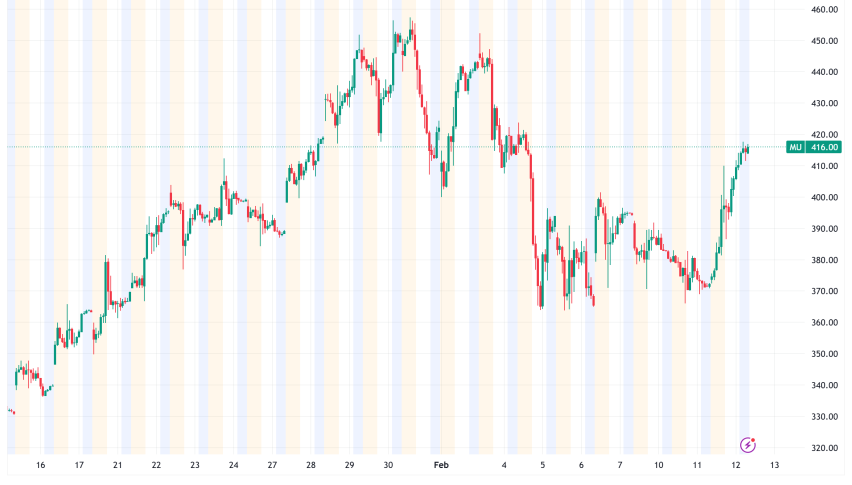
From a technical perspective, Micron’s fall below $311 in March and the quick rebound off the 100 daily SMA (green) was symbolically important. Buyers came back as broader stock market sentiment improved. As a result, we have seen a strong rebound and buyers have pushed MU stock above the $1,000 level this week, reaching $1,089 on Wednesday which is a new high. But we saw a pullback under $1,000 and MU stock slipped to $864, although the 20 SMA held as support again on the daily chart and we saw a rebound on Monday.
MU Chart Daily – Rebounding Off the 20 SMA

Strong Jobs Data Revives Rate Anxiety
Macro conditions added further pressure, as stronger-than-expected U.S. employment data reignited fears of prolonged restrictive monetary policy from the Federal Reserve.
May nonfarm payrolls increased by 172,000, significantly above forecasts, while wage growth remained firm and unemployment stayed low. Although these figures normally signal economic resilience, markets interpreted them as inflationary, reducing the likelihood of near-term interest-rate cuts.
Higher rates pose a particular challenge for high-growth technology sectors. When discount rates remain elevated, future earnings are valued less generously, forcing a reassessment of premium valuations that have underpinned semiconductor stocks throughout the AI boom.
Structural Risks in the Semiconductor Cycle
Beyond short-term catalysts, investors are increasingly focused on structural risks within the semiconductor industry.
The sector’s historical boom-and-bust cycle remains a key concern, particularly as companies expand capacity aggressively during periods of strong demand. While this supports near-term revenue growth, it also raises the risk of future oversupply, weaker pricing power, and margin compression.
For Micron Technology, large-scale investments in memory production capacity represent both opportunity and risk. AI-driven demand for high-bandwidth memory used in data centers remains strong, but any slowdown in infrastructure spending could quickly shift the industry into excess capacity conditions.
At the same time, ongoing export restrictions and geopolitical tensions—particularly between the United States and China—continue to cloud long-term demand visibility and supply chain stability.
AI Narrative Faces Market Reality Check
The recent volatility suggests that the artificial intelligence trade is entering a more skeptical phase. While demand for AI computing infrastructure remains elevated, investors are no longer willing to assume uninterrupted exponential growth without clear evidence.
The combination of stretched valuations, moderating guidance signals, persistent inflation concerns, and geopolitical uncertainty is creating a more fragile market environment for semiconductor equities.
Even though selective optimism—such as optimism around partnerships like those involving NVIDIA Corporation and SK hynix—has offered temporary support, it has not been enough to restore broader confidence.
Ultimately, the sector remains highly sensitive to any deviation from aggressive growth expectations. As a result, volatility is likely to persist, with investors increasingly questioning whether AI-driven valuations have moved ahead of underlying fundamentals.
Micron Technology Earnings Results – Key Takeaways
Strong Earnings Beat
- EPS (adjusted): $12.20 vs. $9.31 expected
- Revenue: $23.86B vs. $20.07B expected
- Significant upside surprise on both top and bottom lines
Explosive Year-on-Year Growth
- Revenue surged from $8.05B a year ago
- Net income jumped to $13.8B (vs. $1.58B prior year)
- EPS increased to $12.07 (vs. $1.41 last year)
- Reflects sharp recovery in memory pricing cycle
Margin Expansion Accelerates
- Gross margin: 74.4% (vs. 36.8% last year)
- Up from 56% in the previous quarter
- Indicates strong pricing power and improved cost efficiency
Segment Performance Highlights
Cloud memory revenue:
- $7.75B (+160% YoY)
Mobile & client segment:
- $7.71B (vs. $2.24B last year)
- One of the strongest growth areas
Forward Guidance Crushes Expectations
- Q3 Revenue forecast: ~$33.5B vs. $24.29B expected
- Q3 EPS (adjusted): ~$19.15 vs. $12.05 expected
- Implies over 200% revenue growth YoY
Capital Expenditure Ramps Up
- FY2026 CapEx raised: $25B (from $20B)
- Further increase expected in FY2027
- Construction-related spending to rise by $10B+
Key Takeaways
- Massive earnings beat driven by memory pricing recovery
- Margins expanding rapidly, showing strong cycle upswing
- Guidance signals continued momentum into next quarter
- Heavy CapEx suggests confidence in long-term demand
Conclusion
- Micron delivered a blowout quarter across all metrics
- Forward outlook significantly exceeds expectations
- However, aggressive spending and cyclical risks remain key factors to monitor
- Check out our free forex signals
- Follow the top economic events on FX Leaders economic calendar
- Trade better, discover more Forex Trading Strategies
- Open a FREE Trading Account
- Read our latest reviews on: Avatrade, Exness, HFM and XM

Related Articles
Sidebar rates

Related Posts
 Save
Save