Apple AAPL Stock Drops Below $300 as WWDC Disappointment and Patent Lawsuit Hit Sentiment
Apple's post-WWDC selloff has intensified as investor disappointment over its AI strategy combines with a new patent lawsuit, raising fresh concerns about the company's growth outlook.
Quick overview
- Apple's stock has declined sharply post-WWDC 2026, falling below the key $300 level due to investor disappointment over its AI strategy and a new patent lawsuit.
- The company's recent announcements were viewed as incremental improvements rather than groundbreaking innovations, leading to concerns about its competitive position in the AI market.
- Despite solid financial results, including a Q2 EPS of $2.01 and strong revenue from services, investor sentiment remains cautious amid rising competition and uncertainty surrounding Apple's future growth.
- The upcoming leadership transition to John Ternus adds pressure for Apple to adopt a more aggressive innovation strategy in response to intensifying competition.
Apple’s post-WWDC selloff has intensified as investor disappointment over its AI strategy combines with a new patent lawsuit, raising fresh concerns about the company’s growth outlook.
Apple’s WWDC Rally Quickly Unravels
Apple’s brief surge to a record high during WWDC 2026 has turned into a sharp decline, with the stock extending its losses below the key $300 level.
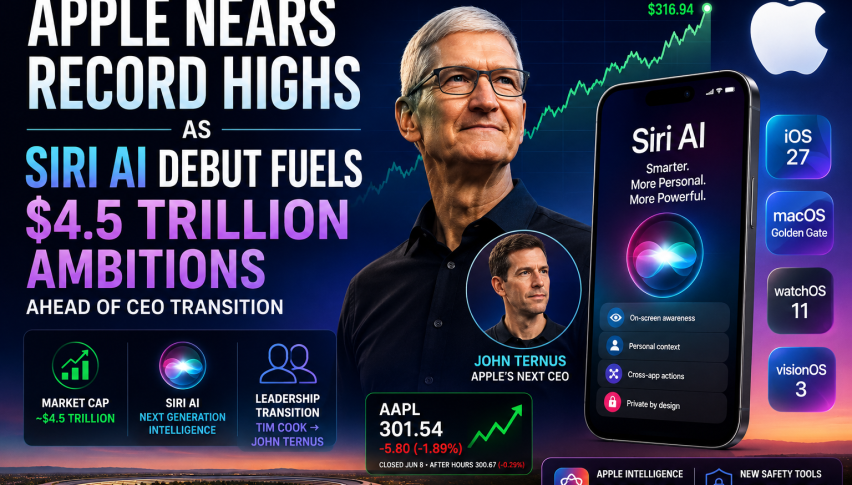
Investor enthusiasm initially pushed shares above $317 after Apple unveiled a series of software upgrades and artificial intelligence features. However, the rally quickly faded as markets concluded the company had failed to deliver the groundbreaking AI announcement many had anticipated.
Selling accelerated throughout the following trading sessions, reflecting growing concerns that Apple remains behind several competitors in the race to commercialize advanced artificial intelligence technologies.
The failure to hold record highs has also weakened the stock’s technical outlook, with the break below $300 damaging short-term investor confidence.
Patent Lawsuit Adds Fresh Uncertainty
Adding to the negative sentiment, Omni MedSci Inc., a Michigan-based medical technology company, has filed a patent infringement lawsuit against Apple.
The complaint, filed in the U.S. District Court for the Western District of Texas, alleges that Apple infringed seven patents covering wearable health monitoring technologies.
According to the lawsuit, Apple copied patented technology used to measure physiological data such as pulse rate, blood flow, and optical sensing in wearable products including the Apple Watch and wireless earbuds.
Although the legal proceedings are in their early stages, the case introduces another uncertainty for investors at a time when Apple is already facing heightened scrutiny over its innovation strategy.
AI Announcements Fail to Inspire Wall Street
This year’s WWDC focused heavily on expanding Apple Intelligence, improving Siri, and introducing new software across Apple’s ecosystem.
The company unveiled iOS 27, the new macOS Golden Gate, additional productivity tools, and a more capable Siri designed to better understand user context, interact across applications, and process visual information.
Apple also showcased refinements to its Liquid Glass interface and further integrated AI-powered features throughout its devices.
Despite these announcements, investors viewed the presentation as evolutionary rather than revolutionary.
Rather than introducing a transformative AI platform capable of reshaping the industry, Apple largely demonstrated enhancements to its existing ecosystem. For many on Wall Street, incremental improvements were not enough to justify the company’s premium valuation.
Growing Perception Apple Is Falling Behind
The muted market reaction highlights a growing concern among investors that Apple is becoming a follower rather than a leader in artificial intelligence.
While rivals continue investing aggressively in generative AI models, cloud infrastructure, and enterprise software, Apple has largely focused on integrating AI into existing products.
Although the company’s enormous installed user base remains one of its greatest competitive strengths, investors are increasingly demanding clearer evidence that Apple can translate that advantage into meaningful AI-driven revenue growth.
Without a breakthrough product or platform, skepticism surrounding Apple’s long-term AI strategy continues to build.
Competition Sends Shares Dipping
Apple reported a better-than-expected fiscal Q2 2026, pushing its stock higher above $300, making a new high after breaking its December 2025 peak of $288. The buying momentum continued throughout May and AAPL stock price reached $317.40 earlier but has slipped to $300 today.
AAPL Chart Weekly – Reversing from All Time Highs

Competition and Leadership Transition Raise Stakes
The pressure comes at an important moment for the company.
WWDC 2026 marked the final developer conference led by Chief Executive Officer Tim Cook, with John Ternus expected to assume leadership in the near future.
The transition increases expectations that Apple will adopt a more aggressive innovation strategy under new leadership, particularly as competition intensifies across both hardware and artificial intelligence.
At the same time, competitors continue applying pressure. Dell Technologies recently introduced a lower-priced XPS 13 laptop aimed directly at education and budget-conscious consumers, increasing competition against Apple’s entry-level MacBook lineup.
Strong Financial Results Overshadowed
Ironically, Apple’s underlying financial performance remains solid.
The company recently reported Mac revenue of $8.40 billion, while its high-margin Services business generated $30.98 billion in revenue. Performance in Greater China also exceeded expectations, easing concerns over weakening international demand.
However, investors are paying less attention to current earnings and more attention to future growth opportunities.
Questions surrounding AI monetization, rising development costs, and intensifying competition have overshadowed otherwise healthy financial results.
Market Wants More Than Incremental Progress
Apple remains one of the world’s strongest technology companies, supported by a loyal customer base, a highly profitable services ecosystem, and exceptional cash generation.
Nevertheless, expectations have changed dramatically. Investors are no longer satisfied with steady software improvements or ecosystem enhancements. Instead, they are demanding transformative AI innovation capable of creating entirely new growth engines.
With the stock now trading below $300, a patent lawsuit introducing additional uncertainty, and concerns growing that Apple is losing ground in the AI race, sentiment has deteriorated rapidly. Until Apple delivers a compelling breakthrough that convinces investors it can compete at the forefront of artificial intelligence, the shares are likely to remain vulnerable to further bouts of selling despite the company’s fundamentally strong business.
📉 Margins Stay Strong, but Risks Remain
Gross margins came in at 49.27%, exceeding expectations despite rising manufacturing and component costs. Premium pricing strategies, particularly across higher-end Pro devices, helped offset inflationary pressures.
Still, while Apple’s momentum remains strong, valuation levels, supply chain dependence, and execution risks tied to future product cycles may continue to create volatility even as the broader long-term trend stays positive. The company also boosted its quarterly dividend from $0.26 to $0.27 per share, reinforcing Apple’s reputation for consistent shareholder returns despite broader market volatility.
Apple Earnings Report
- Apple Q2 EPS $2.01 vs est. $1.95;
- revenue $111.2B vs est. $109.5B.
- iPhone $57.0B misses on supply;
- Mac $8.4B beats;
- Services $30.98B beats.
- China $20.5B. $100B buyback.
Summary:
- Apple reported Q2 fiscal 2026 EPS of $2.01, beating the $1.95 consensus, on revenue of $111.2 billion against estimates of $109.45-109.66 billion
- Net income came in at $29.6 billion versus the $28.5 billion expectation; operating income was $35.9 billion against a $34.8 billion estimate
- iPhone revenue of $56.99 billion came in marginally below estimates of $57.21 billion; CEO Tim Cook attributed the shortfall to supply constraints on advanced processor chips rather than weak demand
- Mac revenue of $8.40 billion beat the $8.02 billion estimate, boosted by the new $500 MacBook Neo, which targets the lower-priced laptop market currently dominated by Chromebooks
- Services revenue reached $30.98 billion, ahead of the $30.39 billion estimate, with the App Store continuing to generate robust income despite ongoing regulatory scrutiny in Europe
- Greater China net sales of $20.50 billion significantly outpaced estimates of $19.45 billion, a notable beat given the competitive and geopolitical pressures in that market
- iPad net sales were $6.91 billion versus $6.66 billion estimated; Wearables, Home and Accessories were $7.90 billion versus $7.70 billion estimated
- Gross margins were 49.27%, above the 48.38% consensus, reflecting Apple’s pricing discipline and product mix
- The board authorised an additional $100 billion share buyback, consistent with the prior year’s programme
- Incoming CEO John Ternus, who takes over from Cook in September, is expected to speak on the earnings call; investors are focused on Siri and AI strategy ahead of the June developer conference
- Check out our free forex signals
- Follow the top economic events on FX Leaders economic calendar
- Trade better, discover more Forex Trading Strategies
- Open a FREE Trading Account
- Read our latest reviews on: Avatrade, Exness, HFM and XM

Related Articles

Sidebar rates

Related Posts
 Save
Save