SpaceX IPO Raises Record $75 Billion, Valuation Hits $2.1 Trillion
Today, June 12, 2026, is a date that will appear in finance textbooks. SpaceX started trading on Nasdaq. SpaceX's IPO was valued at $135...
Quick overview
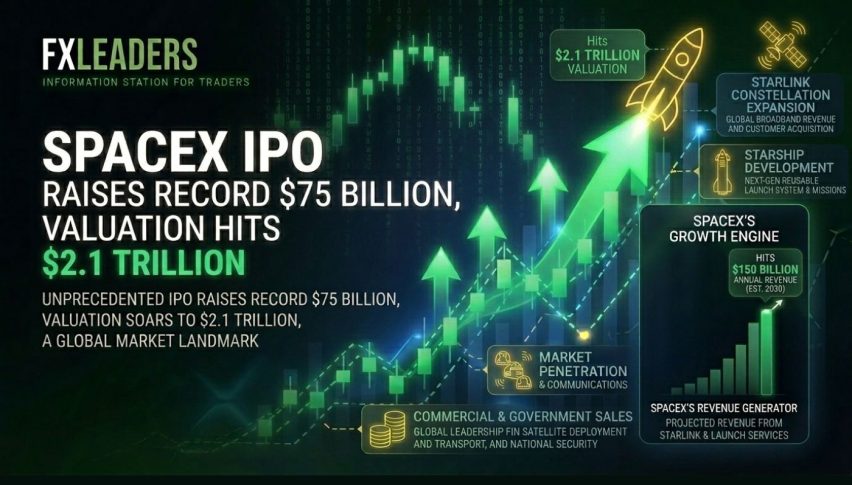
- SpaceX's IPO on June 12, 2026, raised $75 billion at a valuation of $2.1 trillion, making it the 7th largest company in America.
- The IPO was significantly oversubscribed with orders totaling $150 billion against $75 billion in shares offered.
- Investors should be cautious as SpaceX operates in three distinct business segments, each with different financial dynamics and risks.
- Musk's substantial voting power raises governance concerns, prompting some institutional investors to blacklist the stock.
Today, June 12, 2026, is a date that will appear in finance textbooks. SpaceX started trading on Nasdaq.
$SPCX. Now trading on Nasdaq. pic.twitter.com/2IRWdeSFpM
— Nasdaq (@Nasdaq) June 12, 2026
SpaceX’s IPO was valued at $135 per share and raised $75 billion, more than twice the amount raised by Saudi Aramco in 2019 with a $29 billion IPO, and nearly a quarter more than Alibaba’s $22 billion IPO in 2014. The total value of SpaceX at $2.1 trillion made it the 7th largest company in America and made Musk the World’s first trillionaire.
The demand figures are incredible. Orders for SPCX totaled $150 billion with only $75 billion worth of shares offered — a ratio that was roughly 400% oversubscribed. Musk had long refused to list the company publically, preferring to let it grow in private. It was the combination of two factors that convinced him to finally think, “All right, let’s do it for real”: the profitable milestone that Starlink had reached, and the need to currency-ize equity for the xAI deal, which was completed in February 2026 as an all-stock transaction.
One IPO. Two companies. Three totally different financial business segments, and that’s where the investor thesis lives or dies.
The IPO Opening
Shares opened at $150.00 to $176.52 and are trading at $160.77, 19% above its IPO price. Meanwhile, pre-IPO crypto perpetual futures trading on Hyperliquid had priced SPCX around $176, which represented a 30% premium over the offer price, while 24-hour derivatives trading volume hit $322.5 million and open interest came in at $293 million, a volume of crypto price discovery never seen before in a traditional IPO. The $175-$176 range is now the initial key resistance level to keep an eye on.
Three Businesses, One Ticker — Know What You’re Actually Buying
This is NOT a one thesis stock! The S-1 lists three business segments with very different unit economics: Space (rockets), Connectivity (Starlink), and AI (xAI + X). The worst thing a new SPCX investor can do is to combine them.
Starlink is essentially funding xAI’s capital expenses. In 2024, SpaceX achieved a net income of $791 million (GAAP). After the xAI merger, it posted a $4.94 billion net loss for 2025, and a $4.28 billion GAAP loss in Q1 2026 alone. The accumulated deficit is now $41.3 billion. It’s not secret, it’s in the S-1, and is being priced in the market as an optionality on the AI, not the current P&L. Total long-term debt at the end of March 2026 was $29.1 billion.
But Starlink’s trajectory is what keeps the bull thesis alive. Currently, there are 9,600+ satellites in orbit providing data services to 164 countries with 10.3 million subscribers up 50% from 5 million a year ago. Bloomberg and Quilty Space analysts forecast Starlink revenue will be between $15 and $24 billion by the end of 2026. SPCX is valued at $2.1 trillion, just about 96 times 2025 revenue, an indicator of its ability to execute flawlessly in all three areas until 2030. The single number that all investors should be tracking: Starlink ARPU dropped from $99/month in 2023 to $66 in Q1 2026 as SpaceX’s focus shifts to lower income global markets. Subscriber growth is ahead of price erosion right now, but if that dynamic reversed, the valuation picture would materially alter.
Post IPO Sector Reaction
The initial listing of SpaceX changes the dynamics of capital flows in the space industry. Those who built up listed space names as public proxies for private SpaceX exposure are now making a straight switch into SPCX — and the carnage of the smaller names today is a mirror image of that. Virgin Galactic down 24%, Intuitive Machines -15%, Redwire -14%, Rocket Lab -7.7%. The proxy trade is being unwound.
When SpaceX does come into the S&P 500, adding it on the $2.1 trillion value would account for about 3% of the index, which would need significant index selling elsewhere to cover the purchases. What makes the next 30 days structurally different from any typical post-IPO drift is the mechanical demand story. Index funds aren’t value buyers. The purchases are made as a necessity.
Governance Risk – A Red Flag
Musk has 85.1% of all voting power, even though he owns about 42% of the stock, using Class B shares which have a vote count of 10. He serves as the CEO, CTO and Board Chairman, and the S-1 states he can only be removed through his own consent. Public Class A shareholders own economic exposure but zero governance influence. Denmark’s $25 billion pension fund AkademikerPension already has SPCX blacklisted, describing it as “catastrophic governance” and the valuation as “grossly overvalued. Other large institutional funds have flagged the xAI merger as potential self-dealing: Musk sold his own private AI company to SpaceX in an all-stock deal he personally approved.
Summary for Investors
Investors have to be aware whether they’re buying a business or a founder bet. The two are not the same thing, and at $2.1 trillion, the margin for governance error is zero. SpaceX generated $5.9 billion from the US government in 2025 and any deterioration in Musk’s relationship with Washington becomes a direct earnings risk.
There’s a playbook for every type of investor.
Short-term traders should wait for that initial pop to fade and then enter the $145-$150 range and hard stop below $132.
Long-term investors getting in today are paying the retail premium, and the November earnings report will be the first real fundamental anchor for the stock’s intrinsic value.
Until then, the valuation is more driven by index mechanics, retail enthusiasm, and Starlink data points rather than traditional valuation. The most important thing to monitor is the ARPU in Q2 print. That one number will provide a clue whether the Starlink growth narrative is still on track or going sideways.
The investor’s job today is to decide which version of SpaceX they believe in, and size their position accordingly.
- Check out our free forex signals
- Follow the top economic events on FX Leaders economic calendar
- Trade better, discover more Forex Trading Strategies
- Open a FREE Trading Account
- Read our latest reviews on: Avatrade, Exness, HFM and XM

Related Articles
Sidebar rates

Related Posts
 Save
Save