Microsoft Faces AI Spending Scrutiny as Azure Growth Slows, Yet Analysts See Up to 70% Upside
MSFT stock: Microsoft battles AI spending concerns and Azure slowdown as Wall Street remains bullish on its long-term AI leadership.
Written by:
Arslan Butt•Tuesday, June 16, 2026•4 min read
•Last updated: Tuesday, June 16, 2026
Quick overview
Microsoft is a leading player in the AI sector, but investors are concerned about the timeline for returns on its significant investments.
Despite strong fundamentals and a 39% year-over-year growth in Azure, the stock has faced pressure due to rising capital expenditures and slowing growth.
GitHub is experiencing rapid growth driven by AI-assisted coding, but infrastructure challenges have arisen as demand increases.
Analysts remain optimistic about Microsoft's long-term prospects, viewing current stock weakness as a temporary valuation reset rather than a decline in business fundamentals.
Microsoft (NASDAQ: MSFT) remains one of the most influential companies in the artificial intelligence race, yet investors continue to wrestle with a critical question: how long will it take for massive AI investments to translate into accelerating earnings growth?
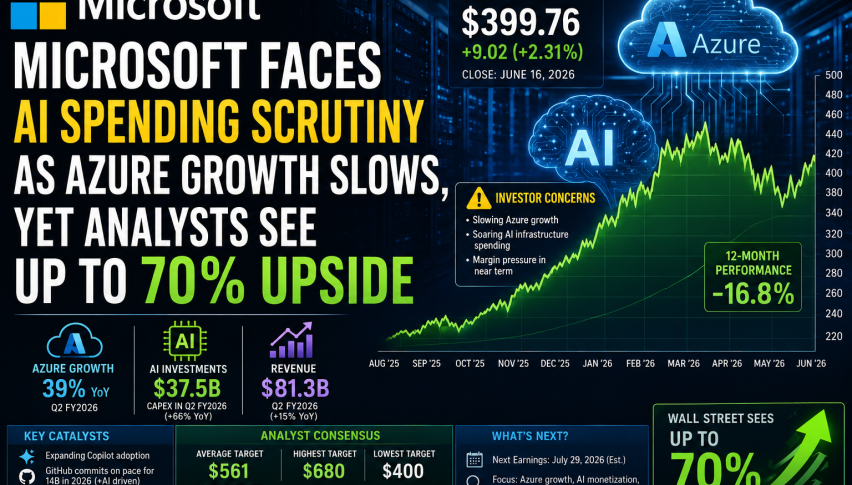
Shares closed at $399.76 on June 16, up 2.31% on the day. While the stock has recovered from its early-2026 lows, it remains well below its long-term highs and continues trading beneath most major moving averages.
The disconnect highlights the market’s current dilemma. Microsoft’s fundamentals remain strong, Azure continues to grow at one of the fastest rates among hyperscale cloud providers, and its AI ecosystem is expanding rapidly. At the same time, surging capital expenditures and slowing cloud growth have raised concerns about near-term profitability.
AI Spending Remains the Center of the Microsoft Story
Microsoft has become one of the largest investors in artificial intelligence infrastructure globally.
The company continues pouring billions into:
Azure AI infrastructure
Data center expansion
Copilot services
OpenAI partnerships
Enterprise AI applications
That strategy has strengthened Microsoft’s position as a leading AI platform provider but has also increased investor scrutiny.
During fiscal Q2 2026, Microsoft reported approximately $37.5 billion in capital expenditures, up nearly 66% year-over-year and significantly above analyst expectations.
The spending surge contributed to a sharp selloff earlier this year when investors questioned the pace of return on those investments.
Azure Growth Remains Strong but Is Slowing
The primary concern remains Azure.
Microsoft reported:
Fiscal Q2 Highlights
Metric
Result
Revenue
$81.3 Billion
Azure Growth
39% YoY
Prior Quarter Azure Growth
40% YoY
Capital Expenditures
$37.5 Billion
Adjusted EPS
$4.14
While 39% cloud growth remains exceptional by most standards, investors focused on the slight deceleration and management’s guidance for continued elevated spending.
The result was Microsoft’s largest one-day stock decline in nearly six years following earnings.
Since then, sentiment has gradually improved as investors refocus on Microsoft’s long-term AI opportunity.
GitHub’s Growth Is Becoming a Major AI Catalyst
One of the clearest examples of AI adoption is occurring within Microsoft’s GitHub ecosystem.
According to recent reports, GitHub is experiencing unprecedented growth in developer activity due to AI-assisted coding.
Management indicated that GitHub commits are on pace to reach:
14 billion commits in 2026
Versus roughly 1 billion commits in 2025
The explosive increase reflects growing adoption of AI-powered software development tools.
Ironically, the success has created infrastructure challenges.
Reports indicate Microsoft is temporarily utilizing infrastructure from Amazon Web Services to support GitHub workloads while continuing its longer-term migration toward Microsoft Azure.
The move highlights both the scale of AI demand and the capacity constraints affecting even the largest cloud providers.
Shareholder Lawsuit Adds Near-Term Headline Risk for MSFT Stock
Microsoft also faces a newly filed shareholder lawsuit.
Investors allege the company failed to adequately disclose:
Slowing Azure growth
Rising AI infrastructure costs
Resource allocation toward AI projects
The lawsuit follows the approximately $357 billion market-cap decline that occurred after Microsoft’s January earnings release.
Microsoft has strongly rejected the claims and stated it intends to vigorously defend itself.
While the case adds near-term uncertainty, investors have historically focused more on Microsoft’s operating performance than litigation headlines.
Analysts Remain Overwhelmingly Bullish on Microsoft Stock
Despite concerns surrounding spending and margins, Wall Street remains constructive.
Current analyst estimates suggest:
Analyst Outlook
Metric
Estimate
Consensus Target
$561-$570
Upside Potential
~40%-45%
Highest Target
$680
Lowest Target
$400
Many analysts continue viewing Microsoft’s weakness as a temporary valuation reset rather than a deterioration in business fundamentals.
The investment thesis remains centered on Microsoft’s ability to monetize AI across Azure, Copilot, Office, GitHub, Dynamics, and enterprise software.
How to trade Microsoft stock today
MSFT Technical Analysis: Long-Term Repair Process Continues
Microsoft (MSFT) is in a stabilization and recovery phase rather than a confirmed uptrend. While the early-2026 decline has paused, the broader trend structure remains technically challenged.
Moving Average Structure
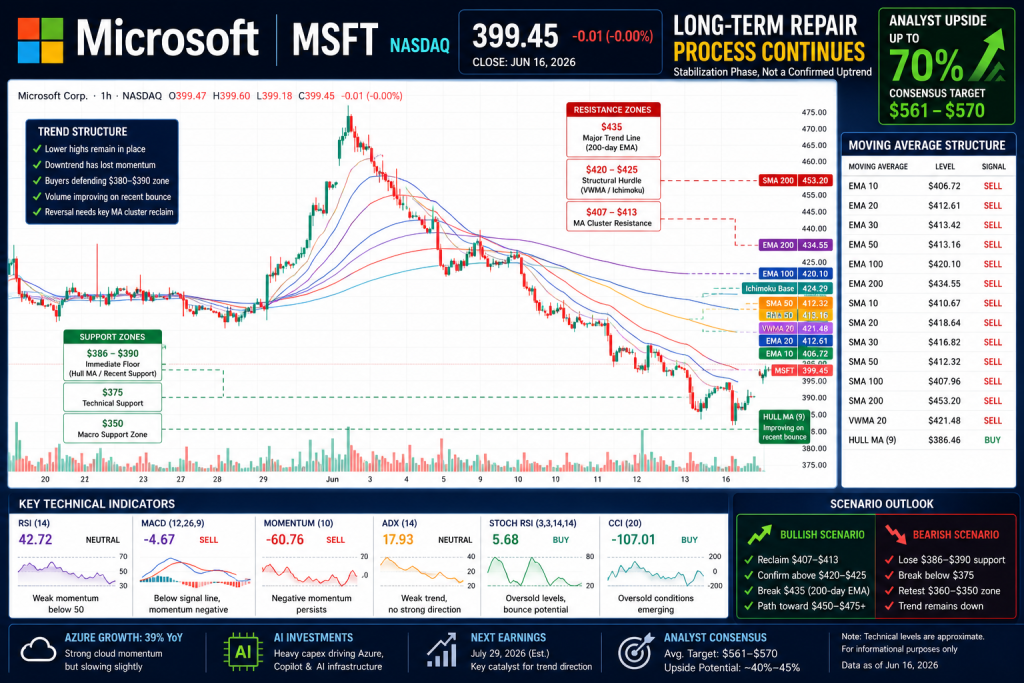
EMA 10 / 20 / 30 / 50 / 100 / 200 & VWMA 20 (All Sell): MSFT trades below nearly all major moving averages, confirming that a long-term trend repair is still incomplete.
Distance from Averages: The stock sits roughly 2% below its 10-day EMA, 7% below its 100-day EMA, and 8% below its 200-day EMA, highlighting ongoing overhead resistance.
Lone Bright Spot: The Hull MA ($386.46) is the only active buy signal, acting as short-term structural support.
Key Technical Indicators
RSI at 42.72 & MACD at -4.67 (Weak Momentum): The sub-50 RSI and negative MACD reflect persistent bearish momentum, though it is beginning to flatten.
ADX at 17.93 (Weak Trend): A reading below 20 confirms the absence of a strong directional trend, pointing toward a base-building phase rather than a breakdown.
Stochastic RSI (5.68) & CCI (-107.01) (Oversold): Highly compressed readings suggest deeply oversold short-term conditions, signaling a potential near-term rebound.
Trend Structure & Volume
Base Formation: Price action shows a pattern of lower highs from previous peaks, but downside momentum is stabilizing as buyers actively defend the $380–$390 region on improved volume.
Reversal Prerequisite: The macro trend remains down until MSFT cleanly reclaims and converts key moving-average clusters into support.
Support & Resistance Levels
Resistance Zones
Moving Average Cluster ($407 – $413): Dense short-term overhead supply that must be cleared first.
Structural Hurdle ($420 – $425): Anchored by VWMA and Ichimoku resistance.
Major Trend Line ($435): The critical 200-day EMA; crossing this shifts the macro outlook back to bullish.
Support Zones
Immediate Floor ($386 – $390): Anchored by recent horizontal support and the Hull Moving Average.
Technical Support ($375): A secondary layer of defense against renewed selling pressure.
Macro Support Zone ($350): The ultimate long-term structural floor.
Is Microsoft a Good Stock to Buy and Hold Long-Term?
Microsoft’s long-term investment thesis remains among the strongest in large-cap technology.
The key question is not whether Microsoft can compete in AI.
The question is how quickly its enormous infrastructure investments translate into accelerating earnings and free cash flow growth.
What Should MSFT Traders Watch Next?
Microsoft remains one of the most important AI companies in the world, but investors are demanding evidence that its massive spending commitments will generate attractive returns. Azure continues growing at nearly 40%, GitHub activity is exploding due to AI-assisted coding, and Copilot adoption remains a major long-term opportunity.
Technically, however, the stock remains in a repair phase. Microsoft trades below all major moving averages, MACD remains negative, and momentum indicators have yet to confirm a sustained breakout. At the same time, oversold readings and improving sentiment suggest downside pressure may be easing.
For long-term investors, Microsoft remains a high-conviction AI and cloud infrastructure story. The next major catalyst will likely arrive with the company’s late-July earnings report, where investors will focus closely on Azure growth, AI monetization, and the trajectory of capital spending.
Lead Markets Analyst – Multi-Asset (FX, Commodities, Crypto)
Arslan Butt serves as the Lead Commodities and Indices Analyst, bringing a wealth of expertise to the field. With an MBA in Behavioral Finance and active progress towards a Ph.D., Arslan possesses a deep understanding of market dynamics.
His professional journey includes a significant role as a senior analyst at a leading brokerage firm, complementing his extensive experience as a market analyst and day trader. Adept in educating others, Arslan has a commendable track record as an instructor and public speaker.
His incisive analyses, particularly within the realms of cryptocurrency and forex markets, are showcased across esteemed financial publications such as ForexCrunch, InsideBitcoins, and EconomyWatch, solidifying his reputation in the financial community.




 Save
Save