Rivian Slides 4.5% as Cost Cuts Overshadow R2 Launch, But Technical Setup Holds Key Support
Rivian (RIVN) stock falls 4.5% as Rivian layoffs raise profitability concerns, while R2 launch keeps long-term EV turnaround hopes alive.
Quick overview
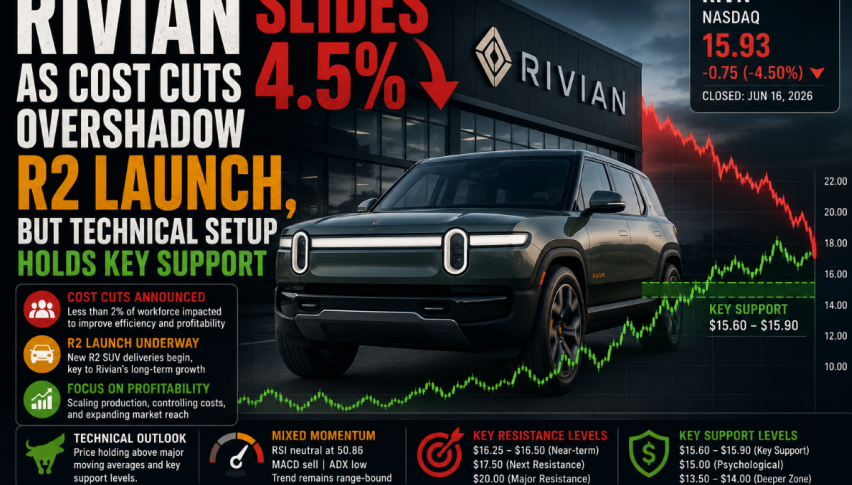
- Rivian shares dropped 4.5% to $15.93 following another round of layoffs aimed at reducing costs and improving profitability.
- The layoffs affect less than 2% of Rivian's workforce and come shortly after the launch of the R2 SUV, which is crucial for the company's growth strategy.
- Despite efforts to cut expenses, Rivian continues to face significant losses and challenges in the EV market, including the removal of key U.S. incentives.
- The success of the R2 SUV launch is seen as a potential catalyst for Rivian's long-term profitability, but investors are cautious about the company's execution capabilities.
Rivian shares fell 4.5% to $15.93 on June 16 after the electric vehicle maker announced another round of layoffs as part of its push to reduce costs and move closer to profitability.
The cuts affect less than 2% of Rivian’s workforce across service, customer, sales, and marketing teams. The move comes just days after the company began deliveries of its highly anticipated R2 SUV, a lower-priced model that investors view as critical to Rivian’s long-term growth strategy.
The market reaction shows the tension surrounding Rivian’s investment case. The company is cutting expenses, but it still faces heavy losses, softer EV demand, and a tougher policy backdrop after the removal of key U.S. EV incentives.
Rivian’s Profitability Push Intensifies
Rivian employed about 15,232 people at the end of last year. The latest layoffs follow a larger October restructuring, when the company cut more than 600 jobs, or roughly 4.5% of its workforce.
Management said the latest restructuring is aimed at improving efficiency as Rivian scales production more profitably.
Key pressure points remain clear:
- Rivian lost $3.6 billion last year.
- The company delivered 42,247 vehicles.
- Its automotive segment lost about $6,000 per vehicle in Q1.
- Rivian has never posted an annual profit.
- The company no longer expects to meet its 2027 adjusted core profit target.
The R2 SUV is central to changing that story. It gives Rivian a chance to move beyond premium EV buyers and compete in a broader market.
R2 Launch Is the Long-Term Catalyst
The R2 marks Rivian’s most important product launch since its IPO.
The SUV is expected to help the company:
- Expand its addressable market
- Improve manufacturing scale
- Lower unit costs
- Strengthen brand relevance
- Compete more directly with Tesla and mainstream EV brands
Rivian also announced a partnership with ChargeScape, allowing its EV batteries to participate in utility-managed charging programs. That could help customers reduce charging costs while supporting grid stability.
Still, the near-term challenge is execution. Investors want evidence that R2 can scale without deepening losses.
Technical Analysis: RIVN Remains Range-Bound
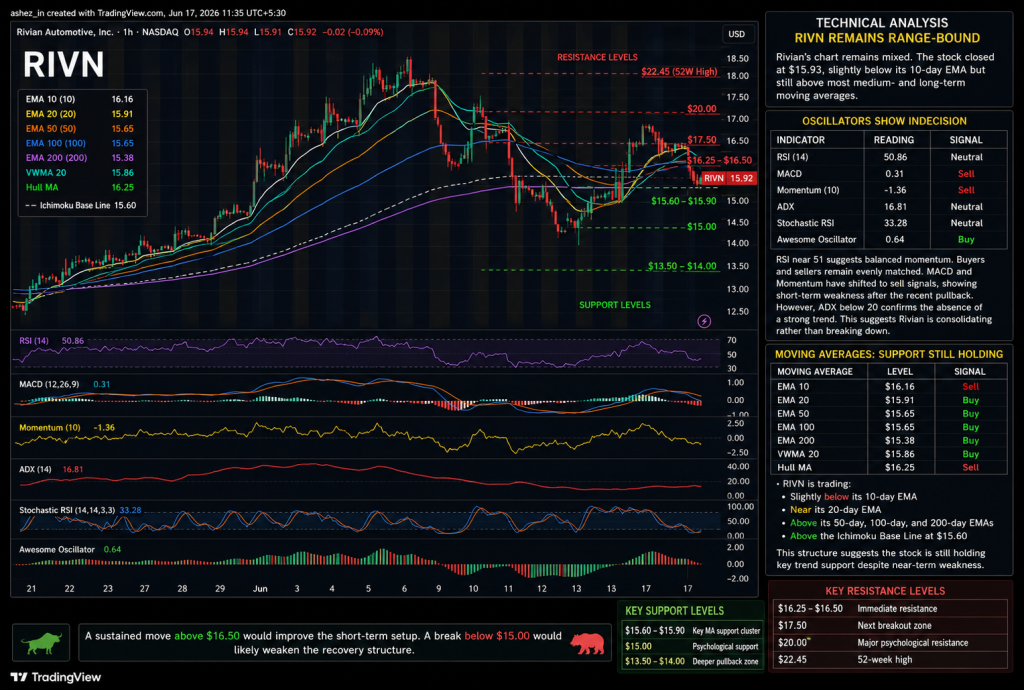
From a technical perspective, Rivian’s chart remains mixed.
The stock closed at $15.93, slightly below its 10-day EMA but still above most medium- and long-term moving averages.
Oscillators Show Indecision
| Indicator | Reading | Signal |
|---|---|---|
| RSI (14) | 50.86 | Neutral |
| MACD | 0.31 | Sell |
| Momentum (10) | -1.36 | Sell |
| ADX | 16.81 | Neutral |
| Stochastic RSI | 33.28 | Neutral |
| Awesome Oscillator | 0.64 | Buy |
RSI near 51 suggests balanced momentum. Buyers and sellers remain evenly matched.
MACD and Momentum have shifted to sell signals, showing short-term weakness after the recent pullback. However, ADX below 20 confirms the absence of a strong trend.
This suggests Rivian is consolidating rather than breaking down.
Moving Averages: Support Still Holding
Rivian’s moving-average structure is more constructive than its daily decline suggests. RIVN is trading:
- Slightly below its 10-day EMA
- Near its 20-day EMA
- Above its 50-day, 100-day, and 200-day EMAs
- Above the Ichimoku Base Line at $15.60
This structure suggests the stock is still holding key trend support despite near-term weakness.
Key Support and Resistance Levels
Resistance Levels
- $16.25-$16.50: Immediate short-term resistance
- $17.50: Next breakout zone
- $20.00: Major psychological resistance
- $22.45: 52-week high
Support Levels
- $15.60-$15.90: Key moving-average support cluster
- $15.00: Psychological support
- $13.50-$14.00: Deeper pullback zone
A sustained move above $16.50 would improve the short-term setup. A break below $15.00 would likely weaken the recovery structure.
Is Rivian a Good EV Stock to Buy in 2026?
Rivian remains a high-risk EV turnaround story.
The bull case depends on successful R2 scaling, cost discipline, improving gross margins, and stronger production efficiency.
The bear case is equally clear: persistent losses, weakening EV incentives, rising competition, and the need for more capital could pressure the stock.
For now, Rivian’s long-term story depends less on demand excitement and more on execution. Investors need proof that the company can build vehicles at scale without destroying cash.
What Should RIVN Traders Watch Next
Rivian’s latest layoffs show management is serious about reducing costs, but the stock’s decline reflects investor concern that profitability remains far away.
Technically, RIVN is not broken. It remains above major medium- and long-term moving averages, with support clustered around $15.60-$15.90. But momentum is fragile, and the stock needs to reclaim $16.50 to rebuild confidence.
The R2 launch gives Rivian a credible long-term catalyst. The next test is whether that catalyst can translate into margin improvement, stronger deliveries, and a clearer path to profitability.
- Check out our free forex signals
- Follow the top economic events on FX Leaders economic calendar
- Trade better, discover more Forex Trading Strategies
- Open a FREE Trading Account
- Read our latest reviews on: Avatrade, Exness, HFM and XM

Related Articles
Sidebar rates

Related Posts
 Save
Save