Crypto Guide: Best Cryptocurrencies to Invest in 2026

The best cryptocurrencies to invest in during 2026 are Bitcoin, Ethereum, Solana, Cardano, Polygon and Polkadot. Bitcoin remains the safest long-term investment, Ethereum dominates smart contracts, while Solana offers higher growth potential with greater risk. The best choice depends on your investment goals and risk tolerance.
What is the safest cryptocurrency?
Bitcoin remains the safest cryptocurrency because of its adoption, fixed supply and institutional ownership.
Which crypto has the highest growth potential?
Ethereum and Solana currently offer stronger ecosystem growth than most large-cap cryptocurrencies, although they also carry higher volatility.
Best Cryptocurrencies to Invest comparison
| Coin | What It Does | Price (June 2026) | Market Cap Rank | Staking/Yield | Risk Level |
| Bitcoin (BTC) | Digital gold. Store of value. | ~$65,000 | #1 | None | Low |
| Ethereum (ETH) | Smart contract platform. DeFi backbone. | ~$3,500 | #2 | 3-4% APY staking | Low-Medium |
| Solana (SOL) | Fast blockchain. High throughput. | ~$180 | #5 | ~8% APY staking | Medium |
| Cardano (ADA) | Peer-reviewed blockchain. Academic approach. | ~$1.20 | #7 | 3.5-5% APY staking | Medium |
Best Cryptocurrencies to Invest overview
- Bitcoin – is still the strongest long-term store-of-value crypto.
- Ethereum – remains the leading smart contract and DeFi network.
- Solana – offers speed and low fees, but with higher technical and centralization risk.
- Cardano – is slower-moving but appeals to investors who value security and research.
1. Bitcoin (BTC): The Safe Boring Choice
Bitcoin is the original. The one everyone knows. It’s boring. It’s also the safest crypto bet. Here’s why. Bitcoin does one thing: store value. It’s digital gold. People understand that. Institutions buy it. Governments can’t kill it because there’s no central server to shut down. In 2026, Bitcoin isn’t exciting anymore. It’s just… reliable. You buy it. It sits there. It does what it did in 2024. That’s not thrilling. But it’s honest.

Why People Actually Buy Bitcoin
- Oldest cryptocurrency. Proven for 17 years. Harder to argue against something that old.
- Institutions own it now. Micro Strategy, BlackRock, Grayscale. Not random retail buyers. Real money.
- Limited supply. 21 million coins. Ever. Once they’re gone, no more printing. That matters.
- It’s digital gold. Inflation hedge. When dollars get weird, people remember Bitcoin.
- Easy to understand. Even your grandmother gets “digital money that can’t be printed.
Why Bitcoin Might Disappoint You
- No new features. Bitcoin hasn’t evolved much. Transaction speed is still slow.
- Price volatility. You could be down 30% in a month. Sleep okay with that?
- Mining uses power. People care about that. Regulations might get tighter.
- Low yield. Bitcoin doesn’t stake or earn rewards. Just sits there. If you want passive income, Bitcoin isn’t it.
- Regulatory risk. Governments understand Bitcoin now. Could crack down. Probably won’t, but could.
2. Ethereum (ETH): The Infrastructure Play
Ethereum is different from Bitcoin. Bitcoin is money. Ethereum is a computer network that runs on a blockchain.
Think of it like this. Bitcoin is cash. Ethereum is the internet. Cash doesn’t need the internet to be valuable.
But the internet? The internet created entirely new industries.
In 2026, Ethereum is staking, DeFi, NFTs, and thousands of projects building on top of it. That’s why it matters.

Why Ethereum Wins
- Smart contracts. Code that runs automatically when conditions are met. Enables everything else.
- Staking rewards. Lock your ETH, earn 3-4% per year. Not amazing but passive.
- Layer 2s. Arbitrum, Optimism, Base. These take load off main chain. Transaction fees plummeted.
- Institutional adoption. Grayscale, Coinbase, exchanges. Institutional products exist.
- Most developers build here. Not because it’s best. Because everyone else is. Network effects.
- DeFi ecosystem is huge. Uniswap, Aave, Curve. Real value flowing through it.
Where Ethereum Struggles
- Still congested. Main chain fees can spike. Layer 2s help but aren’t default yet.
- Competition. Solana, Cardano, Polkadot offer similar features. Ethereum’s advantage is brand + network, not technology.
- Regulatory uncertainty. If governments regulate tokens strictly, Ethereum’s staking might get classified as securities. Unlikely but possible.
- Founder risk. Vitalik is benevolent dictator. If Ethereum governance decentralizes wrong, could be messy.
- ETH not deflationary like Bitcoin. More ETH gets created with staking rewards. Supply pressure exists.
3. Solana (SOL): The Speed Gamble
Solana’s whole thing is speed. Other blockchains process transactions slowly. Solana processes thousands per second.
Sounds great. But speed comes with tradeoffs. More centralized. More outages. Less proven. In 2026, Solana is the network that works really well until it doesn’t.

Why People Love Solana
- Actually fast. 400+ transactions per second. That’s real speed.
- Cheap fees. Transactions cost pennies. That matters for actual use.
- Developers moved here. After FTX collapse, Solana should’ve died. It didn’t. Developers still building.
- Retail trader culture. Raydium, Marinade, Phantom wallet. Built a community.
- Mobile integration possible. Solana’s speed makes it viable for mobile payments. Ethereum can’t do that yet.
- Less network congestion. Ethereum gets clogged. Solana stays fast.
Why Solana Could Fail You
- Outages. Solana network has gone down. Ethereum has never gone down. That’s a big difference.
- Centralization. Solana validators are fewer and more concentrated than Ethereum’s. That’s actually a weakness.
- FTX disaster. Solana was tightly linked to FTX. If one crypto has regulatory ire, it’s Solana.
- Unproven at scale. Ethereum has 8+ years of production history. Solana has ~4. Newer = more risk.
- Less institutional adoption. Grayscale doesn’t offer Solana. Coinbase does but margin is lower than Ethereum.
- Concentration risk. Too much developer focus on single chain. If Solana has major exploit, less recovery path.
4. Cardano (ADA): The Patient Approach
Cardano moves slowly. Like really slowly. Development takes years. Features ship when they’re ready, not when hype demands them.
That’s either genius or disaster depending on who you ask. In 2026, Cardano is the coin for people who don’t trust flashy promises. It delivers quietly.

Cardano’s Actual Strengths
- Academic foundation. Peer-reviewed research before shipping code. Other chains don’t do this.
- Energy efficient. Proof of Stake from the start. Not a later migration like Ethereum.
- Staking is simple. Lock coins, earn rewards, no complexity. Rewards are 3.5-5% APY.
- No major exploits. Security focus is real. Network has had zero major hacks.
- Long-term vision. Not chasing trends. Building for 50 years. Whether that works is unknown but respect it.
- Community is loyal. Cardano holders are usually long-term believers, not traders.
Cardano’s Real Problems
- Slow development. Features arrive in slow motion. Ethereum ships updates faster.
- Hype vs reality. Community talks bigger than execution delivers. “Cardano will be better than Ethereum” for 5 years now.
- Less developer activity. Fewer projects building compared to Ethereum or Solana. Network effects matter.
- Lower institutional adoption. Grayscale has Cardano products but they’re small relative to BTC/ETH.
- Proof of Stake criticism. Some argue Cardano’s PoS is less battle-tested than Ethereum’s.
- Market cap concentration risk. Most Cardano holders are retail. Whale selling could tank price.
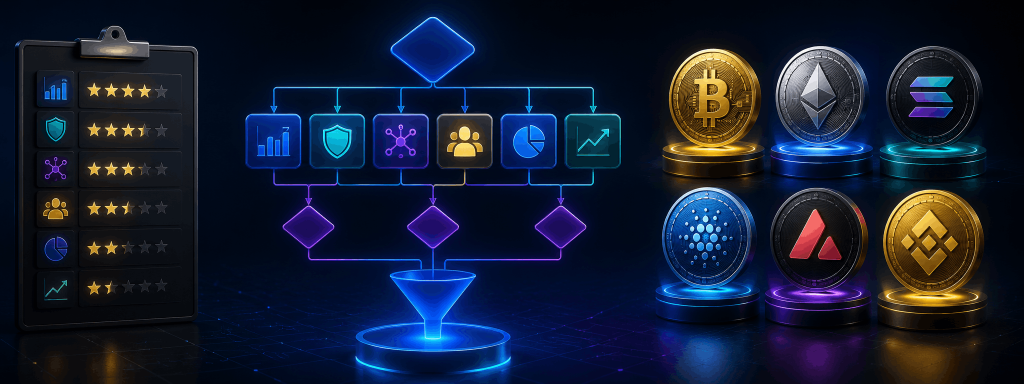
The Decision Framework (How To Actually Choose)
You don’t pick crypto the same way you pick stocks. Stocks have earnings. Crypto has narrative + adoption + technology.
Here’s how to actually decide what’s right for you:
If You’re Boring and Want Safety
Buy Bitcoin. 70% of your crypto allocation should be BTC if you want to sleep at night. It’s the only coin that might exist in 50 years without question.
Add 20% Ethereum. Proven network. Institutional adoption. Smart contracts work.
Leave 10% for experimentation. One alt-coin you think is interesting. Accept you might lose it.
If You Want Yield (Passive Income)
Bitcoin doesn’t stake. So skip it or keep minimum position.
Ethereum 40% + Solana 30% + Cardano 30%. Stake everything. Lock coins for 3-6 months. Earn 3-12% APY. Treat it like a bond portfolio.
Downside: prices could drop 40%. So your 5% yield means nothing if coin value halves. But passive income stacking is real.
If You Believe in Specific Technology (Higher Risk)
Maybe you think Solana’s speed wins. Or Cardano’s academic approach is superior. Or Polkadot’s multi-chain vision matters.
Okay. But keep Bitcoin 40% minimum. Use your conviction picks for remaining 60%. Accept higher volatility. Higher rewards possible. Higher losses also possible.
If You’re a Trader (Shortest Timeline)
Don’t hold these long-term. Use Ethereum or Solana for active trading (most liquid). Avoid smaller alts for now (too thin, you’ll get slipped).
Treat crypto like you’d treat commodity futures. Technical analysis, momentum, reversal trades. Shorter holding periods. Accept you’ll pay more fees.
Honest Risk Assessment
You Could Lose Everything (Real Risk)
Even “safe” cryptos have risks people don’t talk about:
- Regulatory hammer: Governments decide crypto is security/commodity. Suddenly regulations change. Market tanks.
- Central bank digital currencies: If CBDC (government crypto) launches successfully, narrative shifts. Private crypto less relevant.
- Major exploit: Even Bitcoin could theoretically be exploited if quantum computing arrives faster than expected.
- Better alternative emerges: Some new blockchain does everything Ethereum does but better. Migration happens. Old chain becomes MySpace.
- Your own stupidity: You buy high, sell low. You get scammed by fake exchange. You lose seed phrase. User error is the biggest risk.
Coins Could Still Fail (But Unlikely)
- Bitcoin: Failure probability ~1% over next 5 years. Would require major global event or quantum breakthrough.
- Ethereum: Failure probability ~5-10%. Regulatory action or better alternative could displace it. Less certain than Bitcoin.
- Solana: Failure probability ~20-30%. Newer. More centralized. More exploitable. Still likely to survive but less certain.
- Cardano/Polkadot: Failure probability ~30-40%. Nice technology but network effects matter. Could remain small forever.
Tax Implications (Don’t Ignore)
You earn 5% staking on Ethereum. That’s taxable income. In the USA, you owe taxes on that in the year you earn it.
You sell at a loss. That loss is tax deductible but there are limits.
You have holding periods. Long-term capital gains (1+ year) are taxed lower than short-term (under 1 year).
Talk to an accountant. Different countries tax crypto differently. USA is harsh. Portugal is tax-free. Know your country’s rules.
Conclusion
Investing in cryptocurrencies can be a high-risk, high-reward opportunity. By building a strong crypto portfolio and conducting thorough research, you can minimize risk and maximize returns. Remember to diversify your investments, stay informed about market trends, and develop a clear investment strategy. With a strategic approach, you can navigate the volatile crypto market and achieve your investment goals.
You might also like:
Crypto Guide: Cryptocurrency Wallets
What is a Decentralized Application
Frequently Asked Questions
Should I invest in Bitcoin or Ethereum?
Both. Bitcoin for safety and long-term store of value. Ethereum for participation in crypto ecosystem and staking yield. 60% BTC / 40% ETH is boring but sensible.
Is it too late to invest in crypto?
No. Bitcoin has been “too late” since $100. Ethereum since $10. This is a 20+ year asset class. You’re not late. You’re just not early. There’s a difference.
Which crypto will 10x?
Unknown. If I knew I’d be rich and not writing this. 10x requires either: (1) Bitcoin goes to $650k+, (2) alt-coin becomes top 5. Possible. Not predictable.
Should I stake my crypto?
If your timeline is 3+ years, yes. Earn yield. If you think price might crash soon and you need to exit, no. Staking locks coins.
What if I buy and it crashes 50%?
Welcome to crypto. Bitcoin has crashed 80%+ multiple times. Ethereum crashed 99.8% from all-time-high in 2018 (to under $0.50). Then came back 1,000,000%. You have to tolerate this.
Is crypto a scam?
Bitcoin and Ethereum are not scams. They’re networks that work. Many alt-coins are scams. Many are just poorly conceived ideas. Do your own research (DYOR).
Should I use leverage/margin to trade crypto?
Probably not. If you have to ask this question, no. Leverage kills retail accounts. You can lose more than you invested. Not worth it.
Where should I buy crypto?
Coinbase (US, safest), Kraken (good security), Binance (most features, more risk). Never buy from sketchy exchange. Your coins are only as safe as your exchange is secure.
Should I use a hardware wallet?
If you have $10k+, yes. Ledger or Trezor. If you have $1k, probably not yet. Coinbase is actually secure enough for small amounts.
Which crypto will be worth $1M?
If Bitcoin reaches $1M, BTC could be $1M. Ethereum reaches $50k, ETH could reach $1M if you bought at $100 years ago. Picking the future is impossible. Which is why diversification matters.
 ABOUT THE AUTHOR
See More
ABOUT THE AUTHOR
See More


Sidebar rates

