Bitcoin Reclaims $68,000 as Deleveraging Meets Spot Demand: Is the Bottom In?
Following a strong surge that saw the currency momentarily reach $69,788 on Bitstamp earlier in the session, Bitcoin (BTC) is currently
Quick overview
- Bitcoin is currently trading above $68,000, up 3.9% from the previous day, following positive US manufacturing data.
- Despite the price surge, derivatives data indicates the lowest demand for futures since mid-2024, raising concerns about the sustainability of the rebound.
- Short-term holders are showing reduced selling pressure, with realized losses dropping significantly compared to previous capitulation events.
- Institutional involvement remains, but confidence is fragile, as evidenced by a decline in futures open interest and mixed market signals.
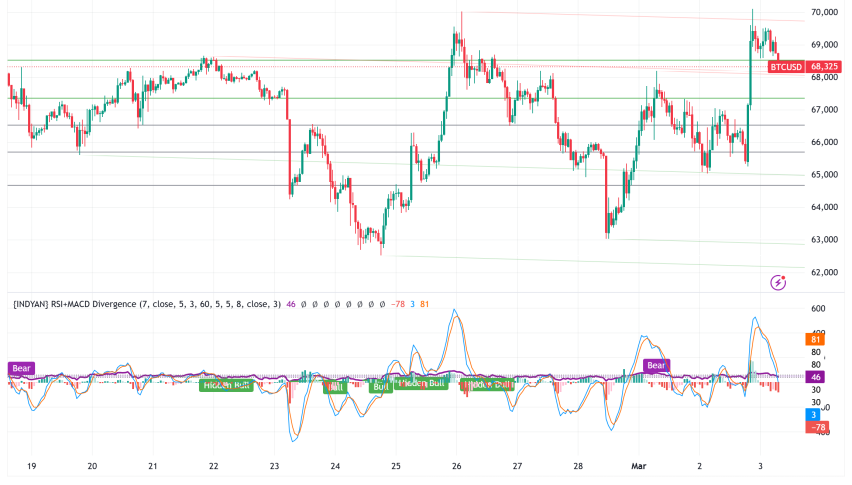
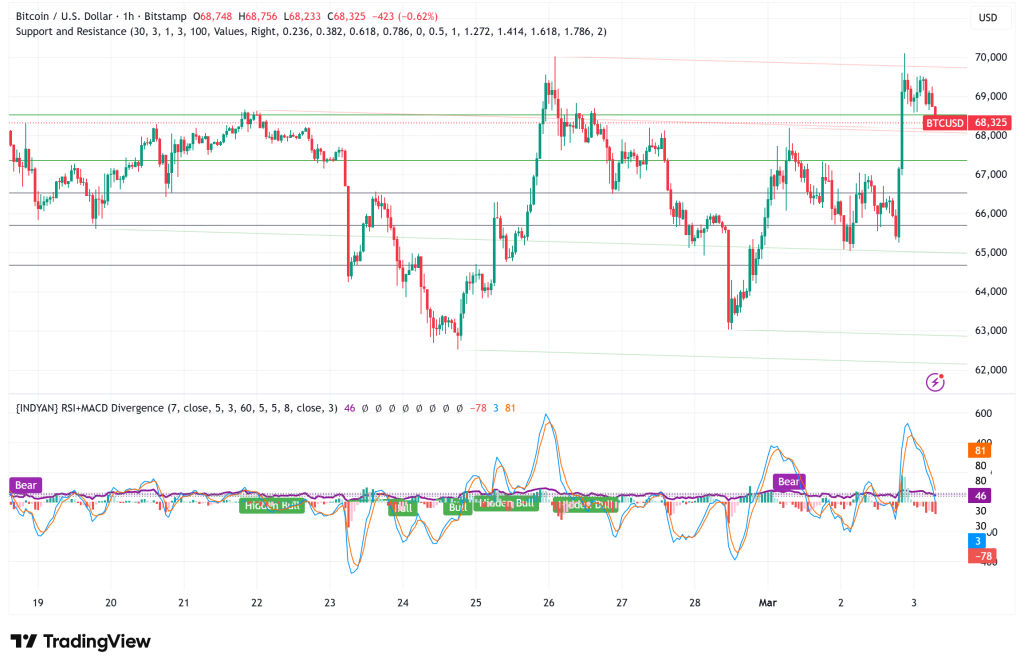
Following a strong surge that saw the currency momentarily reach $69,788 on Bitstamp earlier in the session, Bitcoin BTC/USD is currently trading above $68,000 on Tuesday, up 3.9% over the previous day. The action coincides with US manufacturing statistics that printed over the crucial 50 expansion barrier for the second consecutive month, providing cryptocurrency markets with unanticipated macro tailwinds even as Wall Street stocks declined due to growing tensions in the Middle East.
However, a startling difference is emerging beneath the optimism: derivatives data shows the lowest demand for futures since mid-2024, which raises serious concerns about how long the present rebound will last and whether institutional traders have covertly decreased their exposure.
PMI Surprise Gives BTC the Fuel to Decouple From Stocks
After three years of recession, the Institute of Supply Management’s (ISM) February Manufacturing Purchasing Managers Index (PMI) printed above 50, indicating a return to expansion. Because risk appetite tends to widen and capital flows into higher-beta assets like Bitcoin when manufacturing activity increases, the price of Bitcoin has historically been positively connected with PMI strength.
That association was demonstrated in real time on Monday. Bitcoin jumped above $69,000, avoiding the larger equities selloff, while the S&P 500 and Nasdaq continued to be burdened by geopolitical risk in the wake of US-Iran tensions. During the breakout leg, Binance spot markets produced almost $7.79 million in positive delta, with Coinbase contributing $1.16 million and OKX contributing almost $3.7 million. This suggests that there was actual spot demand rather than a short squeeze driven by derivatives.
BTC Futures Open Interest Crashes to 18-Month Low: A Red Flag or a Healthy Reset?
The futures market for Bitcoin is issuing a warning despite the strength of the price. On Sunday, aggregate futures open interest on key exchanges dropped to $32 billion, a 20% decrease from a month earlier. Open interest was at 491,300 BTC, the lowest level since August 2024 when measured in BTC terms to account for the price decrease.
The premium that monthly futures contracts trade at above spot, known as the annualized basis rate, has fallen to a 12-month low of barely 2%. To compensate traders for the lengthier settlement period, this indicator should fall between 5% and 10% in a healthy, neutral market. Since Bitcoin’s record high of $126,200 in October 2025, there has been a consistent lack of leveraged bullish conviction, which is reflected in the premium’s ongoing compression.
Open interest on Binance alone has decreased by 25%, from 130,800 BTC at the beginning of the year to 97,680 BTC. In the current cycle, the exchange’s projected leverage ratio has dropped to a weekly average of 0.146, which is below the 0.15 level that has historically been linked to significant deleveraging stages.
Short-Term Holders Show ‘Zero Panic’ as Selling Pressure Cools Sharply
The short-term holder (STH) profit/loss (P&L) to exchanges measure from CryptoQuant is one of the more encouraging data points this week. In stark contrast to the capitulation window of February 5–6, when STHs sent 89,000 BTC to exchanges at a realized loss within 24 hours, the realized losses transferred to exchanges from this cohort dropped to just 3,700 BTC on March 1, despite the fact that BTC briefly dropped to $63,000 amid geopolitical headlines. This was a two-week low.
The most reactive, event-sensitive holders may have already completed their capitulation cycle based on the consistent shrinkage in loss-driven inflows. The price’s path of least resistance may be changing as a result of drastically decreased leverage and waning panic selling.
Institutions Have Not Left — But Conviction Remains Fragile
There is conjecture that institutional investors are pulling out of Bitcoin due to the drop in futures open interest. The information presents a more complex picture. Major mutual fund and pension fund managers are among the listed holders of spot Bitcoin ETFs, which continue to trade at an average of nearly $3 billion per day. Together, publicly traded firms Strategy (MSTR), MARA Holdings, Metaplanet, and XXI own more than $79 billion in Bitcoin on the chain. Bitcoin exposure has also been developed in nation-states such as Bhutan, El Salvador, and the United Arab Emirates.
More importantly, the open interest in CME Bitcoin futures is still around $7.5 billion, which is primarily driven by professional and institutional trading desks. Although confidence has been damaged, structural involvement is still present in this market, which is not one that has been abandoned.
BTC/USD Technical Analysis: $71,500 Is the Make-or-Break Level
Bitcoin is trying to recover its Monthly RVWAP (rolling volume-weighted average price), which is anchored to the beginning of March and is presently trading in the high-$68,000 range on the four-hour chart. In the past, trading above this level has shifted short-term positioning bias toward the bullish side and put the average monthly participant back in profit.
The first notable liquidity pocket is located in the range of $70,000 and $71,500. Stacked liquidation clusters from longer-term leveraged holdings are present in this zone, which may attract price. Given the ongoing favorable spot delta, a clear conversion of this range into support might spur a rise toward $80,000, the last time supply halted upside in January 2026.
Bullishness is not shared by all. Some traders have flagged what they call a typical bear flag pattern, with a possible downside objective in the $52,000 range, as a result of the daily chart’s RSI and MACD divergence. Material Indicators warns that a “up signal” on the monthly chart does not necessarily rule out future down, pointing out that Bitcoin’s present price behavior closely resembles March 2022, a time that preceded a protracted downtrend.
Bitcoin Price Outlook: Three Scenarios for the Weeks Ahead
Bullish Case – $80,000
Bitcoin may move quickly toward the January supply zone near $80,000 if it closes over $71,500 on high volume, selling off the overhead leveraged shorts. Supporting drivers would include stabilizing geopolitics, strengthening PMI data, and continuing ETF inflows.
Base Case: $65,000 to $71,500
Continued range-bound trading with $69,000 serving as a contested pivot is the most likely short-term result. A slow grind higher is supported by a low-leverage environment with diminishing selling pressure, but a clean breakout over $72,000 is challenging to sustain without new capital inflows due to the weak futures demand and lack of a bullish basis premium.
Bearish Case: $52,000–$58,000
The $58,000–$52,000 structural support band would come back into focus if the market was unable to hold $65,000 on a daily close, especially if this was coupled with a worsening of macro conditions, an increase in the likelihood of a conflict in the Middle East, or a recurrence in STH capitulation selling. Despite being the minority opinion among on-chain specialists, this possibility cannot be disregarded in light of the continued parallels to the 2022 trend.
- Check out our free forex signals
- Follow the top economic events on FX Leaders economic calendar
- Trade better, discover more Forex Trading Strategies
- Open a FREE Trading Account
- Read our latest reviews on: Avatrade, Exness, HFM and XM

Related Articles


Sidebar rates

Related Posts
 Save
Save