Gold Weekly Outlook: Will XAU/USD Hold $5,000 or Collapse to $4,800?
This week, the gold market faces a crucial moment as it reacts to both global tensions and a stronger US Dollar.
Quick overview
- The gold market is currently experiencing volatility due to global tensions and a stronger US Dollar, with prices recently pulling back to the $5,010 to $5,040 range.
- Despite a significant rally over the past year, recent price movements indicate weakness, influenced by higher interest rates and competition from the US Dollar.
- Technical analysis suggests that gold could face further declines if it falls below the critical $5,000 support level, while a recovery requires breaking above $5,130.
- Long-term demand for gold remains strong, particularly from central banks, with predictions suggesting prices could reach $5,400 to $6,000 by year-end.
This week, the gold market faces a crucial moment as it reacts to both global tensions and a stronger US Dollar. After a strong start to 2026, with prices reaching nearly $5,600, gold has now pulled back to the $5,010 to $5,040 range. Both individual and institutional investors are wondering if this is a rare buying chance or the beginning of a bigger drop. As we move into the third week of March, the outcome for XAU/USD is especially important.
Even though long-term risks still support gold, recent price moves show signs of weakness. After a huge 70% rally over the past year, gold is now dealing with the impact of higher interest rates. From my ten years of experience, I see this not as the end of the bull market, but as a needed phase where weaker holders are leaving before the next big move.
The Oil-Inflation Trap: Why Geopolitics Isn’t Saving Gold Right Now
Usually, rising tensions in the Middle East make gold more attractive. But now, with the situation in Iran and the Strait of Hormuz nearly closed, we are seeing a different effect. Oil prices are climbing toward $120 per barrel, raising concerns about another round of global inflation. Instead of turning to gold, many investors are choosing the US Dollar and Treasury yields, expecting the Federal Reserve to keep interest rates high to fight these energy-driven costs.
This change has made it harder for gold to compete. As 10-year Treasury yields rise, many fund managers see holding gold as less attractive. Right now, investors looking for safety are divided between the US Dollar and gold, but the dollar is coming out ahead.
In the week ahead, the link between Brent crude prices and the US Dollar will likely be the main factor affecting gold’s price swings.
Gold Technical Breakdown: The $5,000 Line in the Sand
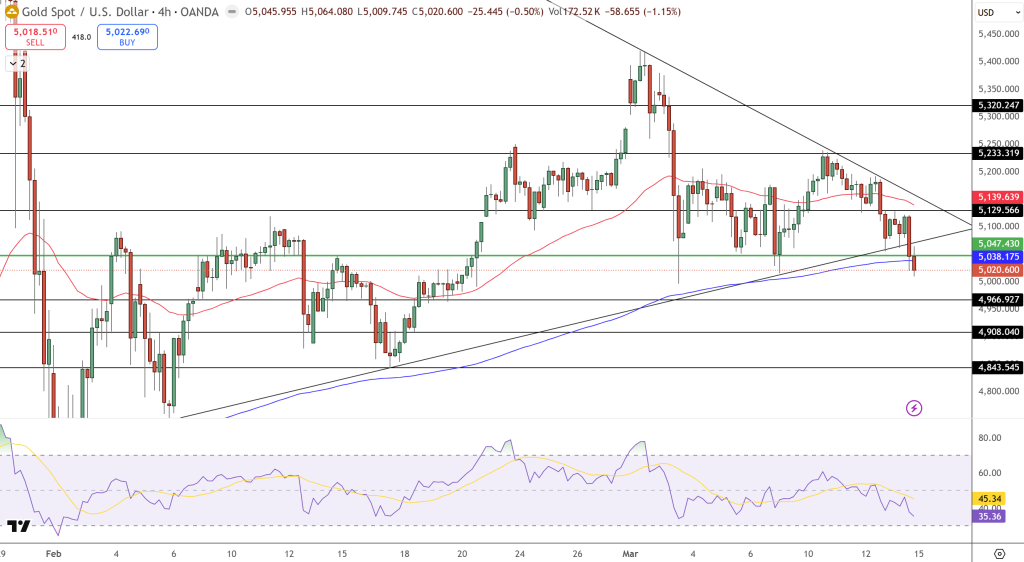
Looking at the charts, both the 4-hour and daily timeframes suggest the correction could continue. GOLD recently dropped below a narrowing symmetrical triangle, which often means more selling pressure is coming. Now, the price is having trouble moving back above $5,047, which used to be a support level but has now become resistance.
If sellers push gold below the key $5,000 level by the end of the day, prices could fall further. The next support is around $4,960, and in a worst-case scenario, gold could test the 50-day moving average near $4,842. On the other hand, for buyers to take charge again, gold needs to break above $5,130 to show that this drop was just a temporary setback for those betting against it.
- Immediate Resistance: $5,047 (Triangle base) and $5,129 (Recent swing high).
- Critical Support: $5,000 (Psychological level) followed by $4,966.
- RSI Indicator: Currently hovering near 35, suggesting the market is oversold but lacks the “exhaustion” spike needed for a reversal.
- Trend Outlook: Bearish in the short term (1-7 days) but remains structurally bullish on the weekly and monthly timeframes.
Central Bank “Whales” and the $6,000 Long-Term Dream
Even with recent price swings, the long-term outlook for gold remains strong. Central banks, especially in emerging markets, are moving away from US Dollar reserves faster than ever. Experts predict steady demand of about 60 tonnes per month through 2026. This steady buying by governments helps keep gold prices from falling sharply, even if the Federal Reserve raises rates.
Big firms like Goldman Sachs and experienced analysts such as Ed Yardeni are still very positive, predicting gold could reach $5,400 to $6,000 by year-end. They believe the move toward assets that aren’t tied to traditional currencies will last for years, and a short period of dollar strength won’t change that.
For investors who are paying attention, this week’s ups and downs are just part of the journey toward possible gains later in 2026.
- Check out our free forex signals
- Follow the top economic events on FX Leaders economic calendar
- Trade better, discover more Forex Trading Strategies
- Open a FREE Trading Account
- Read our latest reviews on: Avatrade, Exness, HFM and XM

Related Articles

Sidebar rates

Related Posts
 Save
Save