PLTR Stock Rebounds 1.5% on Record Q1 as US Revenue Doubles, But Valuation War Rages On
PLTR stock: Palantir's record Q1 with 85% revenue growth, Rule of 40 at 145%, can't silence valuation fears and fresh analyst downgrades.
Quick overview
- Palantir Technologies reported its best quarter ever, with revenue of $1.63 billion and adjusted EPS of $0.33, surpassing Wall Street expectations.
- The company achieved a remarkable 104% year-over-year growth in U.S. revenue, marking its first time exceeding 100% growth since its public offering in 2020.
- Palantir's Rule of 40 score reached 145%, highlighting its strong revenue growth and operating margins, a rarity among large-cap software companies.
- Despite strong fundamentals, concerns about valuation and competitive pressures from AI rivals have led to mixed opinions on Palantir's stock performance.
Palantir Technologies (NASDAQ: PLTR) posted its best quarter ever on May 4, topping Wall Street on both the top and bottom lines. Revenue of $1.63 billion was above projections of $1.54 billion and adjusted EPS of $0.33 was 18% more than the consensus of $0.28. Net income more than quadrupled year-over-year reaching $870.5 million with a 53% net margin.
This marks the company’s 11th straight quarter of revenue acceleration, a streak few software businesses of any size can match. “Our financial results now reflect a level of strength that dwarfs the performance of basically every software company in history at this scale,” CEO Alex Karp said plainly in his shareholder letter.
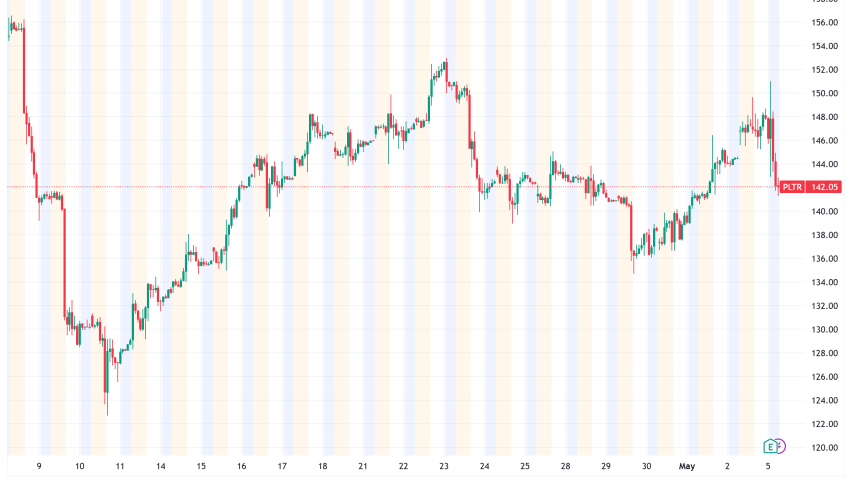
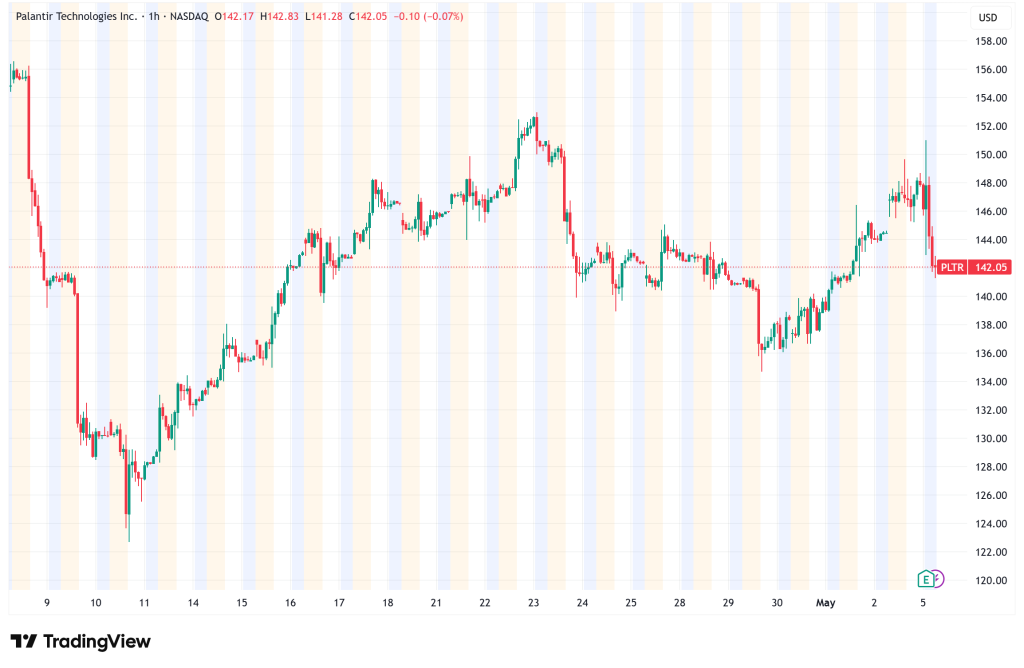
Markets liked that, as PLTR ticked up 1.47% in after-hours trade to $147.83. Still, the stock is down about 18% year to date and far off its 52-week high of $207.52, a reminder that great fundamentals can still struggle against the backdrop of a valuation reset across the software sector.
Palantir’s US Revenue Breaks the 100% Barrier
The headline number from the quarter was $1.28 billion in U.S. revenue, increasing 104% YoY and 19% sequentially. This is the first time Palantir has grown more than 100% year-over-year in the US market since its direct-listing public offering in 2020.
US commercial revenue up 133% to $595 million US government revenue up 84% to $687 million Breaking it out: Sequentially both divisions grew significantly, with government growth rising from 66% in Q4 2025 to 84% in Q1 2026.
Commercial momentum is very impressive. The company currently has 615 US commercial customers, a 42% increase year-over-year, and closed 206 deals valued at $1 million or more in the quarter including 72 deals of more than $5 million and 47 deals of more than $10 million. The amounts of these deals suggest significant industry uptake, not just experimenting at the pilot level.
The corporation says most of this acceleration comes from its Artificial Intelligence Platform (AIP) which has been quickly rolled out across both civilian enterprises and defense organizations. Real-world achievements from companies like as SAP and GE Aerospace were discussed during AIPCon 9: SAP achieved 99%+ validation correctness and reduced cloud migration times by more than 70%, while GE Aerospace saw a 26% increase in engine production.
Rule of 40 Hits 145%, a Rarity at This Scale
Palantir’s Rule of 40 score of 145% — a blend of 85% revenue growth and a 60% adjusted operating margin — was one highlight from the quarter. This indicator, commonly used to judge the health of software companies, generally has a hard time getting above 60-70% among large-cap rivals. To see a 145% reading at Palantir’s current size is quite remarkable and puts it in rarefied company among the best-performing companies in the whole tech industry.
GAAP operating income was $754 million (46% margin) and adjusted operating income was $984 million (60% margin). The corporation posted $925 million in adjusted free cash flow in the quarter — a 57% margin, up from 42% a year ago — and concluded with $8.0 billion in cash and U.S. Treasury securities and zero debt.
Net dollar retention of 150% suggests that not only are existing customers not leaving, but they are rapidly extending their deployments, which bodes good for revenue durability even if new client acquisition slows.
Palantir’s Government Business: From Pentagon to Farmland
On the federal side, Palantir is expanding its presence throughout U.S. defense and intelligence. Its Maven Smart System is being deployed across the whole Department of War, moving AI capabilities from controlled lab environments to active operational warfighters. “The system is critical to mission success and personnel safety,” said Cameron Stanley, Chief Digital and AI Officer, Department of War.
Beyond defense, Palantir also expanded its cooperation with the USDA to protect American farms and strengthen the resilience of the agricultural supply chain—an odd but strategically vital vertical that highlights how broadly the business defines “load-bearing institutions.”
On the commercial side, a multi-year renewal with Airbus for the Skywise platform – with over 50,000 users spanning aircraft design, production and supply chain – speaks to the stickiness of Palantir’s enterprise deployments once implanted. The company also said it is partnering with NVIDIA to offer a joint “Sovereign AI OS” that will combine the NVIDIA Blackwell Ultra hardware with Palantir’s whole software portfolio for customers with data sovereignty needs.
Speaking to CNBC, Karp anticipates Palantir’s total US business — government and commercial — to quadruple again in 2027.
Guidance Raised Across the Board
Management raised its full-year 2026 revenue outlook to $7.65–$7.66 billion, representing nearly 71% year-over-year increase and significantly above the prior $7.27 billion Wall Street average. Commercial revenue in the U.S. alone is projected to exceed $3.224 billion — indicating at least 120% increase in that category for the full year.
Palantir’s Q2 2026 sales guidance was $1.797 billion to $1.801 billion versus $1.68 billion expectation. Its adjusted operating income guidance was $1.063 billion to $1.067 billion. The full-year adjusted free cash flow projection was lifted to $4.2-4.4 billion from the previous $3.925-4.125 billion range.
The company also reiterated its promise to achieve GAAP operating income and net income each quarter of 2026—a critical anchor for investors increasingly focused on genuine profitability rather than adjusted metrics.
The Bear Case for PLTR Stock: Valuation and Eroding Moats
Palantir stock remains a stark divider of opinion — and the Q1 announcement did little to reduce that gap, despite the operational brilliance on show.
On May 4, HSBC analyst Stephen Bersey lowered his rating on PLTR to “neutral” from buy, and decreased his price objective to $151. His thesis is about the competitive dynamics: Rivals including Anthropic and OpenAI are challenging Palantir’s traditional moat of embedding engineers closely into client firms to develop comparable hands-on enterprise integration techniques. Bersey cautioned that “traditional barriers to entry have begun to erode,” and that the increasing proliferation of agentic AI frameworks “increases the risk of multiple compression as the differentiator of Palantir narrows.”
This concern is not without foundation. The whole software industry has been under pressure this year as the spread of AI models threatens to commoditize features that used to attract top dollar. Karp directly tackled this, arguing Palantir is on a fundamentally different path: “There appears to be a rotation among AI model companies that are engaged in an intensely competitive race where we have seen token costs fall by a factor of a thousand over just a few years,” he wrote, positioning Palantir as a builder of durable production infrastructure rather than a player in the model race.
The other elephant in the room is valuation. PLTR currently trades at a P/E of ~130-234x depending on the earnings measure utilized. That’s a premium that requires consistent execution at a level that very few firms have ever achieved.
PLTR Technical Analysis: Support Holding, But Resistance Is Real
Technically PLTR is still in a precarious position. The stock has rallied off the 200-day simple moving average, which has been a short-term support after falling below the 50-week simple moving average earlier this year. But prior support levels have turned into resistance, and initial attempts to recover towards the $155 100-day SMA have been rebuffed.
The earnings-driven pop provides bulls another chance to probe those overhead levels. If PLTR can recapture the 100-day SMA and maintain it, that would be a big technical change. But a failure here would keep the lower high pattern that has been the hallmark of the market action since late 2025.
Traders should note the $130-$135 zone as near-term support on any downturn and the $155-$160 range as the primary resistance cluster to clear before greater upside opens up.
Conclusion: What’s Next for Palantir Investors?
Palantir’s Q1 2026 results are a real milestone – 11 quarters of rising sales in a row, a Rule of 40 score that leaves much of the sector in the dust, and US growth that has broken the triple-digit line for the first time since the business went public. The basics are as robust as ever.
Yet the strain is just as real. With a P/E north of 130x, there is no room for error, competitive moats are being challenged by fast moving AI rivals and the geopolitical tailwinds that formerly provided a floor for sentiment are now receding. HSBC’s downgrade is a warning that even the bulls are getting selective.
For the traders, the short-term strategy is rather simple: look to the $130-$135 support zone for long entries with a stated stop, and a clean break over $155 as the confirmation signal for a more sustainable rebound. Long-term investors will have to determine if Palantir can continue to justify its premium with consistent execution — and if its “uniquely American AI revolution” story holds as the competitive landscape continues to shift.
- Check out our free forex signals
- Follow the top economic events on FX Leaders economic calendar
- Trade better, discover more Forex Trading Strategies
- Open a FREE Trading Account
- Read our latest reviews on: Avatrade, Exness, HFM and XM

Related Articles

Sidebar rates

Related Posts
 Save
Save