Boeing Stock in Focus as 737 MAX Certifications Near; $500 Billion Backlog Meets Recovery Momentum
Boeing stock: Boeing advances MAX 7 and MAX 10 approvals as a $500B backlog and aircraft shortages strengthen long-term growth prospects.
Written by:
Arslan Butt•Thursday, June 18, 2026•4 min read
•Last updated: Thursday, June 18, 2026
Quick overview
Boeing is experiencing a recovery phase driven by improving airline demand and a record commercial aircraft backlog.
U.S. and European regulators are nearing certification for the 737 MAX 7 and MAX 10, which could unlock significant aircraft deliveries and enhance Boeing's competitive position.
The global aviation market remains tight due to production disruptions, leading to increased reliance on aircraft leasing and a strong demand outlook for Boeing.
Boeing's stock shows signs of gradual improvement, supported by a favorable backlog and certification progress, although concerns about debt and production risks persist.
Boeing (NYSE: BA) is entering a pivotal phase in its recovery story.
The aerospace giant is benefiting from improving airline demand, a record commercial aircraft backlog, progress on long-delayed certification programs, and persistent global aircraft shortages that continue to support pricing power across the aviation sector.
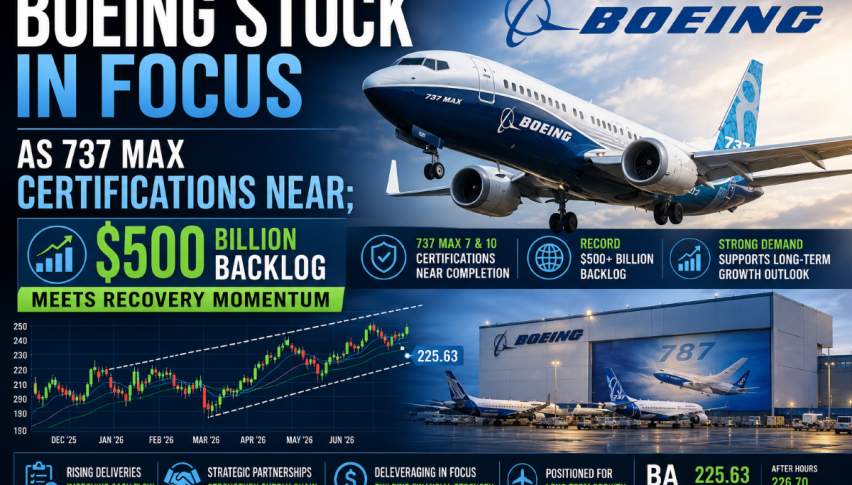
Shares closed at $225.63 on June 17, down 0.82% on the day but up nearly 12% over the past three months as investors increasingly focus on Boeing’s operational recovery rather than its recent challenges.
The latest catalyst arrived this week when U.S. and European aviation regulators signaled that certification of the long-awaited 737 MAX 7 and MAX 10 variants is approaching the finish line.
Boeing Moves Closer to a Major Regulatory Milestone
For years, certification delays have weighed on Boeing’s narrow-body strategy.
That may soon change.
Officials from both the Federal Aviation Administration (FAA) and the European Union Aviation Safety Agency (EASA) said they are nearing completion of the approval process for the MAX 7 and MAX 10.
FAA Deputy Administrator Chris Rocheleau described the remaining work as largely “dotting i’s and crossing t’s,” while EASA indicated only a few procedural hurdles remain.
The implications are significant.
The MAX 10 is Boeing’s direct competitor to Airbus’ highly successful A321neo and represents a major portion of Boeing’s future narrow-body order book.
Certification would:
Unlock hundreds of pending aircraft deliveries
Improve cash generation
Reduce regulatory uncertainty
Strengthen Boeing’s position against Airbus
The approvals could become one of the most important operational milestones since Boeing resumed MAX deliveries following earlier grounding issues.
Aircraft Shortages Continue Supporting Boeing’s Demand Outlook
The broader aviation market remains exceptionally tight.
Years of production disruptions at both Boeing and Airbus have created a global supply shortage that airlines are struggling to overcome.
That dynamic was highlighted this week when private-equity giant KKR announced a $1.4 billion aircraft leasing commitment through Altavair, citing ongoing aircraft scarcity and strong long-term demand.
The investment reflects a growing consensus across the industry:
Global travel demand remains healthy
New aircraft supply remains constrained
Airlines increasingly rely on leasing markets
Aircraft assets continue appreciating in value
For Boeing, this environment provides unusual visibility into future demand.
The company now holds a commercial aircraft backlog valued at more than $500 billion, extending years into the future.
Japan-Boeing Partnership Could Open New Growth Opportunities
Another emerging development involves Japan’s renewed aerospace ambitions.
Following the failure of Mitsubishi’s SpaceJet program, Japanese policymakers are reportedly exploring deeper cooperation with Boeing as part of a broader strategy to rebuild a domestic commercial aircraft industry.
Japan already plays a critical role in Boeing’s supply chain.
Roughly one-third of the Boeing 787 Dreamliner consists of components manufactured by Japanese companies, including:
Mitsubishi Heavy Industries
Kawasaki Heavy Industries
Subaru
Analysts believe future collaboration could help Boeing reduce development costs for next-generation aircraft while strengthening strategic ties with one of its most important manufacturing partners.
The timing is notable because Boeing will eventually need a successor to the aging 737 platform, a program that could require tens of billions of dollars in investment.
Is it a good time to buy Boeing stock?
BA Technical Analysis: Recovery Trend Remains Intact
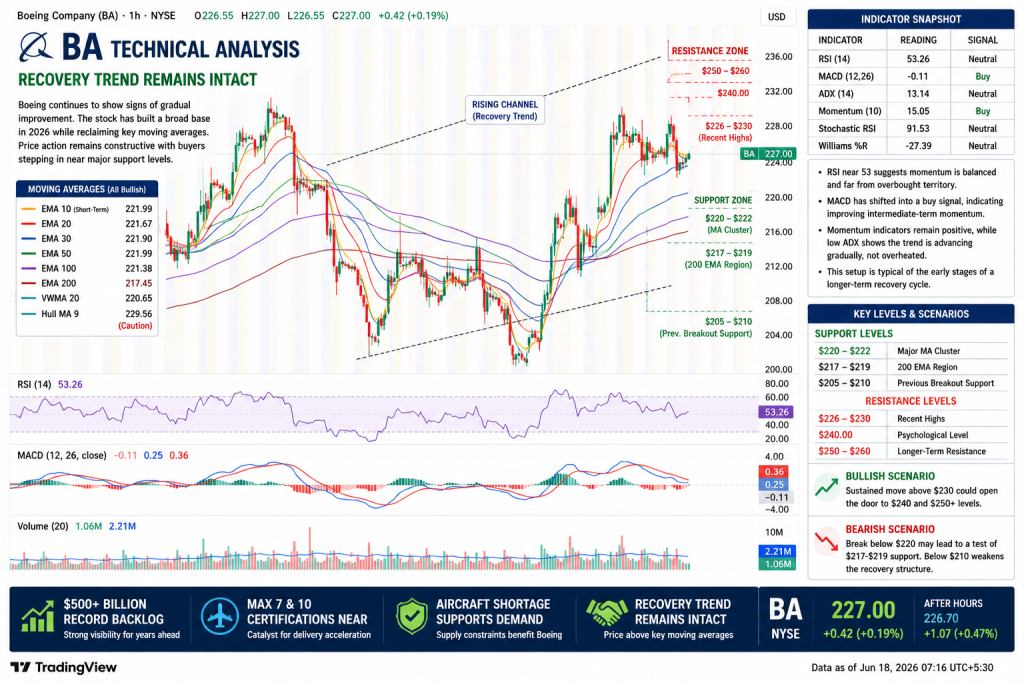
From a technical perspective, Boeing continues to show signs of gradual improvement.
The stock has spent much of 2026 building a broad base while steadily reclaiming major moving averages.
Unlike many high-growth technology names, Boeing’s rally has been driven primarily by improving fundamentals and backlog visibility rather than valuation expansion.
Moving Average Structure Turns Bullish
The moving-average picture is one of the strongest Boeing has displayed in years.
The stock currently trades:
Above every major EMA and SMA
Above the 200-day EMA
Above the volume-weighted average price
Within a well-defined recovery trend
This alignment typically reflects improving institutional accumulation.
The only cautionary signal comes from the Hull Moving Average, which suggests short-term momentum has cooled after the recent rally.
RSI and MACD Indicate Healthy Consolidation
The indicator picture remains constructive.
RSI near 53 suggests momentum is balanced and far from overbought territory.
MACD has shifted into a buy signal, indicating improving intermediate-term momentum.
Momentum indicators remain positive, while the low ADX reading shows the trend is advancing gradually rather than becoming overheated.
This setup often appears during the early stages of longer recovery cycles.
Key Support and Resistance Levels
Support
$220-$222 (major moving-average cluster)
$217-$219 (200-day EMA region)
$205-$210 (previous breakout support)
Resistance
$226-$230 (recent highs)
$240 psychological level
$250-$260 longer-term resistance zone
A sustained breakout above $230 could strengthen bullish momentum, while holding above $220 would help preserve the current recovery structure.
According to recent estimates, the stock may trade below some intrinsic value models that place fair value near $270 per share.
However, traditional valuation metrics tell a different story.
Key considerations include:
Bullish View
More than $500 billion backlog
Improving free cash flow outlook
MAX certification catalysts
Aircraft supply shortages supporting demand
Commercial aviation recovery
Bearish View
Approximately $53 billion debt load
Elevated earnings multiple
Production execution risks
Regulatory scrutiny remains high
Margin recovery still incomplete
Investors are essentially betting that Boeing can convert its enormous backlog into consistent earnings growth over the next several years.
Boeing Stock’s Recovery Story Still Has Room to Run
Boeing remains one of the most strategically important aerospace companies in the world.
Unlike many industrial firms, it operates within a near-duopoly alongside Airbus in large commercial aircraft manufacturing.
Several long-term drivers remain favorable:
Global passenger traffic growth
Airline fleet replacement cycles
Rising defense spending
Aircraft leasing expansion
Emerging market aviation demand
The combination of a record backlog, improving certification progress, and persistent aircraft shortages gives Boeing a stronger foundation than it has enjoyed in several years.
The key challenge now shifts from rebuilding credibility to executing production plans efficiently and converting orders into cash flow.
If management can successfully navigate certification milestones, increase production rates, and gradually reduce debt, Boeing’s recovery story may still be in its early innings despite the stock’s recent rebound.
Lead Markets Analyst – Multi-Asset (FX, Commodities, Crypto)
Arslan Butt serves as the Lead Commodities and Indices Analyst, bringing a wealth of expertise to the field. With an MBA in Behavioral Finance and active progress towards a Ph.D., Arslan possesses a deep understanding of market dynamics.
His professional journey includes a significant role as a senior analyst at a leading brokerage firm, complementing his extensive experience as a market analyst and day trader. Adept in educating others, Arslan has a commendable track record as an instructor and public speaker.
His incisive analyses, particularly within the realms of cryptocurrency and forex markets, are showcased across esteemed financial publications such as ForexCrunch, InsideBitcoins, and EconomyWatch, solidifying his reputation in the financial community.





 Save
Save