Circle Stock Heads to $50 after $65 Support Break on Insides Sales, Passive Fund Exit and Open USD Stablecoin Announcement
The company's long-term stablecoin growth story was obscured by insider selling, removal from major growth indexes, and Open USDC, which...

Quick overview
- Circle shares fell 15% as the company was removed from major Russell Growth Indexes, raising concerns about its market visibility and liquidity.
- Insider selling and a recent board change have further dampened investor sentiment, contributing to the stock's prolonged decline.
- Despite impressive growth metrics, including a 28% increase in USDC circulation, the company's recent earnings missed expectations, highlighting profitability challenges.
- Circle's aggressive investments are increasing operating costs, leading to a decline in net income, which may deter investors focused on sustainable profitability.
The company’s long-term stablecoin growth story was obscured by insider selling, removal from major growth indexes, and Open USDC, which caused Circle shares to resume their sharp drop.
Shares Resume Sharp Decline
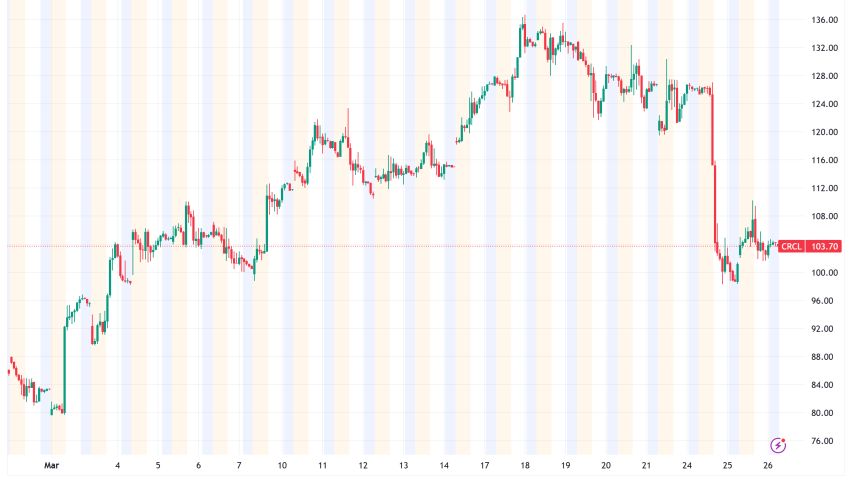
Circle Internet Group extended its bearish trend on Tuesday, falling another 15% as investors reacted to its removal from several major Russell Growth Indexes and a series of insider ownership filings. The latest decline adds to a prolonged selloff that began after the stock peaked near $300 in June 2025.
The shares are now testing a critical support area around $65. Technical analysts view this level as an important line of defense, with a decisive break potentially exposing the next major support zone near $50. The persistent pattern of lower highs and lower lows continues to reflect deteriorating investor sentiment following the company’s explosive post-listing rally.
Russell Index Removal Raises New Concerns
One of the biggest catalysts behind the latest weakness was Circle’s removal from multiple Russell Growth Indexes during the latest annual reconstitution.
Although index changes do not directly affect a company’s underlying business, they can significantly influence trading dynamics. Index-tracking funds and institutional portfolios that replicate Russell benchmarks are often required to adjust their holdings, creating additional selling pressure during portfolio rebalancing.
The removal also raises broader questions about Circle’s position within the listed growth universe. Reduced representation in widely followed benchmarks could gradually affect trading liquidity, passive ownership, and overall market visibility.
For investors already questioning the stock’s lofty valuation, the timing of the index changes has added another source of uncertainty.
Insider Sales Continue to Pressure Confidence
Investor sentiment has also been weighed down by a series of recent ownership disclosures.
Regulatory filings during late June included multiple Form 144 notices, while earlier disclosures showed company insiders selling shares through prearranged Rule 10b5-1 trading plans. Although these transactions are scheduled in advance and do not necessarily reflect management’s view of the business, markets often interpret insider selling as a negative signal during periods of share price weakness.
Adding to investor concerns, Circle also announced a board change during June after Rajeev Date stepped down as a director, reducing the size of the company’s board. While the departure was not linked to operational issues, it added another headline for investors to assess during an already volatile period.
Technical Momentum Improves
The CRCL stock turned bearish soon after the IPO by mid-2025, after touching 300. We saw a couple of attempts to reverse higher earlier in 2026, but both attempts failed at the $140 resistance zone. The 50 weekly SMA turned into resistance the stock turned bearish again. No the stock has pushed below the $65 support level, which opens the door for the last support zone at $50, which is where the stock started after all.
CRCL Stock Chart Weekly – The 20 SMA Has Turns into Support

While the stock trades at a premium valuation—over 8 times sales—investors are pricing in its role as a key infrastructure provider in digital payments. Recent developments, including expansion into Europe under MiCA rules and new payment solutions, add to its growth potential.
CRCL Stock Chart Daily – Testing the Last Resistance

Earnings Disappoint Despite Strong Ecosystem Growth
Circle’s most recent quarterly results delivered mixed signals.
Revenue and reserve income reached $694 million, below analyst expectations of approximately $715 million, while adjusted earnings per share came in at $0.21 versus consensus forecasts of $0.27.
Despite the earnings miss, the company’s core operating metrics remained impressive. USDC circulation increased 28% year over year to $77 billion, highlighting continued adoption of one of the world’s largest stablecoins.
Even more notable was on-chain transaction volume, which surged 263% to $21.5 trillion as blockchain-based settlement activity continued expanding across payments, decentralized finance, and enterprise applications.
However, the market’s attention has increasingly shifted toward profitability rather than growth alone.
Rising Costs Challenge Profitability
Circle continues investing aggressively to expand its ecosystem, but those investments are placing increasing pressure on earnings.
Operating expenses climbed 76% from a year earlier to $242 million as the company accelerated spending on infrastructure, compliance, product development, and ecosystem expansion. As a result, net income declined despite continued revenue growth.
The results underscore a challenge facing many digital asset companies: maintaining rapid expansion while demonstrating a sustainable path to consistent profitability. In the current market environment, investors have become less willing to overlook weakening margins in exchange for long-term growth promises.
Regulatory Progress Overshadowed by Market Weakness
Earlier this year, optimism surrounding progress on U.S. stablecoin legislation helped support Circle shares. Proposed regulatory frameworks reduced uncertainty surrounding the future of stablecoins and were initially viewed as a positive development for USDC adoption.
Circle has also continued expanding beyond its core reserve-income model, including raising significant funding for its Arc blockchain initiative as it seeks additional long-term growth opportunities.
Nevertheless, those positive developments have recently been overshadowed by mounting technical weakness, valuation concerns, insider selling, and forced index-related portfolio adjustments. Unless buyers successfully defend the $65 support level, bearish momentum may continue to dominate trading, with the next major technical objective sitting near the $50 support zone.
- Check out our free forex signals
- Follow the top economic events on FX Leaders economic calendar
- Trade better, discover more Forex Trading Strategies
- Open a FREE Trading Account
- Read our latest reviews on: Avatrade, Exness, HFM and XM

Related Articles


Sidebar rates

Related Posts
 Save
SaveAva
