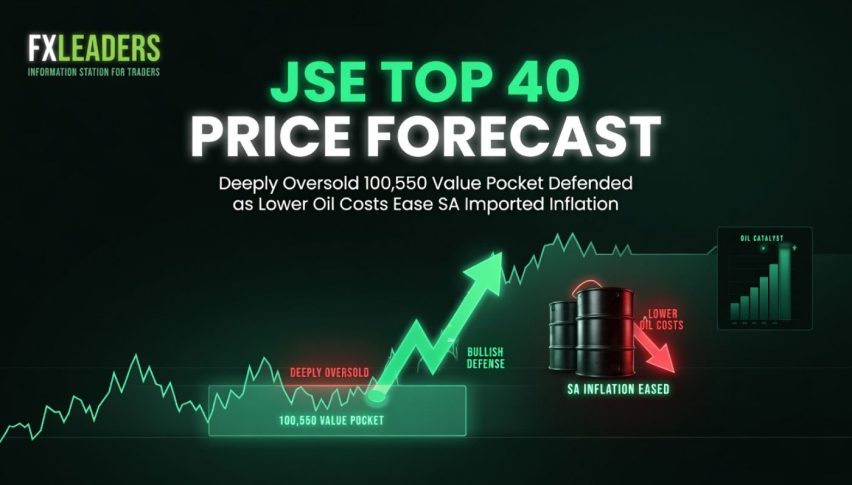
JSE Top 40 Price Forecast: Deeply Oversold 100,550 Value Pocket Defended as Lower Oil Costs Ease SA Imported Inflation
The broad, long-term strengthening of Africa's largest stock index has now entered a high-intensity period where price stability relies...
Quick overview
- The JSE Top 40 Index is experiencing price stability challenges due to conflicting macroeconomic forces, with recent trading showing a slight correction.
- The implementation of the U.S.-Iran peace treaty has significantly reduced imported inflationary pressures for South Africa, benefiting the stock market.
- Falling energy prices and unexpectedly soft CPI data have led analysts to revise their outlook on the South African Reserve Bank's monetary policy.
- Despite high global capital constraints from the U.S. Federal Reserve, the JSE Top 40 is poised for a potential rebound due to favorable domestic inflation and energy costs.
The broad, long-term strengthening of Africa’s largest stock index has now entered a high-intensity period where price stability relies upon conflicting macroeconomic forces, with domestic policy shifts countering the tightening of the global currency liquidity regime. At midday trading hours on Tuesday, June 23, 2026, the JSE Top 40 Index hit its short-term resistance level around 102,402.5, reflecting an intra-day correction of -0.54%. Major trading institutions are currently looking to absorb liquidations as the index retraces, building long-term defensive equity positions directly above core structural floors.
U.S.-Iran Treaty Shatters Imported Inflationary Pressure for SA
A critical positive catalyst underpinning the performance of the South African stock market is the rapid implementation of the “Islamabad Memorandum of Understanding” which represents the first phase of the peace treaty between the U.S. and Iran. The formal ratification of the cross-border treaty occurred in Switzerland, on June 19. With tensions at the Hormuz Strait easing rapidly, transit levels of maritime commercial vessels have recovered quickly to around 85% of normal levels.
South Africa, as an oil-importing country, benefits greatly from the collapse in front-month Brent crude oil prices, which recently broke below $74 a barrel. This development provides immediate relief in the face of the energy crisis in the first half of the second quarter of 2026, during which price increases were R3.27 a litre for petrol and R5.27 a litre for diesel. The energy shocks are now set in reverse, easing costs across the logistics sector, which helps businesses, immediately preserving corporate margins for index-heavy commercial conglomerates.
Unexpectedly Soft CPI Data in May Shifts SARB Policy Rate Path
The relief provided by falling energy prices has contributed to a broader set of positive data, prompting analysts to revise their views on the South African Reserve Bank’s rate-setting policy:
- CPI Buffer: May data released on June 17 for the Consumer Price Index was released in May, and was below expectations, as the 12-month annual consumer price increase was 4.5 percent, compared to a consensus of 4.7 percent to 5.0 percent.
- Long-Term Inflationary Dampeners: Local food inflation dropped to a 17-month low at 1.6 percent in May, aided by the summer harvest which was at 21.1 million tons in total.
Despite Governor Lesetja Kganyago’s Monetary Policy Committee’s (MPC) prior 25-basis-point hike of the repo rate to 7.00 percent at its May meeting, in order to mitigate the potential for second-round pricing effects, the recent deceleration in global energy costs weakens the “non-linear inflation” scenario. While several large brokerages have priced in one final 25-basis-point defense in their rate-setting at the end of its cycle at the next policy rate setting meeting on July 23, the cooling inflation trajectory minimizes the risk of an aggressive, multi-stage domestic tightening cycle.
Warsh Dollar Push Raises Cost of Capital in Rand
The major impediment to a sustained rebound in the JSE Top 40 Index remains the highly restrictive stance at the U.S. Federal Reserve, which met at its June 16 to 17 meetings, as it marked the first monetary policy setting by Fed Chair Kevin Warsh. Warsh, whose public stance is that of a hard-line monetarist, has cited persistent consumer-price pressures, specifically a 4.1 percent annual rise in the core CPI and 3.8 percent in headline inflation, which rule out interest-rate cuts in the second half of 2026.
The Warsh Fed has raised the Federal funds rate to its maximum point and signaled a shift in the interest-rate outlook in its projection charts. Both real U.S. bond yields and the U.S. Dollar Index (DXY) are now at cyclical highs, which are forcing capital flight from riskier assets and leading to a weaker trend across the USD/ZAR exchange rate. As a result, funds have fled from liquid equity investments. For exporters in sectors including gold and precious metals, a lower Rand provides a cushion, as this inflates their localized rand-denominated revenues and shields the Top 40 from deeper liquidations.
JSE Technical Analysis: Top 40 Consolidates At The Bottom Of A 4H Descending Channel
Shifting focus from the central bank’s remarks to the 4H chart, the JSE Top 40 is now pressing firmly into a very wide technical demand block of high volume.
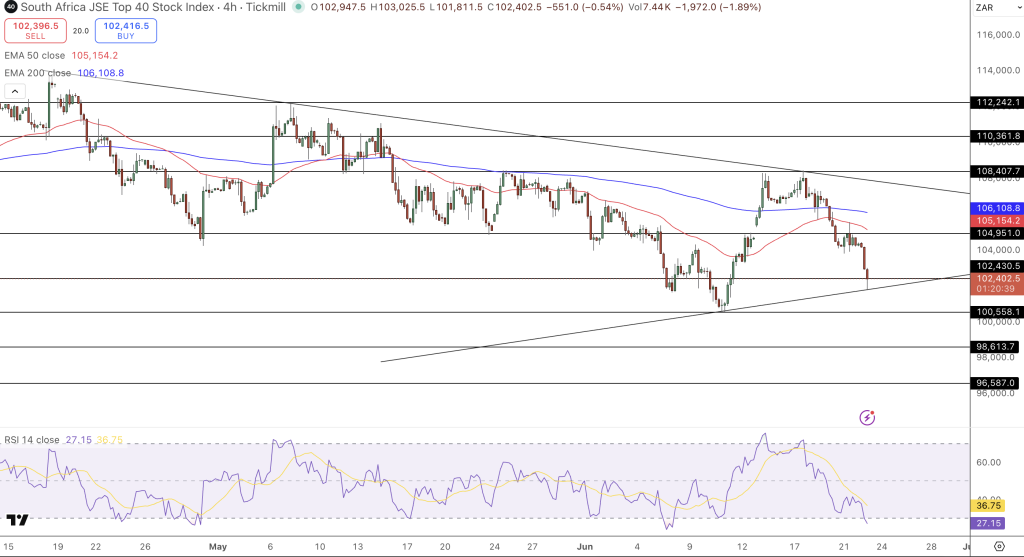
- The Channel Flush Structure: Respect for a dominant descending channel continues to dominate the JSE Top 40 with a series of large consecutive red candles driving the index into a deep test of historical horizontal price levels. The market trades firmly capped from below at the downward sloping 4H EMA50 (105,154.2) and 4H EMA200 (106,108.8).
- Severe momentum exhaustion confirmed: The 14 period RSI is deep within oversold territory at a low of 27.15. This indicates that short term traders have likely hit temporary limits to their selling capacity and are now likely to be short covering.
- The Trading Plan:
Bullish Mean Reversion Plan
Due to the extremely overextended state of the price action, swing traders could consider waiting to initiate long positions in the market on a valid candlestick setup in the area of 100,558.1. The index should be placed in an initial stop loss order below 98,613.7. Targets to take profits in this setup are initially 104,951.0 to a second target of 105,154.2.
Bearish Trend Continuation Plan
Longer term trend traders are wise to avoid selling the market from these oversold areas, but instead sell the index on intraday bounces of weak volume back into the 104,951.0 to 105,154.2 supply zone with stop losses in 106,500.0 and targets to 96,587.0.
As far as macro fundamentals are concerned, the JSE Top 40 is currently in the process of a healthy re-calibration. With Kevin Warsh’s unyielding, data-dependent Federal Reserve maintaining high global capital constraints across emerging-market assets, the emerging market asset class will continue to face high capital constraints for now.
Domestic inflation, however, has yet to spike and sits comfortably at 4.5%, industrial energy prices continue to decline and the technical 4 hour chart is oversold to the extreme. Taken in the aggregate this means that the JSE Top 40 is currently well primed to stage a strong relief rebound in the final stages of the cycle leading into late June.
- Check out our free forex signals
- Follow the top economic events on FX Leaders economic calendar
- Trade better, discover more Forex Trading Strategies
- Open a FREE Trading Account
- Read our latest reviews on: Avatrade, Exness, HFM and XM

Related Articles

Sidebar rates

Related Posts
 Save
Save