WTI Crude Oil Price Forecast: $69.90 Target Eyes Bearish Acceleration in 4H Descending Channel
The worldwide energy complex continues to undergo drastic re-pricing, in which the removal of geopolitical risk premia from paper futures...
Quick overview
- The global energy market is experiencing significant re-pricing due to the removal of geopolitical risk, aligning prices with near-term oversupply realities.
- The successful U.S.-Iran Interim Peace Treaty has restored tanker flow through the Hormuz Strait, alleviating supply fears and increasing Iranian crude oil availability.
- Fed Chair Kevin Warsh's hawkish stance on interest rates is impacting energy demand, contributing to downward pressure on WTI prices.
- Technical analysis indicates WTI is in a bearish descending channel, with potential trading strategies focusing on both bearish and bullish setups.
The worldwide energy complex continues to undergo drastic re-pricing, in which the removal of geopolitical risk premia from paper futures is bringing the price structure in line with the realities of near-term oversupply. On Monday June 22 2026 WTI was down -0.80% in early U.S. afternoon trading to $74.76 per barrel as traders de-hedged longs in favor of physical inventories and rising non-OPEC supply.
Islamabad MOU Signals Return of Tanker Flow
One of the major fundamental themes driving the current WTI de-risking is the successful conclusion of the U.S.-Iran Interim Peace Treaty, a.k.a. the “Islamabad Memorandum of Understanding.” Since the formal signing of the agreement last June 19 in Switzerland, commercial shipping through the Hormuz Strait is back to around 85% of normal capacity, as the U.S. has ended its tanker blockade in the Middle East and Iranian crude oil is flowing into the global market. Supply fear concerns in the spring have been removed with the re-emergence of Iranian flows, coinciding with OPEC+ plans to ease production discipline by increasing supply by 188,000 barrels per day in July; the global logistics network is adapting to a surplus in oil supply from the rapid recovery of Iranian volumes, higher U.S. shale production and the prospect of an OPEC+ supply increase.
Hawkish Warsh Debut Targets Inflation through Higher Rates
In the macro world, demand for energy is reacting to the deeply restrictive interest rate regime implemented June 16-17, the official debut of Fed Chair Kevin Warsh. Under a rules-based monetary policy, Chair Warsh kept the central bank’s statement brief and focused attention on inflation risks from persistently sticky prices in an area where the 4.2% year-over-year headline CPI in May was much hotter than expected. By keeping the Fed Funds Rate at the restrictive zone of 3.50% to 3.75%, adjusting the “dot plot” to demonstrate that nearly all policymakers see steady or rising rates through the end of 2026 and signaling hawkish monetary conditions for longer, the Warsh Fed has been a key driver for real interest rates and the U.S. Dollar Index (DXY). Both have been a headwind for WTI, as stronger dollars weigh on global demand for dollar-priced commodities.
4H Technical Analysis: WTI Crude Oil Bears In Charge Inside 4H Descending Channel
While macro themes remain the most important force for WTI price action over the next several months, let’s take a quick look at the 4H WTI chart, in which price action is still well contained within a typical bearish descending channel pattern.
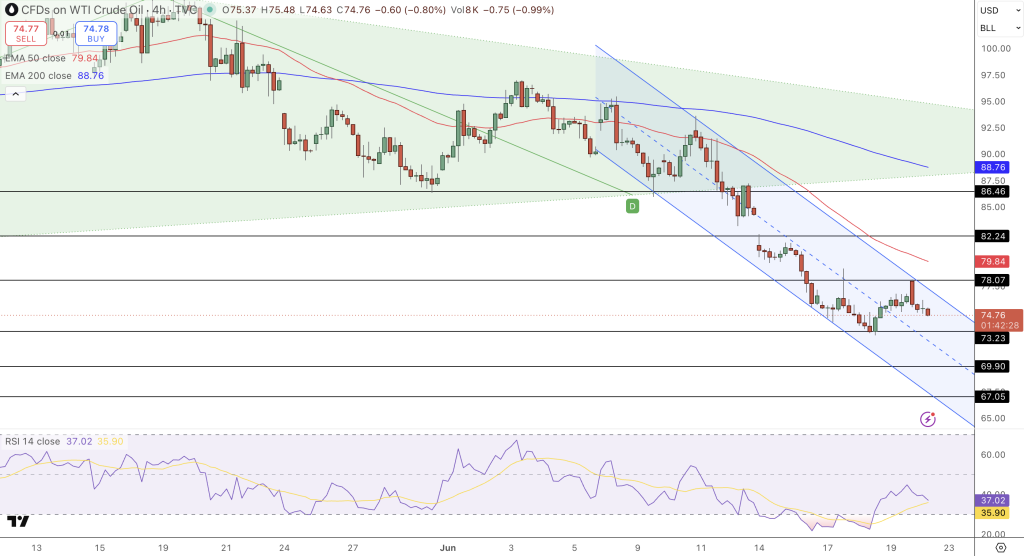
- The Channel Breakdown Setup: WTI oil is well contained within a large descending channel structure (Point D). The presence of a long series of large-bodied red candles indicates that the near-term direction of price momentum is under the control of sellers, as price is well below the 4H EMA50 at $79.84 and 4H EMA200 at $88.76.
- Oversold Price Extension: The 14-period RSI sits at around 37.02, signaling that selling pressure is overdone, but the contracting MACD histogram also means that there could be a short-term cooling or trading range consolidation before the next leg down.
- The Trading Plan: There are two trading setups that we can focus on in a trading plan:
- Bearish Trend-Continuation: Short dips into support at the horizontal trend resistance line at $78.07, with a stop placed above $82.24 (the current invalidation zone) and a first target at $73.23 (channel support) and a second target at $69.90 (liquidity area at a major support level).
- Bullish Reversal: If EIA oil stockpiles data results in a short squeeze higher in oil prices, look for a buy signal with the 4H candle closing above $78.50, first targeting the 4H EMA50 at $79.84 with a stop below $75.50.
All in all, crude oil prices should return to normal after the geopolitical crisis passes. Despite the fact that OPEC+ still has the power to constrain supply in the long run, the combination of new Iranian supply flows, new U.S. shale supply and a more hawkish, data-driven Fed under Chair Warsh should keep WTI near support at $69.90 later in June.
- Check out our free forex signals
- Follow the top economic events on FX Leaders economic calendar
- Trade better, discover more Forex Trading Strategies
- Open a FREE Trading Account
- Read our latest reviews on: Avatrade, Exness, HFM and XM

Related Articles



Sidebar rates

Related Posts
 Save
Save