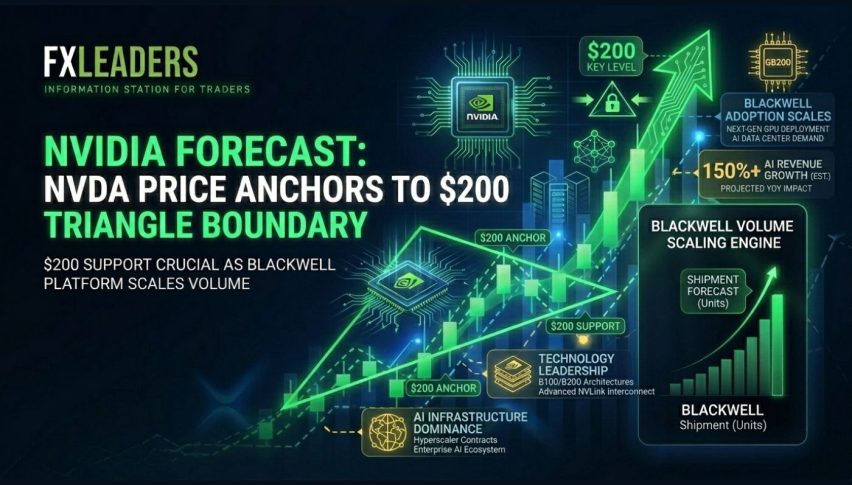
NVIDIA Forecast: NVDA Price Anchors to $200 Triangle Boundary as Blackwell Platform Volume Scales
The market structure underpinning big-name semiconductor stocks looks sturdy. It's trying to hold its ground as the world's leading...
Quick overview
- The semiconductor market, particularly for NVIDIA, is showing resilience despite a challenging macroeconomic environment.
- NVIDIA's Blackwell production ramp is insulated from scrutiny on IT spending, driven by strong corporate demand for AI hardware.
- The recent U.S.-Iran peace accord has lowered operational energy costs for AI data centers, benefiting NVIDIA's margins.
- Technical analysis indicates that NVDA is nearing a potential breakout, with key resistance and support levels identified for trading strategies.
The market structure underpinning big-name semiconductor stocks looks sturdy. It’s trying to hold its ground as the world’s leading chip ramp prepares for its biggest ever while also facing one of the most hostile global macro environments. Thursday June 25, 2026 saw NVDA begin its regular session trading in the high $200s at $200.61. This level of stability was created by algorithmic large cap and sovereign buys that have been deployed to soak up the paper profits as the market has been consolidated across a broad swath of technology names.
Blackwell Production Velocity Bypasses Broad IT Spending Scrutiny
NVIDIA Blackwell production ramp remains insulated from overall IT spending scrutiny. This has been the key element that has driven the stock higher this past quarter. Corporate IT spending is currently experiencing significant scrutiny given the elevated cost of capital and extended procurement cycles. However, hyperscaler capex spending for AI hardware remains robust.
Large cloud providers continue to approve billions in multi-year infrastructure spending on the acquisition of NVIDIA Blackwell compute systems.
The urgency for the deployment of these units is high given the large installed software base of the company, CUDA, and the struggle of traditional hardware OEMs to gain market share with a software driven business.
Cautious Warsh Monetary Regime Enhances Long-Term Carry Costs
Cautious warsh interest rate regime increases carry cost over time. In spite of this overall robust environment, NVIDIA is battling with the restrictive domestic monetary policy posture maintained by newly installed Fed Chairman Kevin Warsh.
The Fed held rates in the current cycle given the data dependent monetarist framework. Fed Chairman Kevin Warsh indicated that with the core inflation rate remaining sticky at 4.1 percent, the Fed is committed to leaving interest rates at these higher levels to achieve stable prices and employment.
This has contributed to yields on 10 year U.S. Treasuries and the U.S. Dollar Index reaching multi year cycle highs. This has increased the cost of capital and reduced speculative leverage throughout the market. This has forced tech growth models to be much more revenue based given the higher cost of capital.
Swiss Peace Accord Lowers Operational Energy Costs for AI Data Centers
Iran peace accord has helped decrease operational costs of AI data centers on the geo-political side. The global risk environment has gained further confidence given the successful deployment of the U.S. and Iran peace accord signed in Switzerland known as the Islamabad Memorandum of Understanding last week.
Commercial shipping routes have returned to roughly 85% capacity, given the restored maritime traffic through the critical Strait of Hormuz.
This has helped pull crude oil spot futures below $73 per barrel. While this has decreased allocations to safe haven asset classes, lower energy costs help the operational expenses associated with running multi-megawatt scale AI data centers helping margin for the end consumer of the chip.
Technical Analysis: NVDA Compresses Within Mature Descending Triangle Base
The recent drop for NVDA has created a mature descending triangle pattern on the 2 hour timeframe. The 2 hour candle is currently trading right next to the diagonal upper trendline for this consolidation matrix right near $200.61. This is trading slightly below its 2H 50 ema at $204.89 and 2H 200 ema at $209.05. The 14-period RSI print is currently at 41.
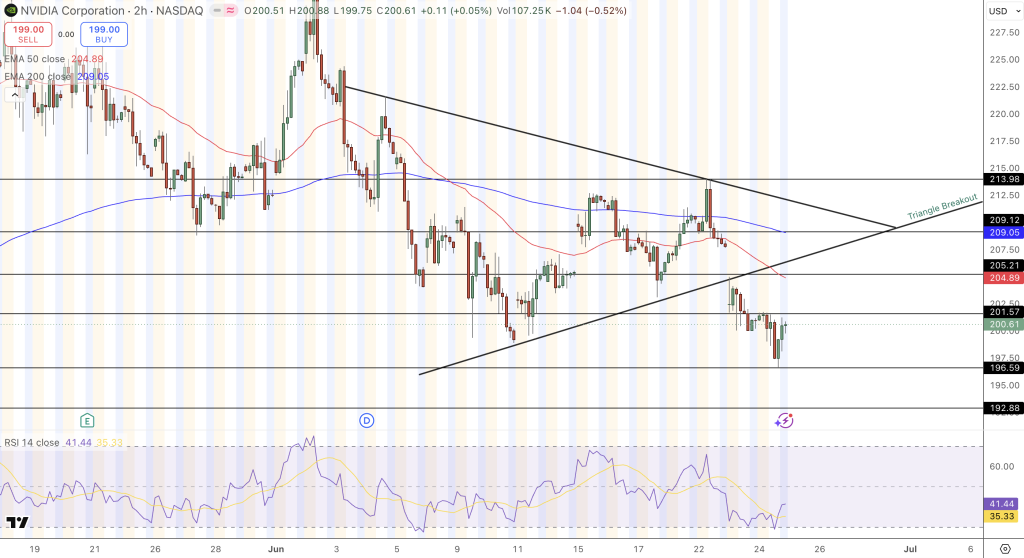
This indicates that the oversold conditions that occurred during the recent slide lower for NVDA from the $224 mark has been cleared. The MACD Histogram line is also relatively flat and indicates the selling volume in the near term is slowing and may be close to exhaustion at this level of support.
Conclusion and Trade Idea
Given the overall fundamental environment, NVIDIA remains a dominant player as the core hardware component in the overall global AI investment cycle. Fed Chairman Warsh has maintained a firm position on interest rates and overall financing costs for the broad market. Given this elevated level for rates, the overall cost of capital and carry cost on a high beta stock such as NVDA increases.
However, given the high priority status of overall Blackwell production ramp, we should be in good shape for the stock to break out from here given its overall fundamental setup. Rebound play, we suggest looking for a 2 hour candlestick close above its immediate resistance level of the 2H 50 ema at $204.89 or a bounce off the support level at $196.59, which is its lower horizontal boundary to the current descending triangle.
For stop loss, we suggest looking to keep below the horizontal support shelf at $192.88. Price target should look for a bounce towards the 2H 200 ema level at $209.05 with extension price targets reaching the horizontal supply area at $213.98.
- Check out our free forex signals
- Follow the top economic events on FX Leaders economic calendar
- Trade better, discover more Forex Trading Strategies
- Open a FREE Trading Account
- Read our latest reviews on: Avatrade, Exness, HFM and XM

Related Articles

Sidebar rates

Related Posts
 Save
Save