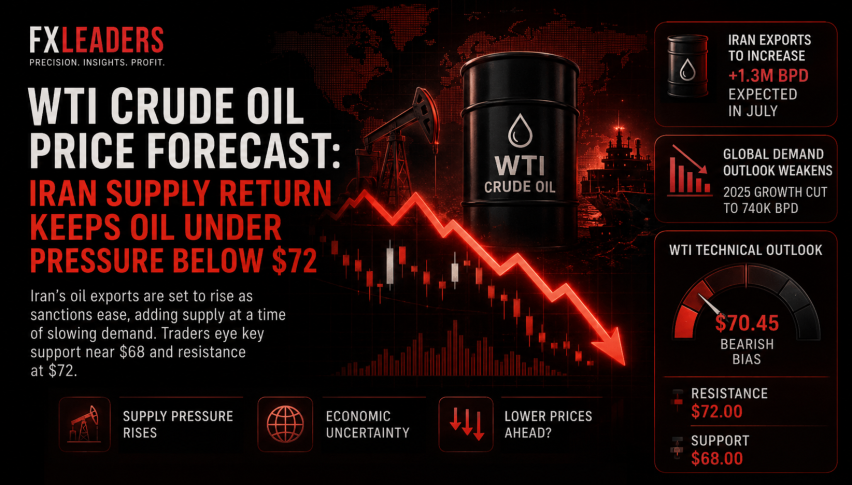
WTI Crude Oil Price Forecast: Iran Supply Return Keeps Oil Under Pressure Below $72
WTI crude stays down as prices re-pricing after the drastic change in the supply outlook. The US benchmark was at $71.93 on July 10, having
Quick overview
- WTI crude prices have declined to $71.93 as the market adjusts to a new supply outlook following the U.S.-Iran interim agreement.
- The return of Iranian crude has diminished the geopolitical risk premium, impacting market expectations for oil supply disruptions.
- OPEC+ is set to increase output while U.S. production remains high, but demand growth is slowing, particularly in developed economies.
- Technical analysis indicates that WTI crude faces resistance at $74.16, with support at $69.90, influencing future price movements.
WTI crude stays down as prices re-pricing after the drastic change in the supply outlook. The US benchmark was at $71.93 on July 10, having given back most of the geopolitical premium that saw prices hit their highest levels earlier this year.
With the U.S.-Iran interim agreement now formally in place and reopening the Strait of Hormuz to oil transit, alongside allowing further Iranian crude to reach the markets, attention is likely to be directed to supply levels from oil producing countries, inventories and demand growth.
Given the weaker crude prices, the market does not seem oversupplied. Rather, it depends on the OPEC+ production policy, U.S. production and global consumption for oil prices to stabilize in the coming weeks or continue to slide.
Iranian Supply Returns as the Market Adjusts to a New Balance
The reason for the recent weakness in crude prices seems to be the return to the previous level of supply following the signing of the Islamabad Memorandum of Understanding, or the U.S.-Iran interim agreement on June 19, which saw the Strait of Hormuz reopen to commercial shipping and Iranian crude to reach the global oil markets, alongside the return of normal tanker levels.
Consequently, the re-introduction of Iranian crude into the market seems to have removed most of the geopolitical risk premium that has been in place for crude oil prices throughout the first half of the year. While the implementation of the accord is ongoing with international oversight, it has altered the market expectations that saw a focus on oil supply disruptions from the Middle East.
Furthermore, OPEC+ continues on its planned output increase of nearly 188,000 bpd in July as members start to remove the voluntary output cuts. The group has signaled that it is committed to stabilizing the oil markets, but the market will closely watch its inventory and demand figures as a signal of further increases.
Beyond OPEC+, non-OPEC supply is still strong. U.S. oil production is hovering near record highs and production in places like Brazil, Guyana and Canada continue to increase. The American oil producers, however, have remained mostly focused on capital discipline, keeping operations tight and prioritizing efficiency over drilling, even at a time of falling prices.
Oil demand growth remains strong but at a slower pace. The International Energy Agency and OPEC continue to forecast oil demand growth of 1.2 million bpd for 2026, primarily driven by developing markets. However, lower growth rates in the developed economies, improving fuel efficiency and higher debt servicing have kept consumption lower.
The macroeconomic backdrop has also been unfavorable to commodity prices. With the Federal Reserve remaining on a higher-for-longer interest rate stance, the US dollar has strengthened and this has led to a higher US dollar premium on commodities and kept oil prices from making further significant strides.
WTI Faces Strong Resistance While Buyers Defend Channel Support
On the charts, WTI crude is continuing to trade within a channel on the two-hour time frame with the market recovering after it found support from recent lows.
Buyers continue to defend support at $69.90, with the overall trend remaining bearish so long as prices don’t reclaim levels below the key resistance area. The first level of resistance is $74.16, coinciding with the 0.236 Fib retracement level and the top of the channel. The next resistance is seen around $74.95, and the subsequent barrier is placed at $76.11.
Below this level, $69.90 remains the first line of support. Should prices break below this level, the next support is $67.84, with the 1.272 Fib extension at around $65.60 remaining under consideration as well.
The 200-period EMA at $79.53 continues to confirm the downtrend, with several rejections at this resistance level since.
Technical indicators have remained bearish, although there have been some signs that pressure is easing. The RSI currently sits at around 40.5, implying weak momentum despite being away from the oversold territory. In turn, the MACD histogram continues to improve with no immediate reversal of the prevailing momentum in the market.
WTI Crude Oil Price Outlook
We can conclude that WTI crude oil has entered a phase where supply and demand are once again driving oil prices. The continued return of Iranian exports and non-OPEC output is expected to be countered by slower oil supply increases from OPEC+ and stable growth in global consumption.
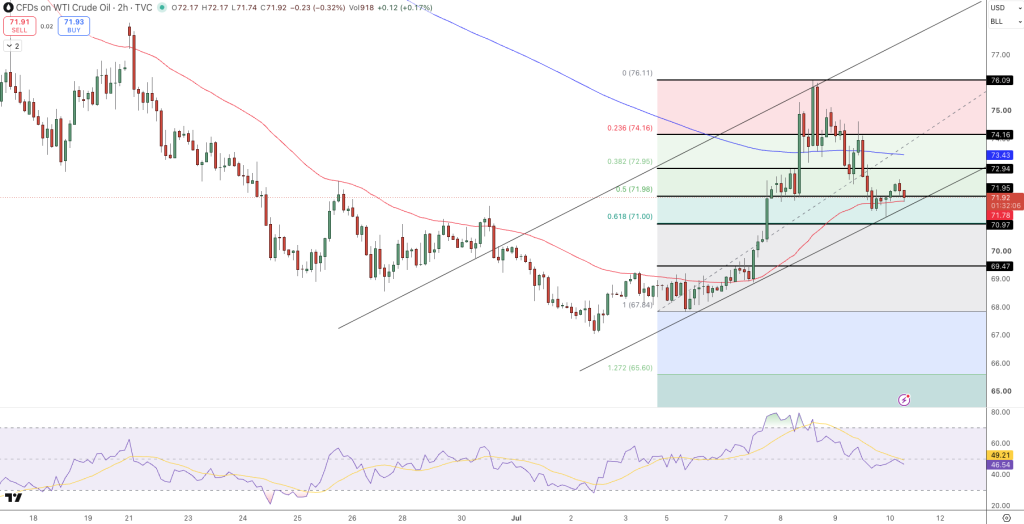
From a technical perspective, the first barrier for WTI crude buyers is $74.16, with oil prices targeting $74.95 and $76.11 should it breakout above this level. Conversely, a decline below $69.90 would imply the continuation of the current downtrend, with next stop being at $67.84. Crude oil price direction is likely to be driven by the next set of US inventory data and comments from OPEC+, as well as macroeconomic releases.
- Check out our free forex signals
- Follow the top economic events on FX Leaders economic calendar
- Trade better, discover more Forex Trading Strategies
- Open a FREE Trading Account
- Read our latest reviews on: Avatrade, Exness, HFM and XM

Related Articles

Sidebar rates

Related Posts
 Save
Save