JSE Top 40 Forecast: Commodity Strength Faces Fed Pressure as Index Tests 103,750 Resistance
The FTSE/JSE Top 40 Index remains a target of selling pressure, trading at 101,541 on July 10, as investors consider the combination...

Quick overview
- The FTSE/JSE Top 40 Index is under selling pressure, trading at 101,541 as investors weigh commodity prices against South Africa's weak economic growth.
- Falling oil prices are lowering inflation expectations, while high global interest rates and a strong U.S. dollar are limiting capital inflows into emerging markets.
- The index's performance is closely tied to resource companies, with strong precious metal prices supporting mining earnings despite high interest rates and local demand challenges.
- Key resistance for the JSE Top 40 is at 103,756, with potential bullish movement if this level is surpassed, while support levels to watch are at 100,364 and below.
The FTSE/JSE Top 40 Index remains a target of selling pressure, trading at 101,541 on July 10, as investors consider the combination of supportive commodity prices, tighter global monetary policy, and weak economic growth in South Africa.
While falling oil prices have contributed to lower inflation expectations in South Africa, the strengthening U.S. dollar and high global interest rates continue to hinder inflow of capital into emerging countries.
Commodity Prices and Banking Earnings Continue to Shape Market Direction
With the majority of the JSE Top 40’s value still concentrated in resource companies (especially in the mining and financial sectors), the index is still closely related to the movement of the world’s key precious metals and industrial commodities, and also the price action of the South African rand and interest rate expectations.
Gold prices, which currently exceed $4,000 an ounce, continue to be supportive of major mining companies’ earnings margins, while platinum group metals prices remain well below their respective peaks but continue to benefit from improving demand in the industrial sector. In addition, iron ore prices are currently hovering around $105 per tonne and supported by increased infrastructure spending in China, and coal exports continue to benefit from resilient Asian demand.
Meanwhile, with the signing of an Islamabaad Memorandum of Understanding between the United States and Iran on June 19, oil prices are dropping below $73 a barrel following the normalization of shipping in the Strait of Hormuz, and in South Africa this translates into more favorable operating conditions and a reduced risk of inflation for the retail, manufacturing and logistics sectors.
Lower costs for both fuel and transport services are therefore seen as a positive sign for both consumers and businesses in South Africa.
With the South African Reserve Bank’s 7.25% repo rate, the banks are still enjoying strong net interest margin growth as they continue to benefit from South Africa’s high-interest environment. Meanwhile, borrowing costs have slowed mortgage demand and consumer credit growth.
Given the high level of domestic revenue that still remains within the banks’ business portfolios, the impact of high interest rates remains very relevant for these companies, with earnings outlook for the next few quarters still likely to be dictated by domestic inflation and the SARB monetary policy.
Finally, global economic conditions continue to matter for the JSE. In the same way that China’s economic growth continues to dictate the price of commodities (such as iron ore, manganese, platinum, and coal) that are majorly traded to it, it continues to be a key driver for many South African companies listed in the Top 40 that have significant exposure in that sector.
Moreover, the Fed’s high-for-longer interest rates are keeping the dollar elevated, placing a lid on the South African rand and the cost of foreign debt service in an environment in which many South African companies have significant exposure to currency mismatches.
JSE Top 40 Faces Key Resistance at 103,756
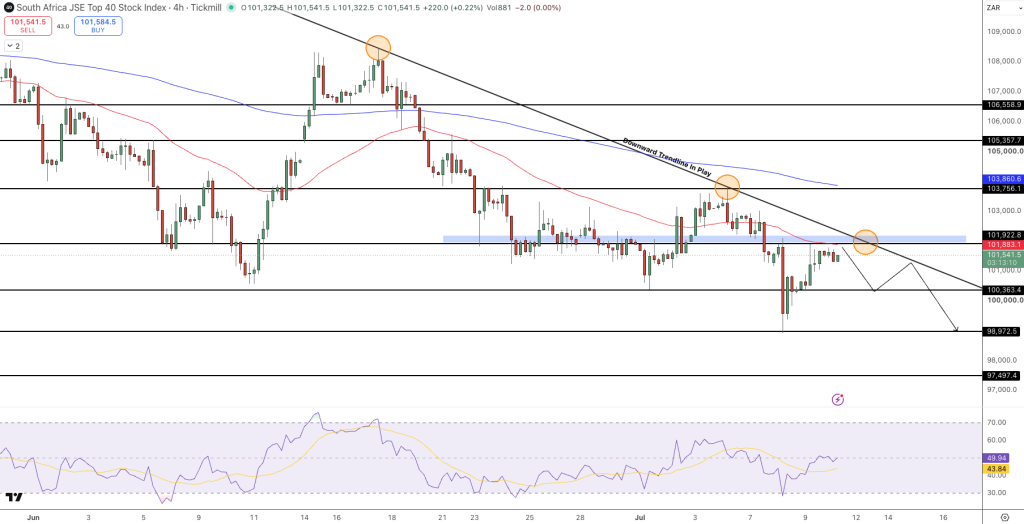
The JSE Top 40 has reached a major resistance level at 103,756. On the four-hour timeframe, the JSE Top 40 has broken down out of a long term descending trendline yet is currently trading below the 200-period EMA at 103,756, maintaining bearish bias after bouncing off near 101,541.
A decisive close above 103,756 would be bullish and open the way for 105,358, followed by 106,559. The next bearish levels of interest are support near 100,364, followed by 98,973 and 97,497.
While the RSI remains below 50 at 43.84, it is recovering from oversold and not getting more negative. And while the MACD histogram is yet negative it is flattening out. The JSE Top 40 is stuck between good commodity fundamentals and poor global financial conditions.
Good fundamentals:
-
strong precious metal prices
-
resilient mining earnings
-
cheap oil
Weak fundamentals:
-
high interest rates
-
rand volatility
-
weak local demand
Lastly, 103,756 is the resistance level bulls should be gunning for. If a break out takes place then 105,358 and 106,559 are on the board. If 100,364 support breaks and price drops lower, then 98,973 is the risk. Other factors to watch: commodity prices and the rand, Chinese data, and local inflation and monetary policy data.
- Check out our free forex signals
- Follow the top economic events on FX Leaders economic calendar
- Trade better, discover more Forex Trading Strategies
- Open a FREE Trading Account
- Read our latest reviews on: Avatrade, Exness, HFM and XM

Related Articles


Sidebar rates

Related Posts
 Save
Save