JBLU Stock Slips Toward $5.50 as JetBlue Debt Concerns Overshadow Cheap Valuation Signals
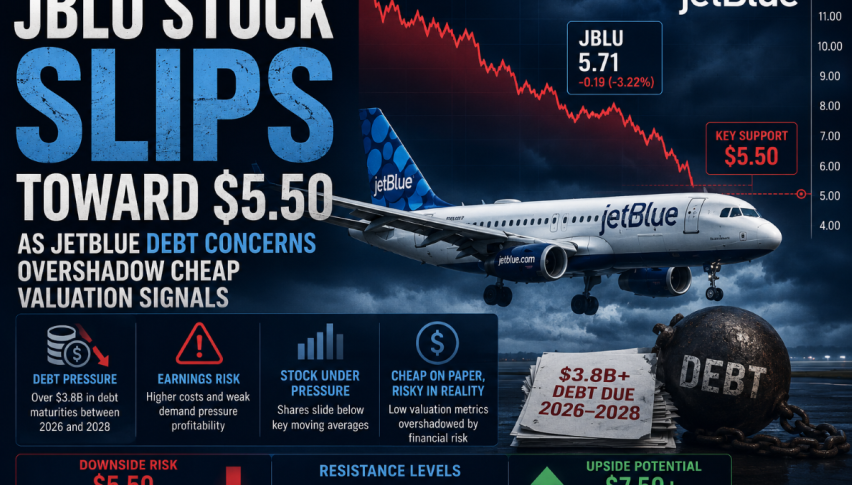
JetBlue stock JBLU tests $5.75 as debt worries and Chapter 11 talk challenge valuation hopes despite improving travel demand.
Quick overview
- JetBlue shares are under pressure due to concerns over heavy debt and weak profitability despite improving travel demand.
- The stock recently fell 2.70% to $5.76, remaining 11% below its 52-week high, while analysts express caution over its capital structure.
- JetBlue's low price-to-sales ratio suggests it may be undervalued, but negative earnings and liquidity issues raise red flags for investors.
- Management's focus on Fort Lauderdale and cost-cutting measures aim to improve efficiency, but the company must demonstrate sustainable profitability to regain investor confidence.
JetBlue shares remain under pressure as investors weigh improving travel demand and low valuation multiples against heavy debt, weak profitability, and capital structure concerns.
JetBlue Rally Loses Momentum After Analyst Downgrade
JetBlue Airways stock came under renewed pressure last week, falling 2.70% to $5.76 even as the Nasdaq Composite and Dow Jones Industrial Average both finished higher. The decline left JBLU around 11% below its 52-week high of $6.50, reached in early February.
The weakness follows a strong rebound in the stock, with TradingView data showing JBLU up more than 19% over the past month and around 26% year to date. However, the longer-term picture remains much weaker, with the stock still down more than 64% over five years.
That sharp contrast has become the central debate for investors. JetBlue looks inexpensive on some valuation measures, but profitability remains weak and debt concerns continue to limit confidence in a lasting turnaround.
Cheap Valuation Meets Weak Profitability
JetBlue currently trades at a low price-to-sales ratio near 0.2x, well below the broader airline industry average of roughly 0.6x. That makes the stock appear undervalued relative to its revenue base, especially for investors looking at a potential recovery in travel demand.
However, the discount reflects real concerns.
TradingView lists JetBlue’s market capitalization at about $2.14 billion, with annual revenue of $9.06 billion, but basic EPS remains negative at -$1.94. Net income for the latest fiscal year was negative at around $602 million, highlighting the company’s difficulty converting revenue into consistent profitability.
The stock also carries a high one-year beta of 2.32, making it more volatile than the broader market and more sensitive to changes in fuel prices, consumer travel demand, interest rates, and investor risk appetite.
For now, investors appear unwilling to reward JetBlue’s low sales multiple without clearer evidence that margins are improving.
Chapter 11 Talk Raises Equity Risk
The most damaging recent pressure came from Raymond James, which downgraded JetBlue to Underperform from Market Perform.
The firm acknowledged that JetBlue could benefit from Spirit Airlines’ recent weakness and that management has taken meaningful steps to improve the business, including building Fort Lauderdale into a more important hub.
However, Raymond James also warned that the stock’s recent rally leaves limited upside and that JetBlue’s capital structure remains a major issue. The analyst pointed to the company’s debt burden, liquidity constraints, and the impact of convertible debt with a conversion price near $6.12.
Most importantly, the firm argued that a Chapter 11 restructuring could be the more prudent long-term way to address JetBlue’s capital structure, even though such a move would likely be unattractive for current equity holders.
That comment has increased investor caution, because it shifts attention away from revenue recovery and toward balance sheet risk.
Fort Lauderdale Strategy Offers Long-Term Upside
Despite the concerns, JetBlue is not standing still.
The company has been shifting more focus toward Fort Lauderdale-Hollywood International Airport as part of a broader network optimization strategy. Management has also announced cost-cutting moves, including plans to close its flight attendant base at Newark Liberty International Airport and technology operations bases at Newark and LaGuardia.
The goal is to simplify operations, improve efficiency, and concentrate resources in markets where JetBlue believes it can build stronger profitability.
JetBlue has also launched new customer-focused initiatives, including Theme Park Experts, a service designed to help travelers bundle flights, hotels, and Orlando theme park tickets while earning TrueBlue points.
These moves support the long-term turnaround case. However, investors are still waiting to see whether network changes and product initiatives can produce sustainable margin improvement rather than temporary revenue gains.
Fuel Prices and Travel Demand Remain Key Catalysts
Recent bullish commentary from Goldman Sachs and Bank of America pointed to stronger-than-expected revenue trends, lower fuel prices, and healthy travel demand ahead of upcoming earnings.
Those factors remain important for JetBlue. Lower fuel costs can provide immediate margin relief, while strong leisure travel demand could support fares and load factors.
However, airline recoveries can be fragile. Rising fuel prices, weaker consumer spending, competitive fare pressure, or macro shocks could quickly reverse margin progress.
That is why investors remain divided. JetBlue may look cheap on sales, but the company still needs to prove that its recovery can survive a more difficult operating environment.
JBLU Technical Analysis: $5.50 Support Becomes Key
JBLU closed at $5.76 on July 10, before slipping slightly to $5.75 in after-hours trading.
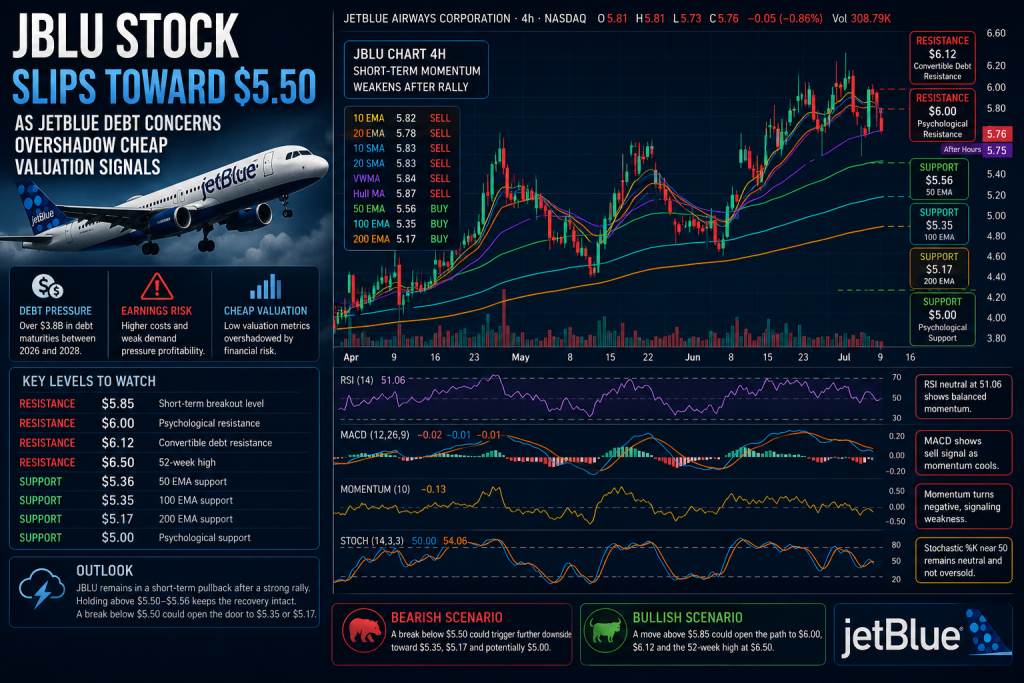
JBLU Chart 4H – Short-Term Momentum Weakens After Rally
The 4-hour chart shows a mixed technical setup. The stock is still trading above several important medium- and long-term moving averages, suggesting that the broader rebound has not fully broken down. The 50-period EMA sits near $5.56, while the 100-period EMA is around $5.35 and the 200-period EMA is near $5.17.
These levels form the key support structure for the current recovery.
However, short-term indicators have weakened. JBLU is trading below the 10-period EMA at $5.82 and the 20-period EMA at $5.78, both of which are flashing sell signals. The 10-period SMA at $5.83, 20-period SMA at $5.83, VWMA at $5.84, and Hull Moving Average at $5.87 also remain above the current price, creating immediate resistance.
Oscillators are mostly neutral, with the RSI at 51.06 and Stochastic %K at 50.00. That suggests the stock is not oversold yet. However, Momentum and MACD are both showing sell signals, confirming that the recent pullback has weakened short-term buying pressure.
The first major support level sits around $5.56, near the 50-period EMA. A break below that area could expose JBLU to $5.35, followed by the 200-period EMA zone near $5.17. If selling accelerates, the psychologically important $5.00 level would become the next major downside target.
On the upside, buyers need to reclaim $5.85 first. A move above that level could bring $6.00 back into focus, followed by the convertible debt resistance area near $6.12 and the 52-week high at $6.50.
JetBlue’s Recovery Story Still Faces Capital Pressure
JetBlue’s investment case remains highly divided.
On one hand, the stock looks inexpensive on sales, travel demand remains supportive, fuel costs have improved, and management is taking steps to simplify the network and strengthen key hubs.
On the other hand, weak profitability, heavy debt, analyst concerns over capital structure, and recent Chapter 11 commentary continue to overshadow the recovery narrative.
For now, JBLU remains technically vulnerable below $5.85. Holding the $5.50-$5.56 support area would keep the rebound structure alive, but a decisive break below that zone could open the door toward $5.35 and $5.17.
A recovery above $6.00 would help restore confidence, but investors may remain cautious until JetBlue proves that its operational changes can translate into sustained profitability and balance sheet improvement.
- Check out our free forex signals
- Follow the top economic events on FX Leaders economic calendar
- Trade better, discover more Forex Trading Strategies
- Open a FREE Trading Account
- Read our latest reviews on: Avatrade, Exness, HFM and XM

Related Articles



Sidebar rates

Related Posts
 Save
Save