ORCL Stock Tests $140 as Oracle’s $638B AI Backlog Faces Debt, Cash Flow and Rating Pressure
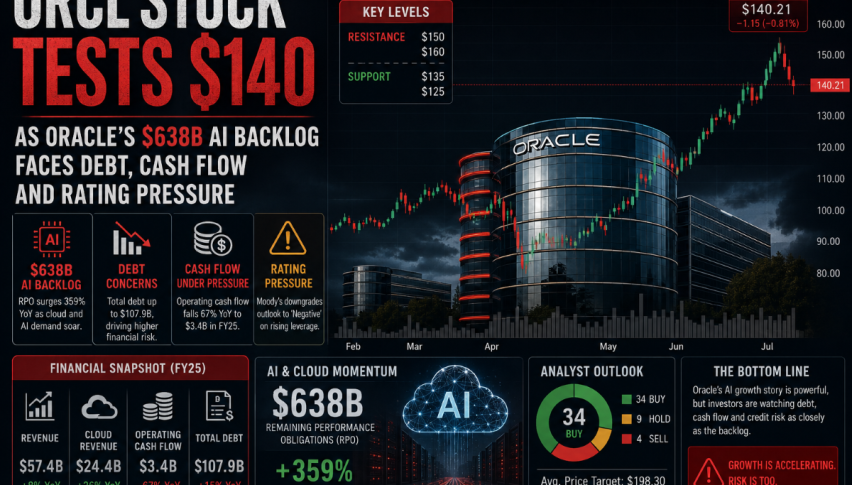
Oracle stock ORCL tests $140 as AI backlog optimism collides with BBB- downgrade, cash burn risk and bearish moving averages.
Quick overview
- Oracle's stock is under pressure as investors doubt its ability to convert a massive AI order book into cash amid rising debt and data center spending.
- The company's recent S&P downgrade to BBB- raises concerns about its capital requirements and cash flow execution, with projected capital spending significantly higher than previous forecasts.
- Oracle's reliance on OpenAI for a substantial portion of its performance obligations introduces counterparty risk, complicating its long-term growth outlook.
- Despite advancements in AI products, investor confidence is shaken by funding concerns, with the stock remaining technically vulnerable below key resistance levels.
Oracle shares remain under heavy selling pressure as investors question whether its massive AI order book can convert into cash fast enough to support rising debt and data center spending.
Oracle Slides as AI Infrastructure Boom Becomes a Funding Test
Oracle has become one of the most important AI infrastructure names in the market, but the stock’s recent decline shows that investors are no longer rewarding backlog growth without asking how much capital it will require.
The company’s remaining performance obligations have reached $638 billion, reflecting enormous demand for cloud and AI infrastructure capacity. Fiscal 2026 revenue rose 17% to $67.4 billion, while fourth-quarter cloud infrastructure revenue increased 93% to $5.8 billion.
Those figures would normally support a bullish growth narrative.
However, the market’s focus has shifted from demand to funding. Oracle’s AI infrastructure buildout requires major data center investment, long-term leases, power commitments, and external capital. As a result, investors are now questioning whether Oracle can turn its massive order book into cash quickly enough to protect margins, credit quality and shareholder value.
ORCL’s S&P Downgrade Intensifies Investor Concerns
The biggest recent pressure came from S&P Global Ratings, which downgraded Oracle’s long-term issuer credit rating to BBB- from BBB.
That places Oracle just one notch above junk territory, increasing the importance of future cash flow execution. The agency cited rising business risk from Oracle’s rapidly expanding AI infrastructure business, higher capital expenditure requirements, uncertain profitability, customer concentration and weaker free operating cash flow.
S&P now expects Oracle’s fiscal 2027 capital spending to reach $90 billion to $95 billion, far above its previous forecast of $60 billion. It also projects a free operating cash flow deficit near $42 billion.
This downgrade has changed the market conversation. Oracle’s AI backlog still looks impressive, but investors are increasingly concerned that growth may require too much debt, equity issuance and lease exposure before profits fully materialize.
OpenAI Exposure Adds Concentration Risk
Oracle’s AI opportunity is also becoming more concentrated.
S&P estimates that OpenAI accounts for roughly half of Oracle’s $638 billion remaining performance obligations. That relationship gives Oracle significant exposure to one of the most important AI companies in the world, but it also creates a major counterparty risk.
If OpenAI continues expanding rapidly and remains well-funded, Oracle’s infrastructure bet could generate substantial long-term returns. But if AI demand slows, funding conditions tighten, or OpenAI reduces spending, Oracle could be left with long-term data center lease obligations and specialized infrastructure that may be difficult to re-lease on attractive terms.
This risk is especially important because some customer contracts are shorter than the lease commitments Oracle has taken on to support them. Investors are therefore questioning whether the company’s long-term obligations are fully matched by equally durable revenue streams.
UK Oversight Adds Another Layer of Complexity
Regulatory pressure is also increasing.
UK regulators are beginning direct oversight of Oracle and other major cloud providers as critical suppliers to financial institutions. That will bring additional resilience testing, self-assessments, incident reporting and compliance obligations.
The new oversight confirms Oracle’s growing importance in global cloud infrastructure, but it also adds costs and operational complexity. For a company already facing investor scrutiny over capital intensity, even incremental compliance burdens may reinforce caution.
Oracle’s AI Products Support Long-Term Growth Case
Despite the pressure, Oracle continues to advance its enterprise AI strategy.
The company recently introduced Oracle Autonomous AI Database Agent-to-Agent Server, a fully managed capability embedded within Oracle Autonomous AI Database. The product is designed to help enterprise clients discover, invoke and govern AI agents across multi-agent systems without deploying separate server infrastructure.
This fits Oracle’s broader pitch: enterprises need AI systems that are governed, secure, observable and integrated with existing databases and cloud environments.
The launch highlights Oracle’s strength in database-native AI, security and enterprise software. It also reinforces the long-term case that Oracle is not only selling raw compute capacity, but also building AI infrastructure and software tools for regulated corporate customers.
However, these product gains have not been enough to offset concerns around funding, leverage and cash flow.
ORCL Technical Analysis: Moving Averages Point to Strong Sell
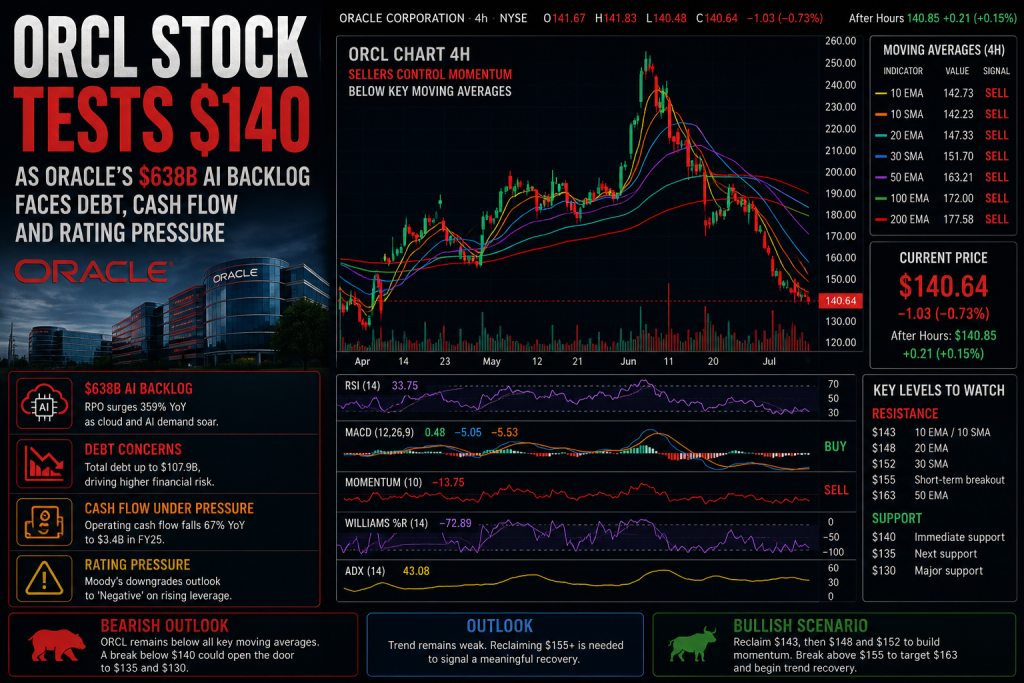
ORCL closed at $140.64 on July 10, with after-hours trading slightly higher at $140.85.
ORCL Chart 4H – Sellers Control Momentum Below Key Moving Averages
The 4-hour technical structure remains clearly bearish. Oracle is trading below every major moving average listed on the 4-hour chart, confirming that sellers remain in control despite signs that the stock may be approaching oversold territory.
The 10-period EMA stands near $142.73, while the 10-period SMA sits around $142.23. These levels now form the first short-term resistance area. Above that, the 20-period EMA near $147.33 and 30-period SMA near $151.70 create the next resistance zone.
The heavier resistance levels are much higher. The 50-period EMA is near $163.21, while the 100-period EMA is around $172.00 and the 200-period EMA is near $177.58. Until Oracle can reclaim at least the $150-$155 region, the broader short-term trend remains damaged.
Oscillators are less extreme but still cautious. The RSI at 33.75 is neutral but close to oversold territory, while the Williams Percent Range near -72.89 also suggests selling pressure has been intense. The MACD level is showing a buy signal, which may point to a possible short-term rebound attempt, but Momentum remains on sell and the ADX at 43.08 indicates that the current trend has strength.
Key Levels to Watch
The first downside support is the $140 level, which is now the immediate technical battleground. A break below $140 could expose ORCL to $135, followed by the $130 area if selling accelerates.
On the upside, buyers need to reclaim $143 first, followed by $148 and $152. A move above $155 would be the first meaningful sign that the recent selloff is stabilizing.
However, the larger technical recovery would require Oracle to move back above the 50-period EMA near $163. Until then, rallies may continue to face selling pressure from investors reducing exposure after the downgrade.
Oracle’s Backlog Strength Overshadowed by Cash Conversion Risk
Oracle’s long-term AI opportunity remains significant. The company has strong enterprise relationships, a fast-growing cloud infrastructure business, a massive AI backlog and new database-native AI products that could support future growth.
But the near-term market is focused on a different question: how much capital will Oracle need before that growth turns into durable free cash flow?
The BBB- downgrade, projected $42 billion free cash flow deficit, customer concentration risk and potential equity issuance have all weakened investor confidence. Strong bookings alone may no longer be enough to support the stock if investors believe each new contract requires heavy outside financing.
For now, ORCL remains technically vulnerable below the $143-$148 resistance zone. A rebound above $155 would help ease pressure, but a decisive break below $140 could open the door toward $135 and $130 as investors continue testing the credibility of Oracle’s AI infrastructure strategy.
- Check out our free forex signals
- Follow the top economic events on FX Leaders economic calendar
- Trade better, discover more Forex Trading Strategies
- Open a FREE Trading Account
- Read our latest reviews on: Avatrade, Exness, HFM and XM

Related Articles

Sidebar rates

Related Posts
 Save
Save