WTI Crude Oil Price Forecast: Can Oil Reclaim $75 as OPEC+ and Iran Reshape Global Supply?
WTI crude oil is changing hands around $74.51 per barrel today, July 13, 2026. But rather than rallying on geopolitical fears, the price...
Quick overview
- WTI crude oil is currently priced at $74.51 per barrel, influenced more by supply and inventory dynamics than geopolitical tensions.
- Iran's oil production has increased following the US-Iran interim deal, reducing concerns about Middle East supply disruptions.
- OPEC+ is gradually increasing production while non-OPEC supply remains strong, contributing to a potential market balance.
- Macroeconomic factors, including a strong U.S. dollar and Federal Reserve policies, continue to impact oil prices and demand expectations.
WTI crude oil is changing hands around $74.51 per barrel today, July 13, 2026. But rather than rallying on geopolitical fears, the price is reacting more to the supply and inventories and demand picture for crude. Much of the Middle East supply premium is now gone from oil prices since the US-Iran interim deal. Traders are now worried about OPEC+ ramps, non-OPEC supply, US inventories, and demand.
Even though short-term price action may still fluctuate around that level, the market as a whole will continue moving towards balance. At least for now, this market is back to its core fundamentals.
Iran’s oil production is back as a Middle East risk premium disappears
2026 has been a big change in the oil market, and one of the major shifts is Iran’s supply. After the US-Iran interim deal at the middle of June, Iran’s oil exports have returned. Since the deal also reopened the Strait of Hormuz, through which close to 20% of global oil passes, oil traders are now less worried about disruptions to Middle East oil supplies.
The movement of oil tankers has begun moving back up to the same levels as before the conflict, and Iran’s exports have continued to go up since the agreement was reached and sanctions were lifted. While Iran is still not exporting all it used to before the deal and the sanctions, the market has assumed more Iranian exports will flow in through the second half of this year.
With the uncertainty around the supply side reduced, the oil market is now dropping its war time premium on oil prices. The price is now closer to where it was before the war, and the upside volatility has reduced to some extent. But traders will continue to keep an eye on this agreement, and a potential failure of it could cause volatility to rise again.
OPEC+ and non-OPEC continue to increase supply
OPEC+ continues to manage its supply as well to balance the market and is in no rush to increase oil prices. The alliance will continue to add 188,000 bpd for July and August production as the group continues to unwind its voluntary production cuts.
And outside of OPEC, supply growth continues. The US remains producing near record highs at around 13.5 million bpd, while oil production has grown in Brazil, Guyana, and Canada, and it remains strong across the world in both of those regions. All the added supply, including Iran’s oil, may help bring the oil market into balance or even create a small surplus later in 2026.
On the oil demand side, the International Energy Agency expects oil demand growth to be around 1.2 million bpd this year. Consumption will continue to grow in the major oil importers in the Asia Pacific region including China, India, and other new oil demanders, as well as in developing countries. Oil consumption has grown less in the US and Europe because of higher efficiency, electric cars, and tighter monetary policy. In contrast, crude oil stockpiles in the U.S. have seen intermittent build-up over recent weeks. This signals that supply is still sufficient, even during the peak summer fuel season.
Federal Reserve And Dollar Strength Continue To Weigh On Commodities
Macroeconomics is still weighing heavily on oil prices. After persistent inflation, as the headline CPI remains near 3.8% and the Federal Reserve keeps rates higher for longer, the U.S. dollar remains stronger. A rising dollar makes crude more expensive to international buyers and, therefore, puts a lid on prices.
Even as low oil prices are helping to bring inflation down globally, central bankers remain in no hurry to cut rates. Consequently, traders are looking to U.S. inflation releases, Federal Reserve commentary, weekly EIA crude oil inventory updates and Chinese data to gauge future demand.
In the near term, expectations for the oil market will continue to be dependent on:
- The status of Iranian oil exports returning to the global market and its ability to ship crude through the Hormuz Strait.
- Decisions made by OPEC+ in regards to production levels going forward.
- Weekly reports of U.S. crude inventory.
- Chinese activity and general global demand data.
- U.S. Federal Reserve policy and strength of the greenback.
WTI Crude Oil Technical Analysis: Fibonacci Resistance Limiting Rebound
On a 1-hour chart, the WTI benchmark is hovering around $74.51 after bouncing off the lower boundary of a descending channel. However, the price has stalled out near the 0.236 Fibonacci level at $74.16, where bears are stepping back in.
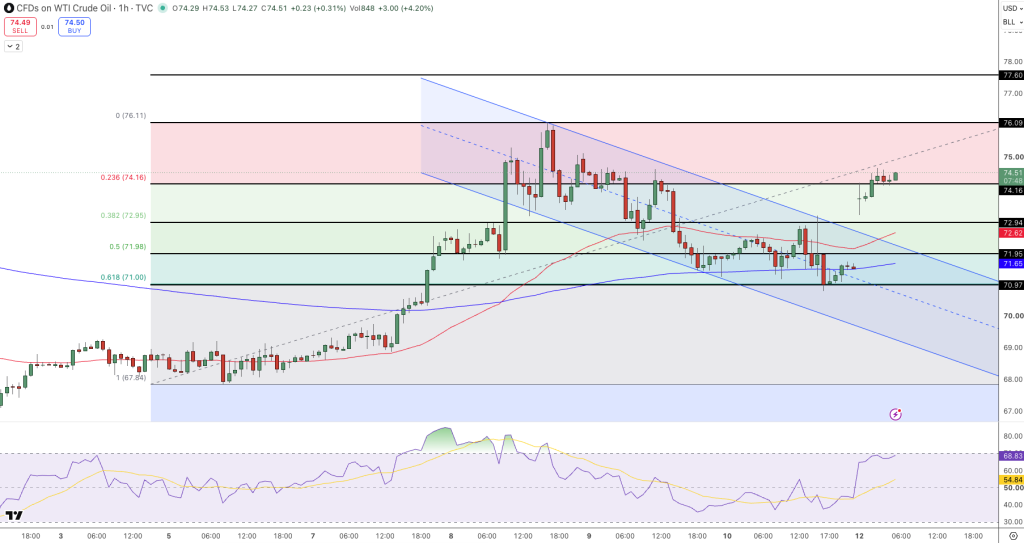
The 200-period EMA sits at $79.53, maintaining the overall downside trend and the descending channel in place. In the immediate term, overhead resistance comes in at $74.16, then $74.95 (0.382 Fibonacci) and finally $76.11. Initial support lies at $69.90, followed by downside targets at $67.84 and $65.60 (1.272 Fibonacci extension).
Oversold conditions remain muted with a Relative Strength Index reading of 40.54, while the MACD remains below the midpoint after improving moderately.
WTI Crude Oil Price Forecast
WTI continues to consolidate after the market has digested higher Iranian output, OPEC+ production hikes and strong growth in supply from other producers. Although buyers have defended support around $69.90, the broader trend remains down below the 200-period EMA.
In the event of a breakout above $74.95, prices are expected to extend to $76.11. However, if price cannot hold above the Fibonacci level, bears will attempt to take back $69.90 and $67.84. With no major fundamental shifts on the horizon and no fresh geopolitical flashpoints, the outlook for crude oil appears range-bound but on the bearish side.
- Check out our free forex signals
- Follow the top economic events on FX Leaders economic calendar
- Trade better, discover more Forex Trading Strategies
- Open a FREE Trading Account
- Read our latest reviews on: Avatrade, Exness, HFM and XM

Related Articles
Sidebar rates

Related Posts
 Save
SaveAva

