TSLA Stock to Head Above $400 on Analyst Upgrade as Chip and Robotaxi Narrative Regains Focus
Tesla rebounds sharply after a steep decline, as improving sentiment, analyst upgrades, and long-term AI potential help reignite investor...
Quick overview
- Tesla shares have rebounded sharply after a significant decline, gaining nearly 8% in one day and extending a five-day rally of around 12%.
- An upgrade from UBS from 'sell' to 'neutral' has boosted investor confidence, despite maintaining a price target of $352.
- Tesla's legal victory regarding its corporate relocation has reduced uncertainty and reinforced management's strategic direction.
- The company's focus on custom silicon for its Full Self-Driving system positions it competitively in the autonomous vehicle market.
Live TSLA Chart
[[TSLA-graph]]
Tesla rebounds sharply after a steep decline, as improving sentiment, analyst upgrades, and long-term AI potential help reignite investor interest.
Rebound After a Difficult Stretch
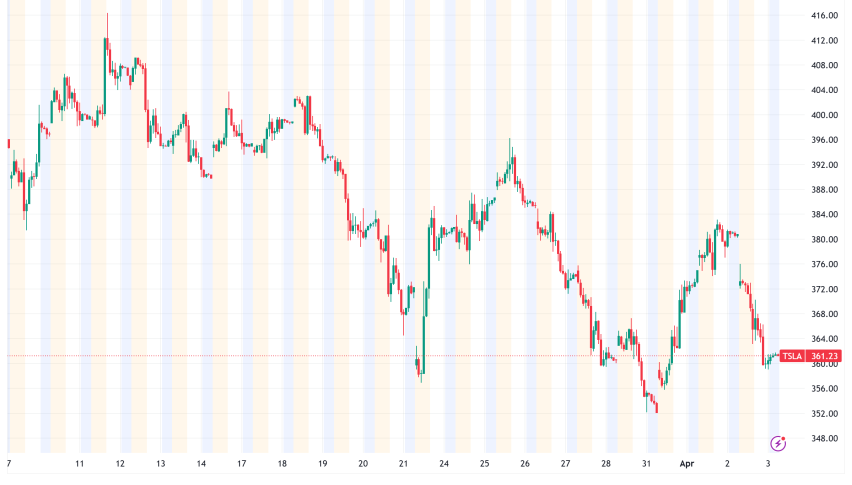
Tesla shares have been under sustained pressure since late December after failing to break above the $500 level. The downtrend accelerated into April, with the stock falling as low as $345 following disappointing first-quarter delivery figures.
However, momentum has shifted this week. TSLA has staged a strong rebound, climbing toward $400 and gaining nearly 8% on Wednesday alone. The move extends a five-day rally of around 12%, suggesting a potential shift in short-term sentiment.
Analyst Upgrade Sparks Optimism
A key catalyst behind the rebound is an upgrade from UBS, which raised its rating on Tesla from “sell” to “neutral.” While the firm maintained its $352 price target, the shift in stance from a previously bearish position has been enough to boost investor confidence.
For a stock that has faced persistent skepticism, even a modest upgrade can trigger meaningful price action, particularly when positioning is heavily skewed to the downside.
Legal Win and Strategic Confidence
Tesla also scored a legal victory as a shareholder lawsuit challenging its corporate relocation was moved from Delaware to Texas. While not directly tied to financial performance, the ruling removes a layer of uncertainty and reinforces management’s strategic direction.
At the same time, Tesla’s vertically integrated model continues to gain attention. Unlike competitors relying on third-party suppliers, Tesla designs key components in-house, including batteries and AI chips. This approach is increasingly seen as a competitive advantage.
Chip Strategy in Focus
Tesla’s custom silicon efforts are becoming central to its long-term narrative. By designing chips optimized for its Full Self-Driving system, the company aims to outperform rivals using third-party hardware from firms like Nvidia and Qualcomm.
If Tesla can successfully deliver fully autonomous vehicles at scale, the potential upside is significant. The robotaxi market alone is projected to be worth hundreds of billions, and Tesla’s integrated hardware-software approach could position it as a leader in this space.
Tesla Steadies After a Powerful Run
Tesla entered the final stretch of 2025 with extraordinary momentum, carrying its share price to a record high just shy of $500. That rally reflected strong enthusiasm around the company’s long-term vision in autonomy, artificial intelligence, and next-generation manufacturing. As often happens after such a sharp advance, however, the stock entered a period of consolidation as investors took profits and reassessed positioning.
Shares retreated roughly 30% from the December peak of $498.80, briefly testing support indicators near the $350 area. The pullback coincided with broader market unease, including the war on Iran from US-Israeli armies.
TSLA Chart Daily – The 200 SMA Acting A Support

Following the earnings release, Tesla shares rebounded to $382 but failed to move above the 100 daily SMA (red). The sales miss weighed on TSLA on Thursday, sending it to $337 but the stock reversed this week and on Wednesday we saw a strong rebound, sending TSLA close to $400 and above the 100 SMA (red) which suggests that the larger bullish trend is resuming.
China Remains a Key Growth Engine
Tesla’s earlier strength was supported by strong performance in China. The company sold 58,600 China-made Model 3 and Model Y vehicles in February, marking a 91% year-over-year increase.
Although sales declined month-over-month due to seasonal factors like the Lunar New Year, the broader trend remains positive. China continues to be one of Tesla’s most important markets for both domestic sales and exports.
Shanghai Factory Anchors Global Strategy
The Shanghai Gigafactory plays a central role in Tesla’s global operations, serving as both a production hub for China and a key export base for Europe and other regions.
Its scale and efficiency provide a cost advantage, especially as competition from local EV manufacturers intensifies. Maintaining strong output from this facility will be critical for Tesla’s global competitiveness.
Delivery Miss Raises Concerns
Tesla’s recent weakness was largely triggered by its Q1 2026 delivery report. The company delivered 358,023 vehicles, missing expectations of around 370,000 units.
Production reached 408,386 vehicles, creating a notable gap between output and deliveries. While the miss was not dramatic, it was enough to unsettle investors given high expectations following a strong 2025.
Margins and Financial Position
Despite revenue pressures from pricing competition, Tesla has shown resilience on profitability. Gross margins improved to 20.1%, supported by cost efficiencies and easing input costs.
The company also generated $1.42 billion in free cash flow, slightly below expectations but still reflecting solid financial health. Continued investment in AI, manufacturing, and future technologies remains a priority.
Long-Term Vision Remains Intact
Under Elon Musk, Tesla continues to push deeper into artificial intelligence, robotics, and automation. Initiatives like Optimus and advancements in autonomous driving highlight its ambition to evolve beyond a traditional automaker.
For many investors, these long-term opportunities—particularly in AI and robotaxis—remain central to the investment case.
Conclusion
Tesla’s rebound reflects improving sentiment and renewed confidence in its long-term vision. However, challenges remain, including delivery volatility, rising competition, and execution risks. Sustaining the recovery will depend on Tesla’s ability to deliver on both its near-term targets and its ambitious AI-driven future.
- Check out our free forex signals
- Follow the top economic events on FX Leaders economic calendar
- Trade better, discover more Forex Trading Strategies
- Open a FREE Trading Account
- Read our latest reviews on: Avatrade, Exness, HFM and XM

Related Articles

Sidebar rates

Related Posts
 Save
Save