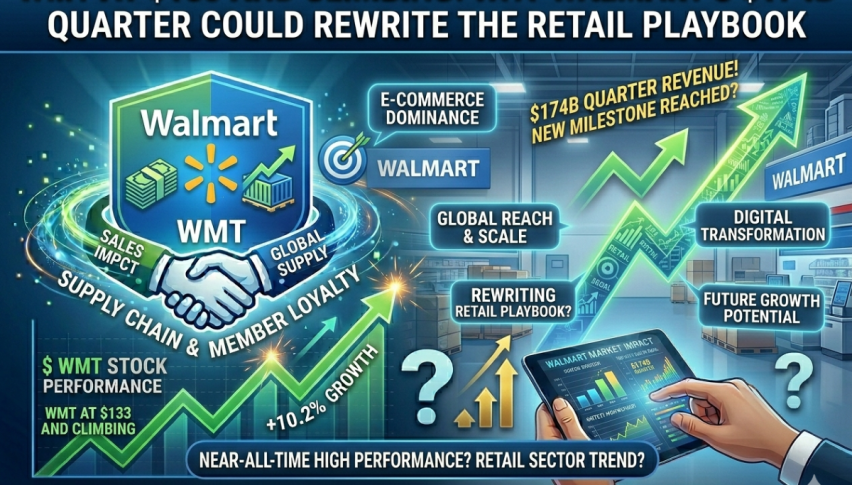
WMT at $133 and Climbing: Why Walmart’s $174B Quarter Could Rewrite the Retail Playbook
Walmart reports May 21. Analysts eye 8% EPS growth, 24% e-commerce surge, and $174B revenue, as WMT stock trades near all-time highs.
Quick overview
- Walmart's upcoming earnings report is highly anticipated, with analysts expecting adjusted EPS of $0.66 and revenue of $174.8 billion.
- The company is benefiting from a trade-down effect as higher-income consumers seek value amid inflation, which could positively impact same-store sales.
- Analysts are bullish on Walmart's stock, raising price targets across the board, but caution remains due to potential macroeconomic headwinds like fuel costs and tariff uncertainties.
- Walmart's growth engines, particularly in e-commerce and advertising, are redefining its long-term valuation, making it a compelling investment despite current risks.
With earnings due Thursday and a wave of analyst upgrades rolling in, Walmart heads into its most closely watched report of the year. Here’s everything investors need to know — from fundamentals to technicals to the macro headwinds ahead.
It’s a real-time X-ray of the American consumer. With inflation running hot, gasoline prices up 50% in recent months, and trade policy still clouding the outlook, Walmart’s results will tell investors how households across every income tier are holding up.
The stock is within striking distance of its all-time high of $134.69. A fresh wave of analyst upgrades suggests the market believes this quarter could push it there.
What Analysts Expect From Walmart Earnings on May 21
Wall Street is looking for adjusted EPS of $0.66 — up more than 8% versus the $0.61 earned a year ago. Revenue is expected to top $174.8 billion, rising roughly 6% year over year. Net income is forecast at around $7.97 billion for the quarter ending April 30.
EPS growth is outpacing revenue growth. That’s a signal of improving operational leverage — a company getting not just bigger, but smarter.
Here are the key metrics analysts are watching:
- Same-store sales (Walmart U.S.): Expected at +3.9% without fuel impact. A year ago the figure was 4.5%, so the bar has dipped — making a beat more achievable.
- E-commerce growth: Consensus calls for a 24% surge, fueled by marketplace expansion and third-party seller momentum. This is the segment redefining Walmart’s long-term valuation multiple.
- Advertising revenue: Analysts project global ad growth of 30%. This high-margin business is rapidly becoming one of Walmart’s most important profit engines.
- Membership revenue: Projected at $1.75 billion, up 7.3% year over year — driven by Walmart+ and Sam’s Club subscriptions.
- Walmart International net sales: Expected at $33.82 billion, up a strong 13.7% year over year.
- Sam’s Club comp sales: Forecast at +3.3% without fuel — a notable step-down from 6.7% posted a year ago.
- Net income per share: Last quarter WMT earned $0.74, beating the $0.73 estimate. The earnings surprise streak is a key part of the bull case.
“Walmart is earning 11 cents in every extra retail dollar — and that share is growing.” — Logan Capital Management, May 2026
Walmart Is a Trillion-Dollar Machine Gaining Speed
Walmart’s financials are staggering in scale. Full-year revenue hit $713 billion. Net income came in at $21.89 billion. EBITDA reached $44.03 billion. The company employs 2.1 million people worldwide.
But what makes Walmart genuinely interesting right now isn’t its size. It’s the quality of its growth engines.
- The ad business that’s changing everything. Walmart Connect, the company’s retail media network, is becoming a high-margin cash machine. Advertising revenue grew at double-digit rates in recent quarters and analysts project 30% growth in Q1. This isn’t a side hustle — it’s a structurally superior business layered on top of grocery economics.
- E-commerce: the pivot is working. A 24% e-commerce growth forecast isn’t just impressive — it’s evidence of a strategic shift paying off. Marketplace expansion, faster fulfillment, and Walmart+ are compounding. The company now reaches grocery dollars from roughly 90% of U.S. households.
- The trade-down effect. Inflation is Walmart’s unlikely ally. When prices rise, higher-income consumers migrate toward Walmart for value. Bank of America analysts flag this explicitly — and it’s showing up in same-store sales driven by wealthier shoppers trading down. The bigger the macro pressure, the more Walmart benefits.
Analyst Consensus on Walmart (WMT) Stock: Bullish With Caveats
Wall Street has been raising targets all week. The move is broad-based — spanning growth-oriented and value-oriented analysts alike.
| Firm | Price Target | Rating |
|---|---|---|
| Bank of America | $150 | Buy |
| UBS | $147 | Buy |
| Bernstein | $145 | Buy |
| Piper Sandler | $137 | Overweight |
| Wolfe Research | $137 | Neutral |
| Barclays | $132 | Neutral |
The range — from $132 to $150 — reflects genuine disagreement about how much premium to assign to Walmart’s ad and e-commerce businesses versus headwinds from fuel costs and tariff uncertainty.
Walmart is not expected to raise full-year guidance. Given elevated oil prices and trade policy risk, management will likely stay conservative. That could temper enthusiasm even if the quarter beats expectations.
WMT Stock Technical Analysis: Approaching All-Time Highs
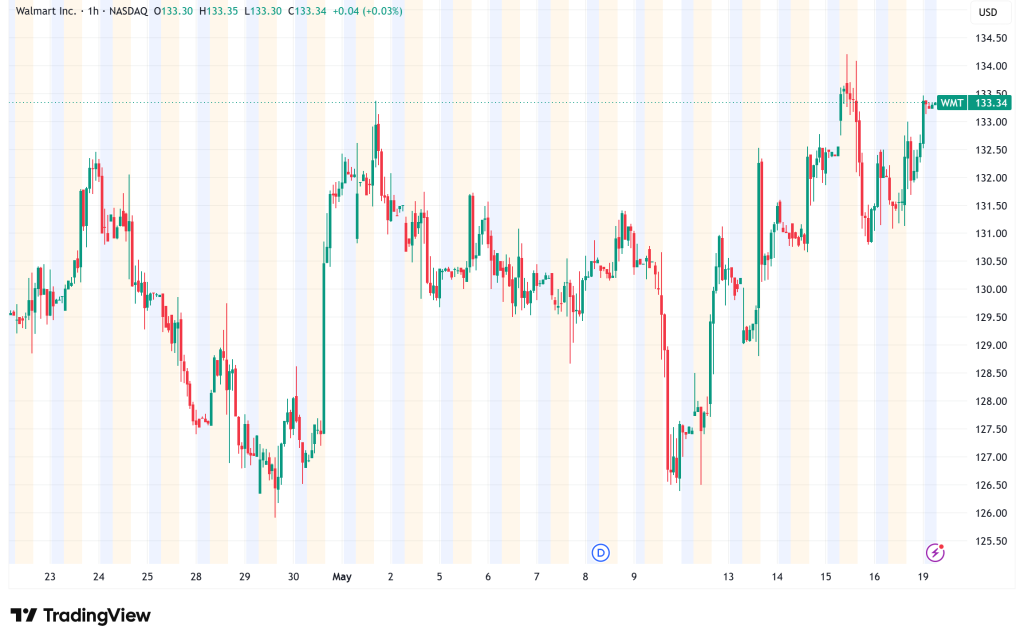
WMT is trading at $133.34 — just $1.35 below its all-time high of $134.69 set in February 2026. The stock has gained 19.6% year-to-date, dramatically outperforming a volatile S&P 500.
TradingView’s technical summary shows a buy signal on both the 1-week and 1-month timeframes. Moving averages are broadly constructive. The stock’s low beta of 0.56 confirms its defensive character — it held up well even as the broader market sold off sharply on Friday.
- Bull scenario. A strong beat on EPS and comp sales, paired with upbeat management commentary, could fuel a breakout above the $134.69 all-time high. The next meaningful resistance sits near $140–$145. Market speculation of a stock split — if WMT approaches $160 — adds an additional longer-term catalyst.
- Bear scenario. An in-line result with cautious guidance — particularly around fuel headwinds or tariff pass-through — could trigger a “sell the news” pullback. Support sits in the $125–$127 range. A deeper correction floor appears near $118–$120, based on prior consolidation zones.
Key technical levels to watch: the $125–$127 support band and the $134.69 all-time high resistance. Volume will be the tell. A breakout on heavy volume carries conviction. A pop on thin volume after earnings deserves more caution.
Walmart’s Macro Headwinds Are Real, But Manageable
No Walmart analysis is complete without flagging the risks. They are real — and they are exactly why Barclays and Wolfe Research remain neutral.
- Fuel costs: Gasoline prices are up 50% in recent months. Morgan Stanley estimates elevated diesel costs could translate into a $1 billion annualized headwind. Walmart operates the nation’s largest private trucking fleet.
- Food inflation: U.S. food prices rose 3.2% year over year in April, per Bureau of Labor Statistics data. Grocery makes up about two-thirds of Walmart’s U.S. sales — sustained food inflation pressures margins even as it drives foot traffic.
- Tariff uncertainty: Walmart has pledged to hold prices on essentials as long as possible, but discretionary categories have already seen increases. Management’s tariff commentary will be one of the most watched elements of Thursday’s call.
- Leadership transition: This is CEO John Furner’s first quarter at the helm, having taken over from Doug McMillon on February 1. Markets will be listening closely for tone and any signals of strategic shift.
- Decelerating comps: A 3.9% comp growth figure compares against 4.5% a year ago at Walmart U.S., and Sam’s Club drops from 6.7% to a projected 3.3%. Deceleration is baked in — the question is whether reality matches or beats expectations.
“Rates increasingly reflect a higher-for-longer inflation regime, while equities continue to price a far more benign outcome. Something eventually has to give.” — Wolfe Research, May 2026
Walmart (WMT) Long-Term Potential: Why the Premium May Be Earned
Walmart trades at 46.44x trailing earnings — a rich multiple for what some still call a brick-and-mortar retailer. But that label misses the story entirely.
What Walmart is becoming is a three-engine machine: a dominant grocery and essentials retailer, a fast-growing e-commerce marketplace, and an advertising platform with Amazon-like economics. That combination justifies a meaningfully higher multiple than traditional retail.
The long-term chart makes the compounding clear. WMT has delivered a 38.6% return over the past year, 171% over five years, and 446% over ten years. It has compounded through recessions, supply shocks, and multiple rounds of retail disruption.
A potential stock split — likely if the price exceeds $160 — could broaden the retail investor base and add a fresh wave of buying interest. Precedent from prior splits suggests this is a non-trivial catalyst specifically for WMT.
What Should Walmart Traders Watch Next?
Walmart enters Thursday’s earnings report from a position of genuine strength. E-commerce momentum, advertising growth, and the trade-down tailwind all point toward a solid quarter. The fundamentals support the bull thesis.
The risk is in the setup, not the business. At $133 — a whisker from its all-time high — a clean beat may already be partially priced in. Watch whether management raises, holds, or softens full-year guidance. That commentary, more than the headline EPS number, will likely determine price action through the rest of May.
For long-term investors, the thesis remains intact. For short-term traders, the risk/reward at the $134.69 resistance level warrants discipline on position sizing heading into the report.
- Check out our free forex signals
- Follow the top economic events on FX Leaders economic calendar
- Trade better, discover more Forex Trading Strategies
- Open a FREE Trading Account
- Read our latest reviews on: Avatrade, Exness, HFM and XM

Related Articles


Sidebar rates

Related Posts
 Save
Save