Costco (COST) Eyes All-Time High Above $1,000 as Sales Surge, Inflation Returns, and Digital Clicks
Costco (COST) stock hits 52-week high at $1,076. Up 25% YTD, with 13% April sales growth and a digital boom. Is a breakout imminent?
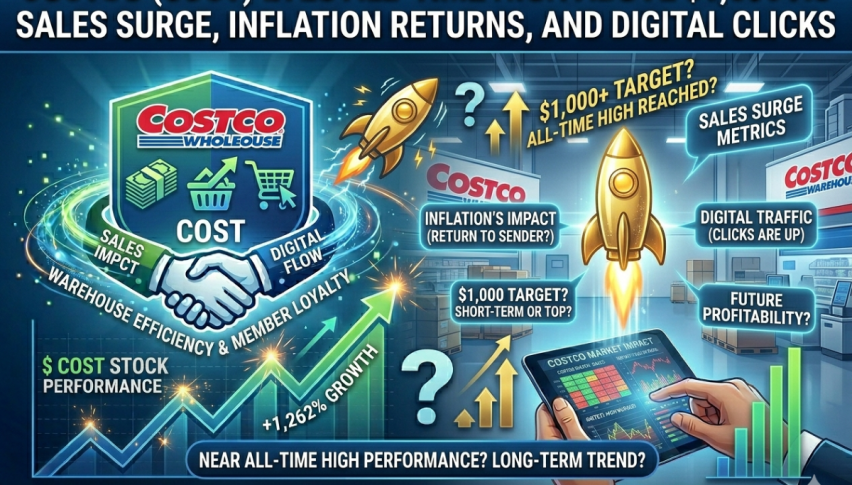
Quick overview
- Costco's stock closed at $1,076.47 on May 18, marking a 2.62% increase and nearing its all-time high.
- The company reported Q2 fiscal 2026 net sales of $68.24 billion, exceeding expectations with a 9.1% year-over-year growth.
- Digital sales saw significant growth, with a 22.6% increase in comparable sales, indicating a successful online transformation.
- Costco's strong financials and favorable macro environment position it as a resilient player amidst rising inflation.
Costco Wholesale Corp (NASDAQ: COST) closed at $1,076.47 on May 18, up 2.62% on the day. That single session erased the last gap between the stock and its all-time high of $1,078.23, set on February 13, 2025. The warehouse giant is no longer just recovering. It’s knocking on the door.
Costco’s Trade Setup: A Year in Reverse
For much of 2025, Costco was a laggard. The S&P 500 and Nasdaq raced higher while COST drifted, triggering comparisons to a stock that had run too far, too fast. Investors who rotated out into AI names looked smart — for a while.
Now the macro backdrop has flipped. Inflation is back. Consumer sentiment is cracking. And Costco — the retailer built precisely for this environment — is the one with momentum.
Shares are up close to 23% year to date, now sitting approximately 2% from last year’s highs. For a $465 billion company, that kind of comeback in under five months is not noise. It’s a signal.
Costco’s Strong Financials Are Hard to Argue With
Costco posted Q2 fiscal 2026 net sales of $68.24 billion, up 9.1% year-over-year, beating Wall Street estimates. Comparable sales rose 7.4% in the quarter, or 6.7% adjusted for gasoline and foreign exchange — outpacing analyst estimates of 5.88%.
The earnings beat was clean, not engineered:
- Net income rose nearly 14% to $2.035 billion, with diluted EPS of $4.58 against $4.02 a year ago.
- Membership fee income reached $1.355 billion, up 13.6% year-over-year, with 82.1 million total paid members.
- Executive memberships grew 9.5%, now totalling 40.4 million — a key indicator of deepening loyalty.
Post-quarter data confirmed the momentum wasn’t a one-quarter blip. March net sales reached $28.41 billion, up 11.3%. April net sales hit $23.92 billion, up 13.0%, with total comparable sales up 11.6%.
Costco’s Quiet Digital Transformation Delivers a Surprise
The most underappreciated part of the Costco story is happening online.
Digitally-enabled comparable sales grew 22.6% in Q2, with site traffic up 32% and app traffic up 45%. For a company historically defined by giant parking lots and oversized shopping carts, those are staggering numbers.
Personalized product recommendation carousels alone generated over $470 million in e-commerce sales in Q2 — a figure that was essentially zero two years ago. Management has laid out a clear road map to expand this capability further.
Analysts believe this digital strength is a big driver and one that may not yet be fully reflected in the current valuation. If they’re right, the stock has more room to run than the headline P/E suggests.
Rising Inflation Could Become Costco Stock’s Unlikely Tailwind
Consumer sentiment dropped to 48.2 in early May, down from 49.8 in April, with respondents flagging gas prices and tariffs as top concerns. For most retailers, that’s a problem. For Costco, it’s a business case.
CEO Ron Vachris addressed the tariff environment directly on the Q2 earnings call: Costco committed to returning any IEEPA tariff refunds to members through lower prices — a pledge with real commercial weight, as the company has already been lowering prices on textiles, bedding, and cookware.
The Kirkland Signature private label, which typically delivers 15–20% savings versus national brands, is gaining penetration across food and non-food categories, with approximately 30 new Kirkland items launched in Q2.
When shoppers are squeezed, Costco memberships start to look less like a luxury and more like a lifeline.
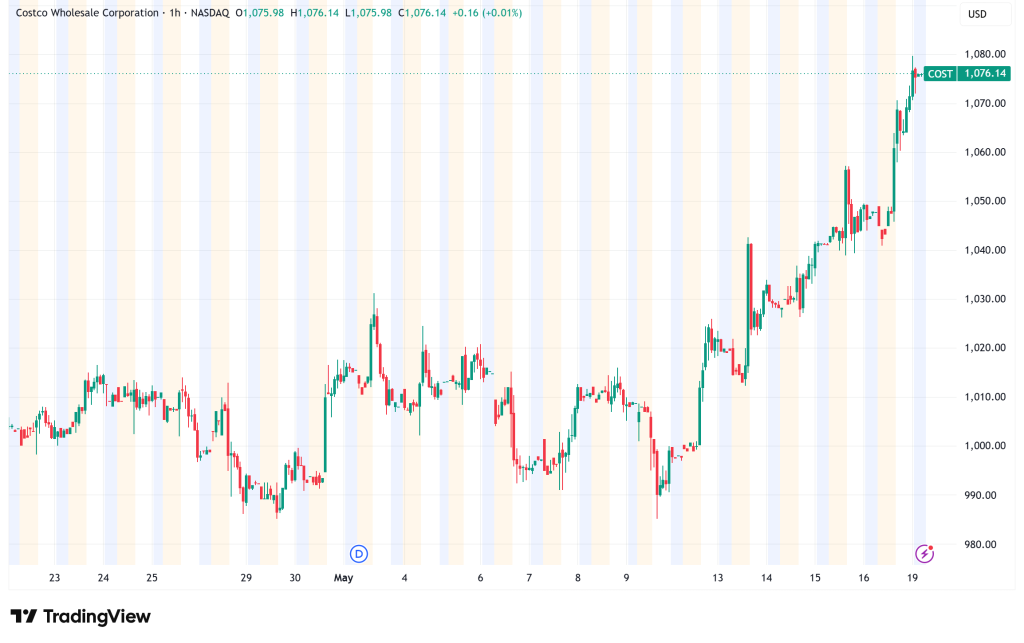
COST Stock Technicals Reveal Constructive Signals
The chart structure on COST is constructive, with several notable signals converging:
Moving Averages
The stock is trading well above both its 50-day and 200-day moving averages. This “golden cross” alignment typically indicates sustained bullish momentum rather than a short-term bounce.
RSI
TradingView’s technical summary currently rates COST as a Strong Buy on the 1-day timeframe, with a Buy signal on the 1-month view. RSI levels approaching the 70 zone suggest the stock is gaining energy — though any reading above 70 would indicate overbought territory and potential consolidation risk near all-time highs.
Support and Resistance Levels to Monitor
- Key resistance: $1,078 (all-time high, Feb 2025)
- Immediate support: $1,040–$1,050 zone (prior breakout level)
- Deeper support: $980–$1,000 (psychological and technical floor)
COST Volume and Beta Analysis
COST has a beta of just 0.22 — among the lowest of any large-cap growth stock. That means it moves far less than the broader market in either direction. In volatile environments, that’s a feature, not a bug.
How Can Costco Stock Move in the Near-Term?
- Bull case: COST closes above $1,078 on volume. A confirmed all-time high breakout could trigger momentum buying, with $1,100–$1,175 (TD Cowen target) as the next reference zone.
- Base case: Stock consolidates in the $1,040–$1,080 range ahead of the May 28 earnings report, then breaks direction on the Q3 print.
- Bear case: A miss on renewal rates or a gas-price reversal dents comparable sales. A pullback toward $980–$1,000 would be the natural support to watch.
Costco Stock’s Valuation Debate: Expensive or Fairly Priced?
At 54–55x trailing P/E, COST is not a cheap stock. It never has been. The question is whether the premium is justified.
The analyst consensus is decisively bullish: 19 Buy ratings, 3 Outperforms, 12 Holds, 1 Underperform, and 2 Sells, with a mean price target of around $1,073. That’s near current prices — but the distribution tells the real story.
The high target sits at $1,315, from BMO. TIKR’s base case values Costco at $1,423 per share, anchored to a mid-case revenue CAGR of around 7% through fiscal 2030, implying a total return of approximately 36% over four years.
The bear case on valuation is straightforward: if margins disappoint or membership growth stalls, there’s little cushion at 55x earnings. But Costco’s track record of execution makes that scenario historically rare.
TD Cowen analyst Oliver Chen flagged complacency as the key risk — the danger that just because the stage is set doesn’t mean Costco will deliver an applause-worthy performance. Fair warning. But with Q3 earnings on May 28, the market will soon have an answer.
Costco’s Dividend: Quiet But Growing
Costco isn’t a yield play. But the dividend matters. The company raised its quarterly dividend 13% to $1.47 per share, making it $5.88 annualized. That’s a gesture of financial confidence, not just a shareholder sweetener.
Cash balances have rebuilt to pre-special-dividend levels, per Q2 call commentary. Whether management authorizes another special dividend remains an open question — but the optionality exists.
What to Expect From Costco (COST) Q3 2026 Earnings on May 28
The Q3 fiscal 2026 report drops May 28 at 1:15 PM Pacific. Here’s what will move the stock:
- Renewal rates: U.S. renewal rate dipped 10 basis points to 92.1% last quarter. Any further softness would raise questions about digital-channel member loyalty.
- Digital sales growth: Can 22.6% comparable digital growth hold, or accelerate?
- Warehouse expansion: Management targets 28–30 net new openings in fiscal 2026. Progress on that plan is a key compounding driver.
- Tariff pass-through: Did sourcing costs bite into margins, or did Costco’s limited-SKU model absorb the impact?
- Gas price impact: Bank of America estimates higher gas added ~320 basis points to April comps. If prices normalize, that tailwind fades.
Is Costco a Good Stock to Buy in 2026?
Costco is a rare combination: a defensive business in an offensive position. It wins when consumers are stressed. It wins when inflation rises. And now, quietly, it’s starting to win online too.
The stock trades just below its all-time high. Momentum is strong. The macro environment is tailored to its strengths. And Q3 earnings are 9 days away.
At 54.5x trailing P/E, Costco is getting expensive again — but if positive margin trends prove the start of something bigger, and inflation pushes consumers back toward the retailer that promises the most value, it may be the ultimate defensive growth play for investors ready to move on from the hot AI names.
The stage is set. May 28 raises the curtain.
- Check out our free forex signals
- Follow the top economic events on FX Leaders economic calendar
- Trade better, discover more Forex Trading Strategies
- Open a FREE Trading Account
- Read our latest reviews on: Avatrade, Exness, HFM and XM

Related Articles
Sidebar rates

Related Posts
 Save
SaveAva

