Amazon AMZN Stock Slides Again as AWS Rules, Legal Challenges, Rising Costs Weigh on Outlook
As worries about the company's long-term profitability increased due to mounting regulatory scrutiny, rising infrastructure expenses, and deteriorating cash flow, Amazon shares fell behind a larger technology surge.

Quick overview
- Amazon's shares have underperformed amid a broader tech rally due to regulatory scrutiny, rising costs, and cash flow concerns.
- The company faces legal challenges, including a lawsuit from the Australian Competition and Consumer Commission regarding children's product safety labeling.
- Regulatory changes in Europe may hinder Amazon Web Services' ability to compete for government contracts, raising concerns about future growth.
- Despite these challenges, Amazon continues to invest heavily in infrastructure, though investors are wary of the associated costs and declining cash flow.
As worries about the company’s long-term profitability increased due to mounting regulatory scrutiny, rising infrastructure expenses, and deteriorating cash flow, Amazon shares fell behind a larger technology surge.
Amazon Struggles While Technology Stocks Advance
Shares of Amazon.com, Inc. came under pressure even as many semiconductor and technology stocks moved higher on renewed enthusiasm surrounding artificial intelligence and cloud infrastructure.
While investors poured money into AI-linked companies and chipmakers, Amazon found itself facing a growing list of challenges that raised fresh questions about future earnings growth. The stock’s weakness reflected mounting concerns that regulatory pressures, escalating capital expenditures, and weakening cash flow could become increasingly difficult to ignore.
Unlike many of its technology peers, Amazon is now confronting a combination of legal, regulatory, and financial issues simultaneously, creating a more cautious backdrop for investors.
Child Safety Lawsuit Adds Another Regulatory Headache
One of the latest developments weighing on sentiment is legal action initiated by the Australian Competition and Consumer Commission.
The regulator has launched proceedings against Amazon over alleged violations involving safety labeling requirements for children’s products. Although the eventual financial impact remains uncertain, the case adds to a growing list of regulatory challenges facing the company around the world.
For investors, the concern extends beyond any potential penalties. Governments and regulators are increasingly scrutinizing large technology platforms, raising fears that compliance costs could continue rising over time. As Amazon expands globally, maintaining compliance across multiple jurisdictions may become increasingly expensive and operationally complex.
The latest case reinforces concerns that regulatory risk is becoming a permanent feature of the company’s operating environment.
New European Rules Threaten AWS Growth
A potentially more significant issue is emerging in Europe, where regulators are reportedly tightening requirements for cloud providers seeking government contracts.
The proposed rules could limit the ability of Amazon Web Services to compete for certain public-sector projects across the region. Such restrictions would be particularly important because AWS remains Amazon’s most profitable division and a major source of earnings growth.
The timing is especially sensitive. Investors have already been questioning whether AWS can maintain its dominant position as rivals aggressively expand their own cloud and AI offerings. Increased competition from major technology firms has narrowed the gap in cloud services, while artificial intelligence has become the industry’s newest battleground.
If regulatory barriers reduce AWS’s access to government opportunities, growth expectations for the division could face additional pressure.
Expansion Continues Despite Investor Skepticism
Despite the growing concerns, Amazon continues investing aggressively across its global infrastructure network.
The company recently announced plans to develop three new logistics facilities in France, representing more than €400 million in investment and creating thousands of permanent jobs. These projects form part of a broader commitment to invest over €15 billion in the country over the next several years.
Amazon is also expanding its logistics ecosystem through services that integrate transportation, warehousing, fulfillment, and delivery capabilities.
From a strategic perspective, these investments strengthen the company’s competitive position. However, investors are increasingly focused on the enormous costs associated with such expansion rather than the potential long-term benefits.
Reversing After the Surge
Amazon entered 2026 hoping to rebuild confidence after a volatile finish to the prior year, but the opening weeks instead reinforced investor unease as AMZN fell below $200. But the 100 weekly SMA (green) held as support. Shares climbed for 6 consecutive weeks, pushing above the 50 weekly SMA (yellow) and gaining roughly 26% as sentiment improves and tech stocks rebound and on Monday AMZN popped again to $278 in early May before reversing lower to $255 today.
AMZN Chart Daily – Reversing Below the 2025 Highs

We saw a 2% jump late last week but buyers faced the 20 daily SMA (gray) which they failed to break above. AMZN stock reversed lower today and judging by recent price action, it might slip below $250, which would open the door for further declines.
Profitability Concerns Begin to Dominate the Narrative
Amazon’s long-term growth opportunities remain substantial, but markets are becoming less willing to overlook short-term financial pressures.
Additional caution emerged after reports that Berkshire Hathaway Inc. had exited its Amazon position, fueling speculation that some institutional investors are reassessing highly capital-intensive technology companies.
The broader concern is that Amazon’s future success increasingly depends on massive spending commitments at a time when regulatory scrutiny is intensifying and competitive pressures are rising. While the company remains a dominant force in e-commerce and cloud computing, investors appear increasingly worried that shrinking cash flow, expanding compliance obligations, and mounting infrastructure costs could limit profitability growth for years to come.
For now, Amazon remains a company with enormous potential, but the market is showing growing signs of impatience with the rising costs required to pursue that future.
Cash Flow Declines as Spending Accelerates
The biggest concern remains Amazon’s spending trajectory.
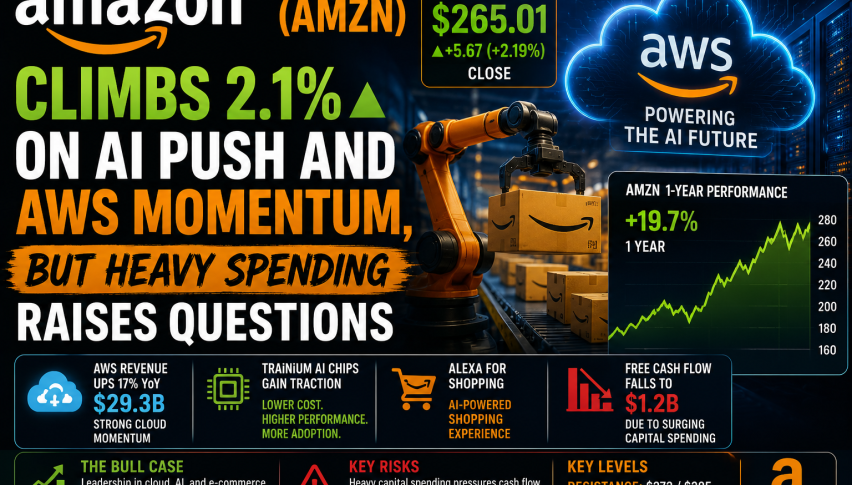
The company continues pouring billions into cloud infrastructure, logistics facilities, automation systems, artificial intelligence projects, and data centers. As a result, free cash flow has weakened significantly, falling to roughly $1.2 billion over the trailing twelve months.
Capital expenditures increased by approximately $59 billion year over year, highlighting the scale of Amazon’s investment cycle.
Management has previously outlined plans that could see spending approach $200 billion through 2026 as the company seeks to maintain leadership in cloud computing, AI, and e-commerce infrastructure.
While such investments may strengthen Amazon’s competitive position in the future, investors are becoming increasingly concerned about whether the returns will justify the extraordinary capital outlays.
Amazon Q1 Earnings Report
Revenue and Profit Growth
- Revenue rose 17% year over year to $181.5 billion, above estimates
- Operating profit increased to $23.9 billion from $18.4 billion
- Growth driven by strength across multiple business segments
AWS Momentum Leads Performance
- AWS sales climbed 28% to $37.6 billion
- Fastest growth since Q2 2022
- AWS contributes majority of operating profit despite ~20% of revenue
Heavy AI-Driven Investment Surge
- Capex reached $151 billion over 12 months (+$57.9 billion YoY)
- 2026 spending plan raised to ~$200 billion (+56%)
- Q1 capex jumped to $44.2 billion, above expectations
Cash Flow Pressure Intensifies
- Free cash flow fell to $1.2 billion from $25.9 billion YoY
- Expansion driven by data centres for AI-focused demand
Retail and Advertising Growth
- Online sales up 12% to $64.3 billion
- Advertising revenue rose 24% to $17.2 billion
- Ads increasingly support retail profitability model
- Check out our free forex signals
- Follow the top economic events on FX Leaders economic calendar
- Trade better, discover more Forex Trading Strategies
- Open a FREE Trading Account
- Read our latest reviews on: Avatrade, Exness, HFM and XM

Related Articles


Sidebar rates

Related Posts
 Save
Save