Cathie Wood Bets $52 Million on Snowflake as AI Rally Tests Wall Street’s Nerve
SNOW stock: Cathie Wood’s ARK bought $52 million of Snowflake after earnings, but SNOW’s chart now faces a key support test.
Quick overview
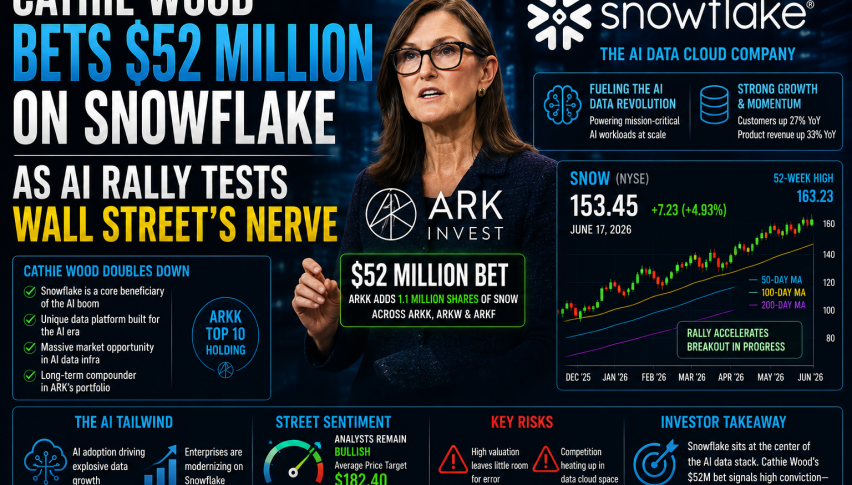
- Cathie Wood's ARK Investment Management purchased 223,690 shares of Snowflake Inc., valued at approximately $52 million, following a strong earnings report and a significant rally in the stock.
- Snowflake's fiscal first quarter results showed a 33% year-over-year revenue increase, alongside a raised full-year product revenue guidance, indicating robust growth potential in AI-driven business intelligence.
- The company secured a five-year, $6 billion agreement with AWS to enhance its AI capabilities, positioning itself as a key player in enterprise AI infrastructure.
- Despite the positive outlook, Snowflake's high valuation and ongoing GAAP losses present risks that cautious investors should consider.
Cathie Wood is back in Snowflake in size.
ARK Investment Management bought 223,690 shares of Snowflake Inc. on June 18, a position worth roughly $52 million based on the stock’s latest close of $232.29. The purchase came after Snowflake’s strongest rally in years, driven by better-than-expected earnings, raised guidance and a major cloud infrastructure commitment with Amazon Web Services.
The move puts Snowflake at the center of a familiar Wood trade: high-growth software, artificial intelligence, and a stock that has already moved sharply.
SNOW has jumped about 35% over the past month, according to TradingView data. The stock surged after its May earnings report, including a record single-day move, as investors reassessed whether Snowflake can turn enterprise AI demand into faster revenue growth.
The question now is sharper: Is ARK buying into a durable AI growth reset, or chasing a rally that already discounts much of the good news?
Snowflake’s AI Quarter Changed the Debate
Snowflake’s latest results gave bulls fresh ammunition.
For the fiscal first quarter ended April 30, the company reported:
- Revenue: $1.39 billion, up 33% year over year
- Product revenue: $1.33 billion, up 34%
- Adjusted EPS: $0.39, ahead of analyst expectations of $0.32
- Net revenue retention: 126%
- Remaining performance obligations: $9.21 billion, up 38%
- Customers above $1 million in trailing product revenue: 779, up 29%
The company also raised full-year fiscal 2027 product revenue guidance to $5.84 billion, from $5.66 billion previously. For the second quarter, Snowflake guided for product revenue of $1.415 billion to $1.420 billion, above Wall Street expectations cited in recent reports.
That matters because Snowflake’s model is consumption-based. Customers spend more when they use more compute, storage and data transfer on the platform. Rising product revenue, therefore, signals stronger usage rather than just signed contracts.
Snowflake’s AWS Deal Adds Weight to the AI Story
Snowflake also announced a five-year, $6 billion AWS infrastructure agreement, aimed at expanding AI workloads and deeper product integration.
The deal strengthens Snowflake’s pitch as an enterprise AI platform. Companies need clean, governed and accessible data before they can deploy generative AI or agentic AI tools at scale. Snowflake wants to sit at that control layer.
Chief Executive Sridhar Ramaswamy said AI is becoming a “powerful tailwind” for the company. Snowflake cited growing adoption of products such as Cortex Code and Snowflake Intelligence, and said more than 13,600 accounts are now using Snowflake AI capabilities.
That is the core of the ARK thesis. Wood’s funds are not simply buying cloud software. They are betting that Snowflake becomes a major infrastructure layer for enterprise AI.
Wall Street Has Turned More Constructive on SNOW Outlook
Analysts moved quickly after the earnings report.
Barclays raised its price target to $285 from $272, while keeping an equal weight rating. Bank of America raised its target to $300 from $205 and reiterated a buy rating, citing Snowflake’s opportunity in AI-driven business intelligence.
Reuters reported that at least 30 analysts raised price targets after the results and AWS announcement. The median target reportedly moved to about $280, up from $230.
That shift reflects a broader sentiment reset. Earlier this year, Snowflake was still fighting concerns over slowing software growth, cloud optimization and heavy valuation. The latest quarter gave investors a cleaner argument: AI is not just a cost center for Snowflake. It may be lifting usage.
Snowflake (SNOW)’s Valuation Remains the Catch
The rally has also made the stock less forgiving.
TradingView lists Snowflake’s market capitalization at roughly $80.5 billion. The company still reports GAAP losses, including last-quarter net income of about negative $295.6 million. Reuters has noted that Snowflake trades at a high forward earnings multiple, near levels that demand sustained growth.
That leaves little room for a stumble.
The risks are clear:
- AI product adoption may not translate into enough paid usage.
- Enterprise software budgets could tighten.
- Cloud consumption can fluctuate quarter to quarter.
- The AWS commitment may support growth, but it also reinforces Snowflake’s need for scale.
- A high valuation magnifies any slowdown in product revenue or net retention.
ARK appears willing to underwrite those risks. More cautious investors may want proof that AI usage keeps converting into revenue growth.
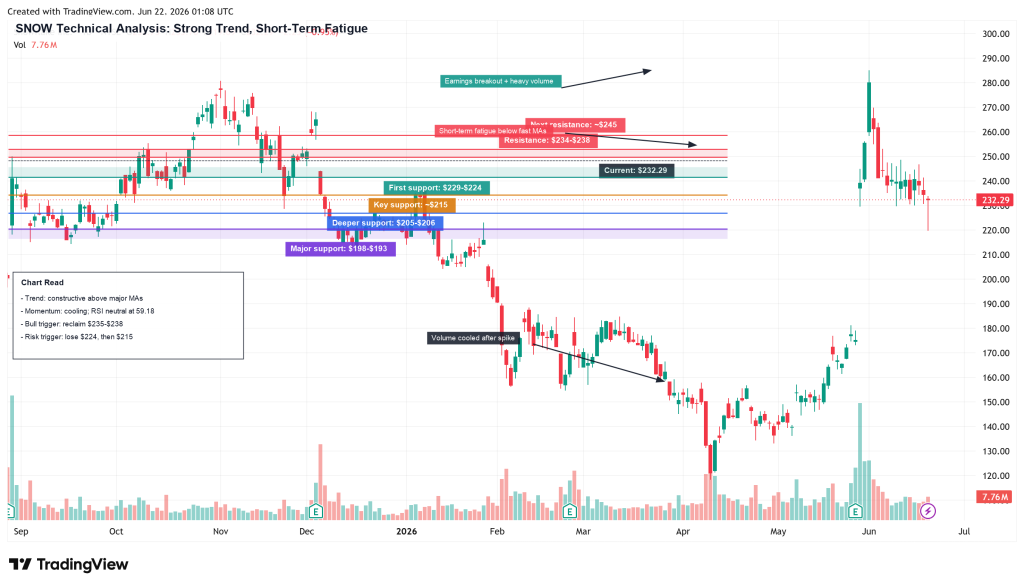
SNOW Technical Analysis: Strong Trend, Short-Term Fatigue
Snowflake’s chart reflects that tension.
The broader trend remains constructive. SNOW trades above most major moving averages, including the 20-day, 30-day, 50-day, 100-day and 200-day exponential moving averages.
Key moving averages on the daily chart include:
- 20-day EMA: $224.26
- 30-day EMA: $212.66
- 50-day EMA: $198.52
- 100-day EMA: $190.93
- 200-day EMA: $192.90
That structure supports the view that the medium-term trend has improved.
But the short-term picture is less clean. SNOW closed below several faster indicators:
- 10-day EMA: $235.25
- 10-day SMA: $237.74
- 20-day VWMA: $233.67
- 9-day Hull MA: $234.91
That suggests the stock is cooling after its earnings-driven surge.
The RSI at 59.18 is neutral. It is not overbought, but it still reflects positive momentum. The MACD level shows a sell signal, and 10-day momentum also flashes sell. The ADX at 36.37 indicates a strong trend backdrop, though not necessarily a fresh entry signal.
In plain terms: the larger trend is still bullish, but the stock may need time to digest its move.
Support and Resistance Levels to Watch
The first resistance zone sits around $234 to $238, where several short-term moving averages cluster. A move back above that range would suggest buyers are regaining control.
The next key resistance area is around $245, near the post-earnings rally zone watched by traders.
Support is layered below:
- $229 to $224: first support zone, near the 20-day average area
- $215: Ichimoku baseline
- $205 to $206: 30-day SMA and 200-day SMA area
- $198 to $193: 50-day EMA and 200-day EMA zone
A hold above $224 would keep the consolidation healthy. A break below $215 would weaken the post-earnings setup and could invite a deeper pullback.
Is Snowflake a Good Stock to Buy in 2026?
Cathie Wood’s $52 million Snowflake purchase gives the stock a fresh headline. But the real story is bigger than ARK.
Snowflake has delivered a quarter that supports the AI bull case. Revenue accelerated. Product usage grew. Large customers expanded. Guidance rose. The AWS deal strengthened the company’s position in enterprise AI infrastructure.
Still, the stock has already moved fast.
For long-term investors, Snowflake remains a high-quality growth story tied to data, AI and enterprise cloud adoption. For traders, the chart says the rally is intact but no longer early. The next signal will come from whether SNOW can defend support near $224 and rebuild momentum above the $235 to $238 zone.
- Check out our free forex signals
- Follow the top economic events on FX Leaders economic calendar
- Trade better, discover more Forex Trading Strategies
- Open a FREE Trading Account
- Read our latest reviews on: Avatrade, Exness, HFM and XM

Related Articles


Sidebar rates

Related Posts
 Save
Save