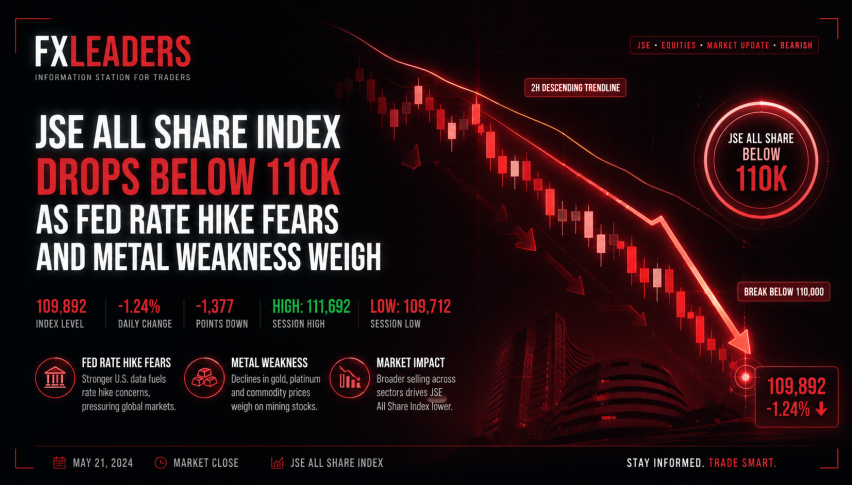
JSE All Share Index Drops Below 110K as Fed Rate Hike Fears and Metal Weakness Weigh
JSE FTSE All Share Index failed to stop its bearish rally and is still showing losses on the day. However, the reason for its bearish rally.
Quick overview
- The JSE FTSE All Share Index continues its bearish trend, currently trading at 109,828 with losses exceeding 1 percent due to weak metal prices and geopolitical tensions.
- The potential for a Fed rate hike in September, driven by rising US CPI inflation, could further pressure the JSE as it may lead to a stronger US dollar and a weaker rand.
- Investors are awaiting South Africa's Producer Price Inflation data, with expectations of 6.7 percent inflation, which could impact the stability of the rand and the JSE.
- Falling metal prices are negatively affecting major mining companies, with significant losses reported in stocks like Harmony and Gold Fields.
JSE FTSE All Share Index failed to stop its bearish rally and is still showing losses on the day. However, the reason for its bearish rally can be attributed to many factors, including weak metal prices, increasing geopolitical tension, and mixed US data results.
All these things put pressure on mining companies and contributed to the losses in the JSE FTSE All Share Index. At the time we are writing this article, the index is trading at 109,828 and is showing losses of more than 1 percent.
Fed Rate Hike Could Hurt JSE Soon
On the US front, the latest inflation report surprised everyone as it showed that US CPI inflation reached 4.2 percent in May, higher than the April 3.8 percent results. This has forced markets to believe that the Fed may raise interest rates at its September meeting.
At this time, the Fed rate is between 3.5 percent and 3.75 percent. Traders now see a 70 percent chance of a 0.25 percent rate hike. Furthermore, Fed Chair Kevin Warsh also said that it is necessary to bring inflation down to 2%.
Therefore, if the Fed increases rates, the US dollar will strengthen, the rand will weaken, and foreign investors will pull money out of the JSE. This will increase pressure on the index. Mining companies could benefit slightly from a weaker rand, but overall volatility will increase.
Investors Wait for South Africa Inflation Data
On the other hand, the South African rand is still stable against the US dollar in morning trading. Investors are now waiting for South Africa new Producer Price Inflation (PPI) data. Experts estimate that the inflation could reach 6.7 percent in May compared to the same period last year.
Meanwhile, the South African 2035 government bond has strengthened slightly. Its yields have moved a little lower, which is making the bond more attractive.
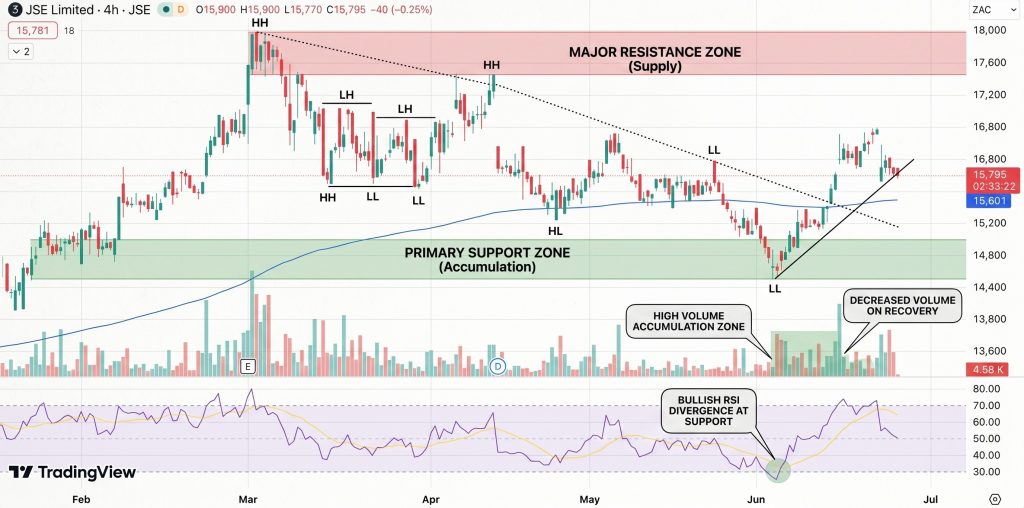
Therefore, the stability of the rand is providing some support to the JSE. If the producer inflation data does not come in too high, the market could get some relief. However, if the inflation data comes in higher than expected, it could put pressure on the rand and may lead to some decline in the JSE.
Falling Metal Prices Put Pressure on JSE
On the flip side, the weak metal prices, such as gold and platinum, are hurting major mining companies. At the time of writing, gold is trading at $3,980 level, platinum is at $1,550, and silver is trading near $57, all showing weakness in recent trading.
As a result, major mining stocks dropped, such as Harmony stock, which is trading at R243.48, showing more than 5 percent losses, while Gold Fields is trading at R526.50 and Sibanye Stillwater at R35.89.
- Check out our free forex signals
- Follow the top economic events on FX Leaders economic calendar
- Trade better, discover more Forex Trading Strategies
- Open a FREE Trading Account
- Read our latest reviews on: Avatrade, Exness, HFM and XM

Related Articles


Sidebar rates

Related Posts
 Save
Save