AMD Stock Gives Back Gains on the Way Toward $500 as Radeon Price Hike Daunts Investors
AMD’s powerful rally unraveled as investors rushed to lock in profits, with valuation concerns, geopolitical uncertainty, and broader semiconductor weakness outweighing optimism surrounding growth.
Quick overview
- AMD's stock fell over 7% after reaching a record high, as investors shifted focus from growth to profit-taking amid valuation concerns.
- The decline reflects broader semiconductor industry weakness and geopolitical uncertainties, raising questions about future demand and supply chain stability.
- Investor caution is heightened by AMD's plans to increase prices on graphics products, potentially impacting consumer demand in the gaming sector.
- Despite strong fundamentals, the recent selloff indicates that elevated valuations may be difficult to sustain in the current market environment.
AMD’s powerful rally unraveled as investors rushed to lock in profits, with valuation concerns, geopolitical uncertainty, and broader semiconductor weakness outweighing optimism surrounding growth.
AMD Rally Reverses as Investors Turn Increasingly Defensive
Shares of Advanced Micro Devices, Inc. came under heavy selling pressure on Wednesday, falling more than 7% and retreating toward the key $540 level only one day after reaching a record high of $584.73. The sharp reversal marked a significant shift in market sentiment as investors moved from chasing momentum to locking in profits following one of the strongest rallies in the semiconductor sector.
The decline reflects broader concerns that elevated valuations, persistent interest-rate uncertainty, and geopolitical risks are making it increasingly difficult for chipmakers to sustain the remarkable gains fueled by the artificial intelligence boom.
Strong Catalysts Fail to Sustain Momentum
AMD entered the week with substantial optimism behind the stock. Wells Fargo boosted its price target after expressing confidence in continued growth for AMD’s EPYC server processors, reinforcing expectations that the company will remain one of the primary beneficiaries of expanding AI infrastructure spending.
Earlier in June, investors also welcomed the launch of AMD’s Ryzen AI Halo platform, a major AI infrastructure partnership with Rackspace Technology, and a series of favorable analyst upgrades from Wall Street. Together, these developments helped propel shares to successive record highs.
However, after months of relentless gains, the market’s focus shifted away from growth prospects and toward valuation risk, triggering a sharp correction that erased a large portion of the recent advance.
Supply Chain Pressures Raise New Questions
Investor caution has also been amplified by reports that AMD plans to increase prices on Radeon graphics cards and graphics memory products by approximately 10% beginning this month.
The proposed price increases are reportedly driven by tightening supplies of graphics memory and rising GDDR6 component costs. While higher prices may help offset rising input costs, they also introduce uncertainty regarding consumer demand, particularly within AMD’s gaming business.
As gaming remains an important contributor to overall revenue, investors are increasingly concerned that higher prices could weigh on unit sales at a time when the consumer electronics market remains uneven.
Semiconductor Sector Weakness Broadens
AMD’s decline mirrors a broader wave of selling across the semiconductor industry. Weakness in Asian technology and memory-chip stocks spilled into global markets, prompting investors to reduce exposure across the sector.
The retreat suggests markets are becoming less willing to pay premium valuations for AI-related companies despite continued strength in demand. While artificial intelligence remains one of the strongest long-term growth themes, investors are beginning to question whether current share prices already reflect years of future earnings growth.
As expectations become increasingly demanding, even companies delivering strong operational performance are finding it difficult to sustain upward momentum.
Share Price Reverses Swiftly
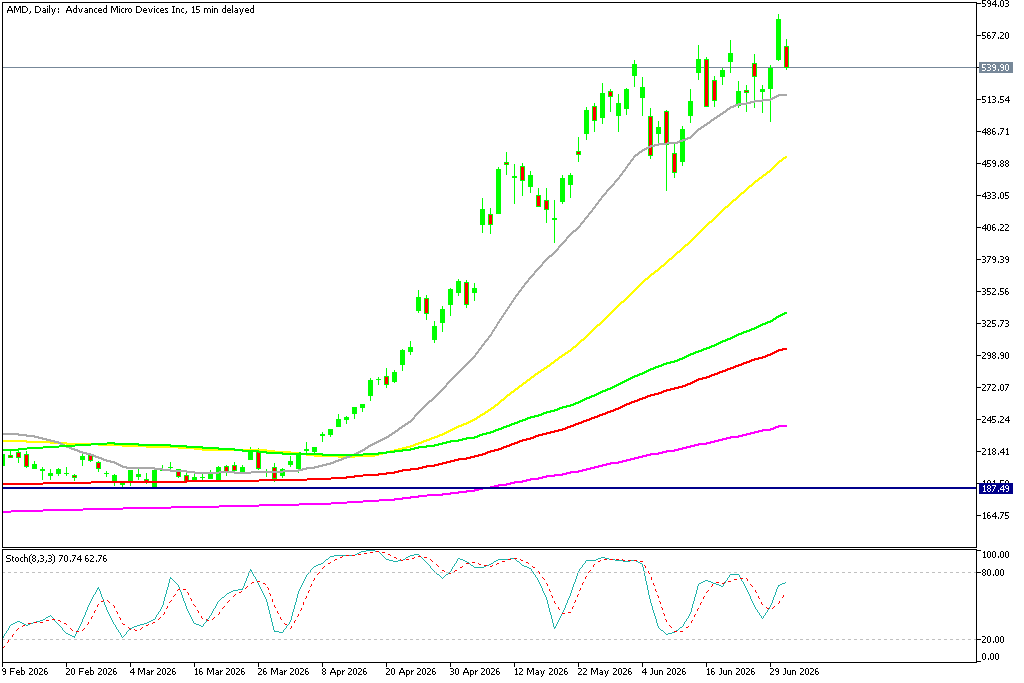
AMD shares fell sharply, sliding roughly 20% in January and pushing the stock below the $200 level. But the 100 SMA (red) acted as support on the daily chart. The price soared higher for three months, with the 20 daily SMA (gray) and reaching a high of $563 yesterday before reversing lower to $540 today.
AMD Chart Daily – Returning Below the June High
High Valuations Leave Little Margin for Error
One of the biggest headwinds facing AMD is its elevated valuation following an extraordinary twelve-month rally. Much of the company’s market value is based on expectations of future earnings expansion rather than current profitability, leaving the stock highly sensitive to changes in investor sentiment.
Persistent interest-rate uncertainty has only added to those concerns. Higher borrowing costs typically reduce the appeal of high-growth companies by lowering the present value of future earnings, making richly valued technology stocks especially vulnerable during periods of market volatility.
Institutional Selling and Geopolitical Risks Add Pressure
Investor confidence has also been weakened by recent portfolio adjustments from major investment firms, including selling activity by funds managed by Cathie Wood’s ARK Invest. Although institutional sales do not necessarily signal deteriorating fundamentals, they often encourage broader profit-taking when stocks are trading near record highs.
Meanwhile, geopolitical uncertainty continues to cloud the industry’s outlook. Expanded U.S. export restrictions on advanced AI chips and ongoing global trade tensions have increased concerns about future demand and supply chain stability. These risks remain particularly significant for semiconductor companies that rely heavily on international markets for long-term growth.
| GAAP Quarterly Financial Results |
|||||
| Q1’26 | Q1’25 | Y/Y | Q4’25 | Q/Q | |
| Revenue ($M) | $10,253 | $7,438 | Up 38% | $10,270 | Flat |
| Gross profit ($M) | $5,416 | $3,736 | Up 45% | $5,577 | Down 3% |
| Gross margin | 53% | 50% | Up 3 ppts | 54% | Down 1 ppt |
| Operating expenses ($M) | $3,940 | $2,930 | Up 34% | $3,825 | Up 3% |
| Operating income ($M) | $1,476 | $806 | Up 83% | $1,752 | Down 16% |
| Operating margin | 14% | 11% | Up 3 ppts | 17% | Down 3 ppts |
| Net income ($M) | $1,383 | $709 | Up 95% | $1,511 | Down 8% |
| Diluted earnings per share | $0.84 | $0.44 | Up 91% | $0.92 | Down 9% |
| Non-GAAP(*) Quarterly Financial Results | |||||
| Q1’26 | Q1’25 | Y/Y | Q4’25 | Q/Q | |
| Revenue ($M) | $10,253 | $7,438 | Up 38% | $10,270 | Flat |
| Gross profit ($M) | $5,685 | $3,992 | Up 42% | $5,855 | Down 3% |
| Gross margin | 55% | 54% | Up 1 ppt | 57% | Down 2 ppts |
| Operating expenses ($M) | $3,145 | $2,213 | Up 42% | $3,001 | Up 5% |
| Operating income ($M) | $2,540 | $1,779 | Up 43% | $2,854 | Down 11% |
| Operating margin | 25% | 24% | Up 1 ppt | 28% | Down 3 ppts |
| Net income ($M) | $2,265 | $1,566 | Up 45% | $2,519 | Down 10% |
| Diluted earnings per share | $1.37 | $0.96 | Up 43% | $1.53 | Down 10% |
Segment Summary
- Data Center segment revenue was $5.8 billion, up 57% year-over-year, driven by strong demand for AMD EPYC™ processors and the continued ramp of AMD Instinct™ GPU shipments.
- Client and Gaming segment revenue was $3.6 billion, up 23% year-over-year. Client business revenue was $2.9 billion, up 26% year-over-year, primarily driven by strong demand for leadership AMD Ryzen™ processors and continued market share gains. Gaming business revenue was $720 million, up 11% year-over-year, driven by solid demand for AMD Radeon™ GPUs partially offset by lower semi-custom revenue.
- Embedded segment revenue was $873 million, up 6% year-over-year, as demand strengthened across several end markets.
Recent PR Highlights
- AMD expanded its data center offerings and deepened strategic collaborations to deliver global compute infrastructure:
- Meta and AMD announced plans to deploy up to 6 gigawatts of AMD Instinct GPUs, with the first 1-GW to be powered by a custom AMD Instinct MI450-based GPU. Meta will also be a lead customer for the upcoming 6th Gen AMD EPYC CPUs, codenamed “Venice” and “Verano.”
- AWS, Google Cloud, Microsoft Azure and Tencent announced new and expanded 5th Gen EPYC-powered cloud instances, including Google Cloud H4D VMs for HPC and Azure instances across general-purpose, memory- and compute-optimized workloads.
- In the latest MLPerf® results, AMD Instinct MI355X delivered strong competitive performance across the full suite, with leadership results in multiple categories.
- AMD announced EPYC 8005 server CPUs, delivering leadership performance per-watt-per-dollar optimized for telecommunications and edge environments.
- AMD and Tata Consultancy Services (TCS) are co-developing AMD Helios-based rack-scale AI infrastructure to accelerate enterprise AI deployments and sovereign AI initiatives in India.
- AMD and Samsung are collaborating on next-generation AI memory and compute technologies, including HBM4 supply for AMD Instinct MI455X GPUs and advanced DRAM solutions for 6th Gen AMD EPYC CPUs.
- AMD is collaborating with NAVER Cloud and Upstage to deploy AMD Instinct GPUs and EPYC CPUs across their AI infrastructure, advancing sovereign AI initiatives in Korea.
- AMD joined Open Telco AI, a GSMA-led initiative to accelerate telco-grade AI models and systems, with AMD Instinct GPUs training Open Telco AI models.
- AMD expanded its offerings for premium enterprise and enthusiast PCs, including:
- The AMD Ryzen AI PRO 400 Series processors, expanding its lineup of next-generation enterprise desktop PCs that deliver Copilot+ experiences.
- The Ryzen 9950X3D2 Dual Edition processor, delivering enhanced performance for creative and developer workloads with dual stacks of AMD 3D V-Cache™ technology.
- AMD announced new adaptive and embedded AI processors, including:
- New Ryzen AI Embedded P100 Series processors, delivering scalable, power-efficient AI compute for industrial and edge applications.
- The Kintex™ UltraScale+™ Gen 2 family of mid-range FPGAs, delivering advanced memory bandwidth and I/O performance for industrial, imaging and broadcast applications.
Outlook Remains Challenging
AMD continues to benefit from powerful structural trends including artificial intelligence, cloud computing, and high-performance data-center demand. However, the latest selloff demonstrates that strong fundamentals alone may no longer be enough to sustain elevated valuations.
With investors becoming increasingly sensitive to valuation risk, macroeconomic uncertainty, and geopolitical developments, AMD now faces a more challenging environment. Unless confidence returns quickly, the recent break from record highs could signal that the semiconductor sector is entering a period of heightened volatility after an extended AI-driven rally.
- Check out our free forex signals
- Follow the top economic events on FX Leaders economic calendar
- Trade better, discover more Forex Trading Strategies
- Open a FREE Trading Account
- Read our latest reviews on: Avatrade, Exness, HFM and XM

Related Articles
Sidebar rates

Related Posts
 Save
Save