Taiwan Passes Crypto Law With 56 Articles, 10-Year Terms
Taiwan passed a 56-article crypto law with 10-year prison terms for fraud and new stablecoin reserve rules. See what the Virtual Asset Service Act now covers.
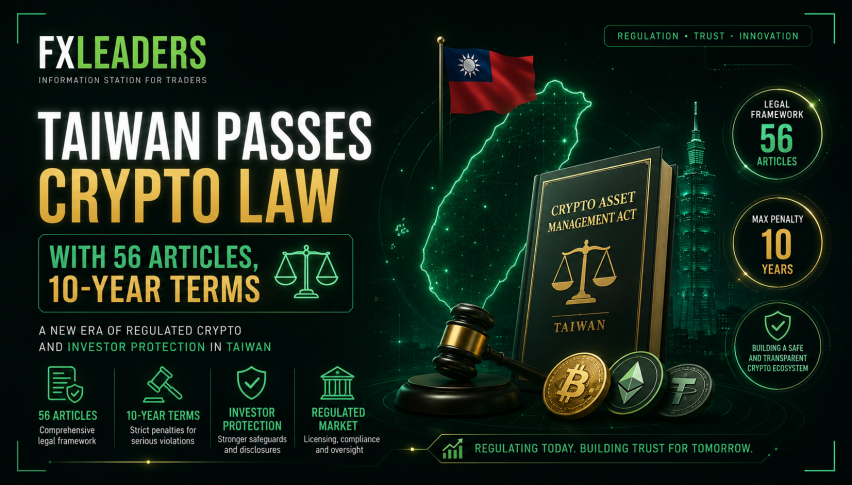
Quick overview
- Taiwan has enacted the Virtual Asset Service Act, a comprehensive 56-article law regulating the cryptocurrency sector under the Financial Supervisory Commission.
- The law mandates that virtual asset service providers obtain licenses instead of simple registration, categorizing them similarly to banks and brokers.
- New regulations for stablecoins require that only banks can issue them, backed by a single fiat currency, while algorithmic stablecoins are banned.
- Criminal penalties for fraud in virtual asset trading have been introduced, with prison terms ranging from 3 to 10 years for manipulation and up to 7 years for unlicensed activities.
Taiwan passed a 56-article crypto law with 10-year prison terms for fraud and new stablecoin reserve rules. See what the Virtual Asset Service Act now covers.
The Virtual Asset Service Act, Taiwan’s pioneering cryptocurrency law, passed June 30 in the parliament and is comprised of 56 articles. It places the entire virtual asset sector under the Financial Supervisory Commission’s (FSC) purview and removes the current Anti-Money Laundering (AML) registration system that has been in place since 2021.
New Licensing Replaces AML Regime
Under the new law, virtual asset service providers (VASPs), including exchanges, custodians, and wallet companies, move beyond simple registration and must obtain a license. Instead of being treated as startup technology firms, they will have to follow rules and regulations similar to a broker or bank.
🚨BREAKING: Taiwan's legislature passes landmark law establishing regulatory framework for crypto exchanges and stablecoin issuers, imposing penalties for fraud and market manipulation. pic.twitter.com/EPp3TLODVz
— Pulse Alpha (@pulsealpha_) July 1, 2026
They are not allowed to bundle their businesses anymore. Companies have to choose a single license from the following seven categories of VASP:
- Exchange and trading platform operations
- Asset transfer and custody services
- Underwriting and lending activities
Eight companies that already completed AML registration including MaiCoin, BitoGroup, and XREX will have to obtain licenses within 12 months following the implementation of the law. They will be granted a maximum 21-month period to complete the licensing review process, though they are eligible to ask for up to 3 months for an extension of the application period.
Other companies are required to meet licensing criteria immediately; there is no transition period for new applicants.
Stablecoins Get Reserve Mandate
A major part of the law is that it now also sets the regulatory framework for domestic stablecoin issuance. Only banks will be permitted to issue such currencies within Taiwan, and they must be anchored against one single fiat currency rather than a basket of assets.
Each token must be backed with the equivalent amount of fiat currency held separately from company funds in trust accounts.
Issuing algorithmic stablecoins will be banned, and issuers have to conduct regular audits. Furthermore, they will not be able to offer interests to tokenholders.
For foreign stablecoins such as Tether and USD Coin, they will be considered regulated commodities rather than a currency in Taiwan. They also have to be listed on a licensed trading platform in Taiwan before they can be bought and sold, and the tokens must be approved by the FSC.
Foreign virtual asset platforms targeting Taiwanese customers will be subject to law enforcement directly without a license.
LATEST: Taiwan has passed a comprehensive crypto law requiring licenses for crypto firms and stablecoin issuers, introducing stricter oversight, reserve requirements, and tougher penalties for violations. pic.twitter.com/4y7UYzfGrH
— EyeWhales (@EyeWhales) July 1, 2026
Fraud Now Carries Prison Terms
One of the biggest changes that Taiwan’s crypto firms have been waiting to happen is the addition of criminal penalties to a market that has long been plagued by scams. The new law will criminalize the disclosure of false or concealed material facts concerning virtual asset trading activities and any fraudulent or manipulative trading activity, such as price manipulation and trading volume manipulation. Two penalties have been added to the criminal code:
- Fraud or manipulation: 3-10 years imprisonment
- Unregistered business or unlicensed stablecoin issuance: 7 years or less
This new law clarifies how to take action against schemes such as pump-and-dump and wash trading. Previously, prosecution was difficult because proving a fraudulent intent was hard under the general fraud laws.
The FSC still has to issue roughly nine more secondary laws and the whole law is set to take effect by early 2027. The new legislation in Taiwan is part of a larger global trend towards the implementation of licensed, reserve-backed, and regulated crypto regulations, similar to the EU’s MiCA framework and the US GENIUS Act.
- Check out our free forex signals
- Follow the top economic events on FX Leaders economic calendar
- Trade better, discover more Forex Trading Strategies
- Open a FREE Trading Account
- Read our latest reviews on: Avatrade, Exness, HFM and XM

Related Articles



Sidebar rates

Related Posts
 Save
Save