Apple Stock Jumps 5% as Foldable iPhone Hopes and Google Cloud AI Deal Lift Bulls
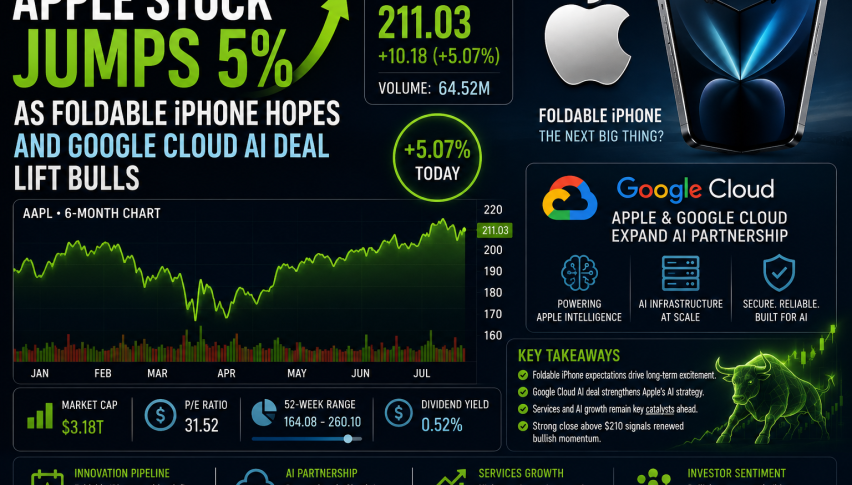
Apple stock AAPL jumps 4.8% on foldable iPhone hopes and Google Cloud AI expansion, with $309-$317 resistance now in focus.
Quick overview
- Apple's stock surged to $308.63, nearing its 52-week high, driven by optimism around a new foldable iPhone model and AI infrastructure expansion.
- The company plans to launch at least five new iPhone models, including a premium foldable 'iPhone Ultra', with production goals raised to 10 million units.
- Investors are hopeful that Apple can alleviate rising memory costs by exploring supply options with Chinese chipmakers, which could improve margins.
- Apple is also extending its Private Cloud Compute to Google Cloud, enhancing its AI capabilities while maintaining a focus on user privacy.
Apple (AAPL) rallied to $308.63 as investors focused on a bigger foldable iPhone rollout, memory supply options, and its first Private Cloud Compute expansion to Google Cloud.
Apple Rally Puts 52-Week High Back in Sight
Apple Inc. (NASDAQ: AAPL) delivered one of its strongest sessions of the year on Thursday, closing at $308.63 after gaining 4.84%. The move pushed the stock back near its 52-week high as investors looked past recent memory-cost concerns and focused on product-cycle upside.
The rally was driven by reports of a more aggressive iPhone roadmap, including a foldable premium model, and new signs that Apple is expanding its AI infrastructure strategy.
Foldable iPhone Ultra Fuels Product-Cycle Optimism
The biggest catalyst was renewed excitement around Apple’s next iPhone cycle.
Reports indicate Apple is preparing at least five new iPhone models between late 2026 and the first half of 2027. The most important potential launch is a foldable premium model, widely discussed as an “iPhone Ultra.”
Apple reportedly raised its foldable production goal to roughly 10 million units from an earlier target near 7-8 million. That suggests management may be more confident in demand for a higher-end device.
The pricing could be significant. Market estimates suggest the foldable model may cost around $2,500, and possibly more with higher storage. If Apple can create a new premium iPhone tier, it could lift average selling prices and support margins.
Memory Costs Remain a Key Pressure Point
The rally also reflects hopes that Apple may find relief from soaring memory costs.
Apple has reportedly been exploring supply options with Chinese chipmakers, including ChangXin Memory Technologies and Yangtze Memory Technologies. That matters because DRAM and NAND prices have surged as AI server demand absorbs more capacity.
Memory inflation recently forced Apple to raise prices across some Macs, iPads, home devices, and Vision Pro products. Investors had treated that as a warning sign for gross margin.
If Apple can broaden its supplier base, it may reduce some cost pressure and improve negotiating leverage. Still, supply-chain politics and regulatory risks remain important, especially if Chinese memory sourcing becomes part of the story.
Apple Extends Private Cloud Compute to Google Cloud
Apple’s AI infrastructure strategy also moved into focus.
Apple is extending Private Cloud Compute to Google Cloud for the first time, allowing some privacy-sensitive AI workloads to run outside Apple-owned data centers. The system uses confidential computing protections involving NVIDIA Blackwell GPUs, Intel TDX, and Google’s Titan chip.
The key point is that Apple is trying to scale cloud AI without abandoning its privacy narrative. Private Cloud Compute is designed to ensure stateless processing, no privileged runtime access, verifiable transparency, and cryptographic protections that prevent operators from accessing user data.
This matters because Apple’s AI ambitions require more cloud capacity for complex reasoning, agentic tasks, and future Apple Foundation Models. Partnering with Google gives Apple more AI infrastructure flexibility, but it also raises new questions about dependency and jurisdiction.
AAPL Technical Analysis: 4-Hour Chart Turns Strongly Bullish
From a technical perspective, Apple’s 4-hour chart is bullish after Thursday’s rally.
The stock is trading above every major moving average listed on the 4-hour setup. The first support zone sits around the 30 SMA at $299.59. Below that, the Hull Moving Average at $295.72, Ichimoku base line at $295.58, 20 SMA at $294.80, 20 EMA at $294.42, and 30 EMA at $294.02 create a dense support cluster.
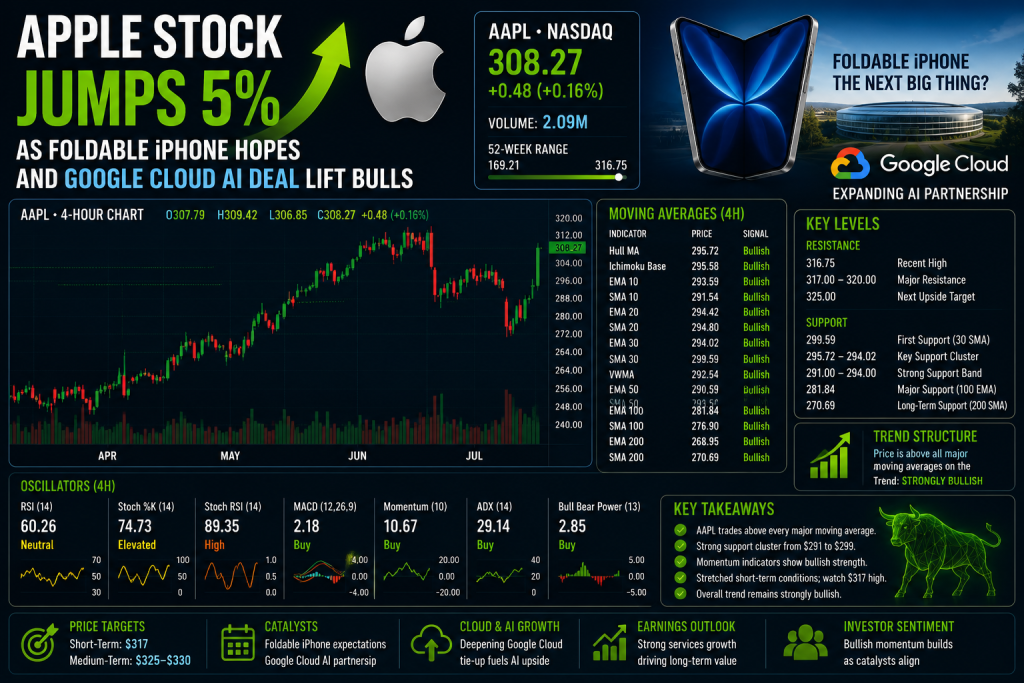
AAPL Chart 4H – Buyers Reclaim Momentum as $317 High Comes Into Focus
The next support band sits near $291-$294, including the 10 EMA at $293.59, 50 SMA at $293.52, VWMA at $292.54, and 10 SMA at $291.54. The 50 EMA at $290.59 is also nearby.
Longer-term support remains lower at the 100 EMA of $281.84, 100 SMA of $276.90, 200 SMA of $270.69, and 200 EMA of $268.95.
Oscillators confirm improving momentum. RSI is neutral at 60.26, while Momentum, MACD, ADX, and Bull Bear Power are all flashing buy signals. Stochastic %K is elevated at 74.73, and Stochastic RSI is high at 89.35, meaning the rally is strong but may be nearing short-term stretched conditions.
Is It a Good Time to Buy Apple Stock?
The first upside test is $309-$310. If Apple clears that area, traders will look toward the 52-week high near $317.40.
On the downside, the first support is $299.59. Below that, the $294-$296 cluster becomes the key area buyers need to defend. A deeper pullback could bring $291-$293 back into focus.
For now, Apple has regained momentum as investors price in a stronger iPhone cycle and a more serious AI infrastructure push. A clean break above $317 would turn the rally into a fresh breakout, while failure near that level could trigger profit-taking after the sharp move.
- Check out our free forex signals
- Follow the top economic events on FX Leaders economic calendar
- Trade better, discover more Forex Trading Strategies
- Open a FREE Trading Account
- Read our latest reviews on: Avatrade, Exness, HFM and XM

Related Articles
Sidebar rates

Related Posts
 Save
Save