South African Rand: USD/ZAR Heads Under R16 as Risk Sentiment and NFP Employment Weigh on Dollar
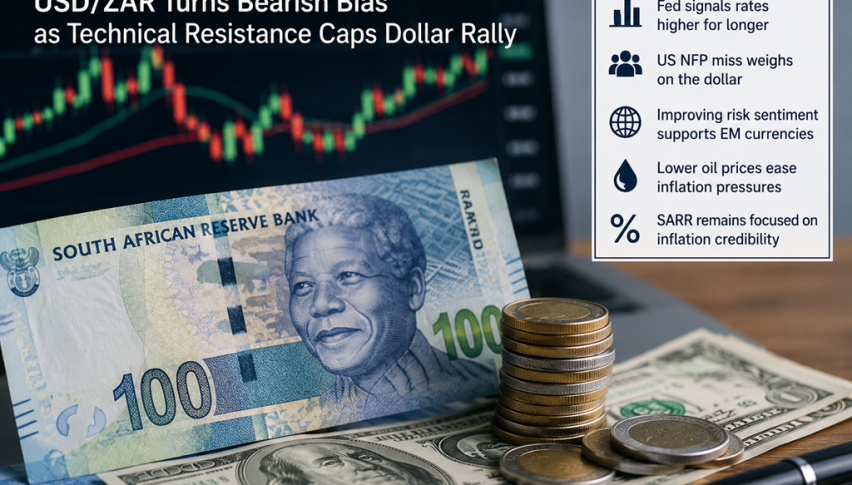
As USD/ZAR responds to hawkish signals from the Federal Reserve and poor US labor data, changes in the S&P 500, Nasdaq Composite, and Dow Jones Industrial Average reflect shifting risk appetite.
Quick overview
- Movements in major US indices reflect changing risk appetite, influenced by the Federal Reserve's hawkish signals and weaker US labor data.
- USD/ZAR initially surged due to expectations of prolonged high interest rates but faced selling pressure after softer non-farm payrolls data.
- The South African rand is supported by domestic policy and inflation signals, despite mixed economic data indicating moderating growth.
- Broader macro conditions, including easing geopolitical tensions and falling oil prices, are favorable for emerging market currencies like the rand.
As USD/ZAR responds to hawkish signals from the Federal Reserve and poor US labor data, changes in the S&P 500, Nasdaq Composite, and Dow Jones Industrial Average reflect shifting risk appetite.
USD/ZAR Volatility Driven by Fed Guidance and Dollar Flows
USD/ZAR initially surged after the latest policy decision from the Federal Reserve, which reinforced expectations that interest rates will remain higher for longer. The reaction strengthened the US dollar broadly, pushing USD/ZAR briefly above the R16.50 level as carry trade positioning was reassessed.
However, the rally proved short-lived. Softer US non-farm payrolls data undermined dollar momentum, easing expectations of sustained tightening and triggering renewed selling pressure in the pair. The shift highlighted how sensitive USD/ZAR remains to US macro surprises, particularly labour market signals.
Technical Resistance Rejects Upside Move
Despite the initial breakout attempt, USD/ZAR failed to sustain gains above its 200-day simple moving average, a widely monitored technical threshold. Repeated rejection at this level reinforced its role as a strong resistance zone, encouraging profit-taking and fresh short positioning.
By the end of the week, USD/ZAR had retreated to close around R16.23, indicating that bullish momentum had largely dissipated. The inability to confirm a breakout above resistance suggests that the recent rebound may have been corrective rather than the start of a new bullish trend.
Rand Supported by Domestic Policy and Inflation Signals
The South African rand continued to gain traction as investors assessed commentary from the South African Reserve Bank. Governor Lesetja Kganyago reiterated that inflation credibility remains a priority, leaving the door open to further rate action if price pressures persist.
At the same time, South African data remained mixed. Producer price inflation accelerated to 7.8% year-on-year in May, signalling persistent domestic cost pressures. However, a decline in the composite leading business cycle indicator by 1.8% pointed to moderating future growth, reflecting weaker confidence and softer credit and employment conditions.
Manufacturing PMI readings also showed deterioration in factory sentiment, driven by weaker demand, although easing energy costs provided some offset to future expectations.
Global Risk Sentiment and Commodity Trends
Broader macro conditions have increasingly supported emerging market currencies. Easing geopolitical tensions, including diplomatic progress between the United States and Iran and improved shipping stability through key energy routes, have helped reduce global risk premiums.
Falling oil prices have been particularly supportive for South Africa as an energy-importing economy. Lower crude costs reduce inflation pressure, improve trade dynamics, and enhance household purchasing power, all of which indirectly support the rand.
Gold prices also strengthened alongside a weaker dollar, with bullion rising above the $3,900 level and trading near $4,064 per ounce, reflecting broader diversification flows away from US assets.
USD/ZAR Chart Daily – The 200 SMA Keeps the Pressure to the Downside

On the monthly chart, USD/ZAR seems to have bottomed at the 100 SMA (green) where it found support in the last two months. Last month we saw a rebound as the Rand weakened while the Dollar gained, but buyers are facing the 50 SMA (yellow) and in April the forex pair has reversed lower again. For the larger uptrend to resume, USD/ZAR would need to push above this moving average.
USD/ZAR Chart Monthly – Rebounding Off the 100 SMA

Medium-Term Outlook Still Favors Rand Strength
Despite near-term volatility, structural factors continue to underpin the rand. South Africa maintains one of the highest real interest-rate differentials among emerging markets, supporting carry trade inflows.
Institutional confidence in monetary policy credibility from the South African Reserve Bank, combined with ongoing reform efforts and supportive commodity export conditions, continues to provide medium-term support.
While USD/ZAR may still experience temporary spikes during periods of dollar strength, the broader setup suggests downside risk remains toward the R16 level and potentially lower if global risk appetite continues to improve.
- Check out our free forex signals
- Follow the top economic events on FX Leaders economic calendar
- Trade better, discover more Forex Trading Strategies
- Open a FREE Trading Account
- Read our latest reviews on: Avatrade, Exness, HFM and XM

Related Articles

Sidebar rates

Related Posts
 Save
SaveAva
